
News
Marwa: With 50,901 Arrests, 9,034 Convictions We Have Sent a Message to Drug Cartels

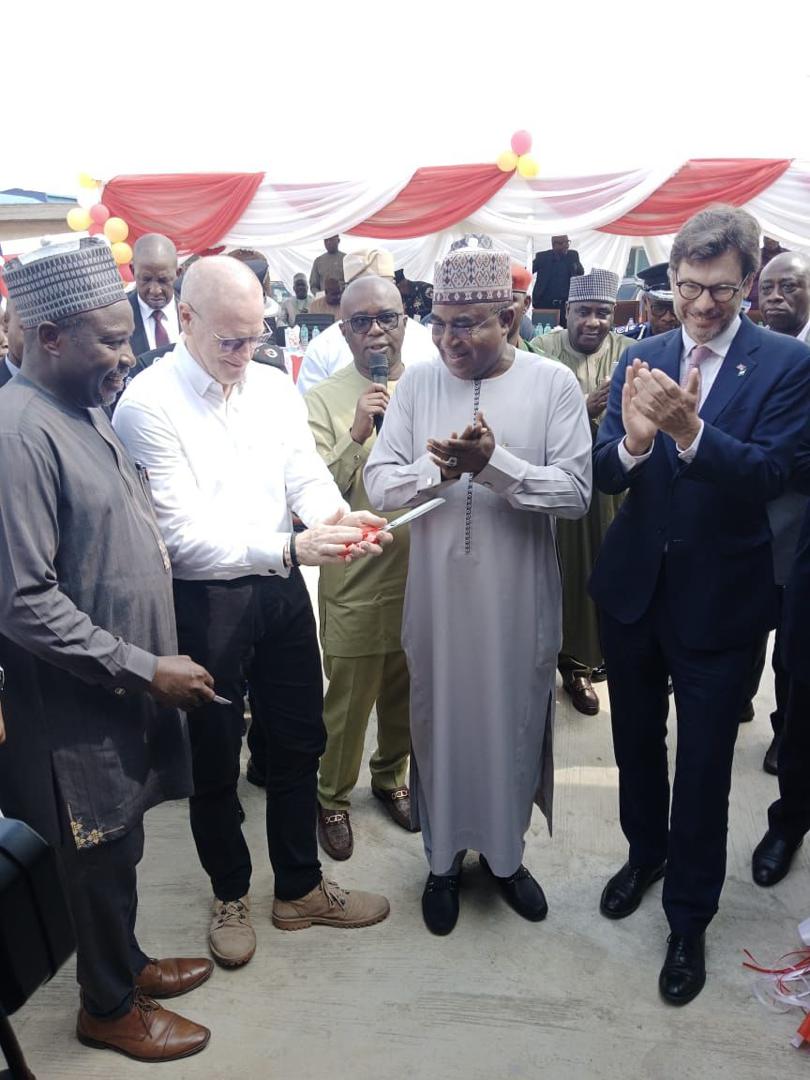
Marwa: With 50,901 Arrests, 9,034 Convictions We Have Sent a Message to Drug Cartels
By: Michael Mike
Chairman/Chief Executive Officer of the National Drug Law Enforcement Agency (NDLEA), Brig Gen Mohamed Buba Marwa (Retd) has said that the arrest of 50,901 drug offenders including 46 barons and the successful prosecution and conviction of 9,034 of them as well as the seizure of over 7,561 tonnes of illicit substances in the past 38 months has sent the right message to drug cartels and their kingpins that Nigeria won’t tolerate their criminal activities.
Marwa stated this in Lagos on Monday in his remarks at the commissioning and handing over ceremony of an operational facility built and donated to NDLEA by the British government.
He commended the British government for its generous support, noting that it would further boost the capability of the anti-narcotic agency in tackling the menace of substance abuse and illicit drug trafficking in Nigeria.
He said: “We gather here not just to commission a new building complex but to celebrate a significant milestone in our ongoing fight against the scourge of licit and illicit drug trafficking. Today, we commission the newly acquired building, a project made possible through the generous support of the British Government.
“I must begin by expressing our deepest gratitude to the British Government, for their unwavering commitment and invaluable contributions to our cause. From the onset of our collaboration, the UK has been a steadfast ally in our relentless pursuit to neutralise transnational organised criminal activities, particularly in the realm of illicit drug production and trafficking.
“This building complex stands not only as a physical structure but as a symbol of the enduring partnership between our two nations in the global fight against drug trafficking. It represents the culmination of years of cooperation, mutual trust, and shared determination to combat one of the most pressing threats to our societies.
“The significance of this project cannot be overstated. It will serve as a vital hub for data analysis and strategic planning in our efforts to disrupt drug trafficking networks and apprehend those responsible. With state-of-the-art facilities and technology at our disposal, we are better equipped than ever before to tackle this complex and ever-evolving challenge head-on.
“But beyond the bricks and mortar, this building complex embodies the spirit of collaboration and solidarity that defines our partnership with the British Government. It is a testament to what can be achieved when nations come together with a shared purpose and a shared commitment to making our world a safer place for all.
“As an agency, NDLEA has undergone a tremendous reformation, with its metamorphosis catalysed by partners like the UK. Our operations have undergone substantial reforms, resulting in remarkable achievements within the last three years.
“During this period, the NDLEA achieved significant milestones in its mission to combat drug trafficking and abuse. With a total of 50,901 arrests, including the apprehension of 46 drug barons, our agency has demonstrated its unwavering commitment to bringing those involved in illicit drug activities to justice.
“Furthermore, the conviction of 9,034 offenders underscores our relentless pursuit of accountability and deterrence in the fight against drug-related crimes.
“Our seizure of 7,560,748.5 kilograms (7,561 tonnes) not only disrupts the flow of illegal drugs but also serves as a significant blow to the criminal networks responsible for their distribution. We have taken decisive action against illicit drug crop cultivation with our search-and-destroy campaign against cannabis plantations which have led to the destruction of 1,057.33348 hectares of cannabis farms in the past three years.”
Marwa, while acknowledging officials of the British government that facilitated the realisation of the project especially Mr. Dave Carter, he called for the strengthening of the partnership between Nigeria and the UK. “As we stand on the threshold of a new chapter in our partnership, let us reaffirm our shared commitment to intensifying the fight against drug trafficking and organised crime. Let us continue to work hand in hand, across borders and boundaries, to disrupt criminal networks, intercept illegal drugs, and bring to justice those who seek to profit from the illicit drug trade.”
He stated that though so much has been achieved under his leadership of the agency, the battle against illicit drugs is far from over. “Let us redouble our efforts, with renewed vigour and determination, as we strive to build a safer, more secure future for generations to come”, he charged.
Speaking at the ceremony, British Deputy High Commissioner to Nigeria, Jonny Baxter assured of continued support to NDLEA and Nigeria. According to him, “We, the UK government are delighted to have this long-standing relationship with the NDLEA and I’m in particular delighted to have been personally in a number of activities especially your maritime. This building makes a whole set of different actors and capabilities to address any criminal activity.
“We’re delighted to continue our support for the NDLEA and the Nigerian government to tackle what is sadly a global industry, which needs a global response. I’ll like to join the chairman in affirming our continued support, our continued cooperation and indeed our continued pride in working together with ladies and gentlemen of this agency, the NDLEA.”
Marwa: With 50,901 Arrests, 9,034 Convictions We Have Sent a Message to Drug Cartels



Gombe 2027: Pantamiyya Movement to galvanise grassroots support for Gwamna’s guber bid
The Pantamiyya Movement Brothers, led by prominent grassroots mobiliser, Sanusi Hamisu Usman, popularly known as Ameer Sanusin-Gombe, has declared its full support for the governorship ambition of APC candidate in Gombe State, Dr Jamil Isyaku Gwamna ahead of the 2027 general elections.
Speaking during a solidarity visit to Dr Gwamna, Ameer Sanusin-Gombe described the meeting as strategic and timely, noting that the movement was determined to support what he called “the emergence of a worthy successor” capable of consolidating the achievements of Governor Muhammadu Inuwa Yahaya.
The movement, which boasts more than 100 coordinators spread across all wards in the 11 local government areas of the state, said its decision to align with Dr Gwamna was driven by his growing acceptability within the APC family and among the wider grassroots population.
Sanusin-Gombe appealed to the former Minister of Communications and Digital Economy, Professor Isa Ali Pantami, and other aspirants in the APC governorship race to close ranks with Dr. Gwamna in the overall interest of the party and the development of Gombe State.
He stressed that unity among party stakeholders remained critical to securing a landslide victory for the APC in both the governorship and presidential elections.
According to him, Dr Gwamna’s political experience, grassroots connection, and wide acceptance across different blocs within the party made him the right choice for the task ahead.
“We are here to demonstrate our solidarity and commitment to the project of ensuring APC remains united and victorious in 2027. Dr. Gwamna has shown humility, experience, and the capacity to carry everyone along,” he said.
Responding, Dr. Gwamna expressed appreciation to the Pantamiyya Movement for placing party unity above other interests, describing the visit as a demonstration of political maturity and commitment to the future of the APC in the state.
The APC governorship candidate assured party members that he would pursue an inclusive leadership style that accommodates all interests and tendencies within the party.
He called on all former contestants and stakeholders to set aside differences arising from the primaries and work together as one family toward sustaining the developmental strides recorded under Governor Muhammadu Inuwa Yahaya’s administration.
Dr. Gwamna, therefore reaffirmed his commitment to mobilising support for President Bola Ahmed Tinubu and all APC candidates in the 2027 elections, insisting that unity and collective purpose would remain the party’s greatest strength in Gombe State.
Gombe 2027: Pantamiyya Movement to galvanise grassroots support for Gwamna’s guber bid
NIMC Pushes Digital Identity Reforms to Boost Service Delivery, Security
By: Michael Mike
The National Identity Management Commission (NIMC) has reaffirmed its commitment to strengthening Nigeria’s Digital Public Infrastructure (DPI) through the deployment of secure digital identity systems aimed at improving governance, enhancing national security, and expanding access to public services.
Speaking at a digital conference in Abuja themed “Building Africa’s Digital Foundations Together,” the Director-General and Chief Executive Officer of NIMC, Abisoye Coker-Odusote, represented by the Head of Infrastructure Technology and Identity Databases, Mr. Sulaiman Falade, said the commission is driving reforms and institutional partnerships to build an inclusive and interoperable digital identity ecosystem.
According to her, the National Identification Number (NIN) has become central to Nigeria’s digital transformation agenda, serving as a key tool for identity verification, biometric authentication, and access to both government and private sector services.
She noted that following the Presidential Directive issued on April 5, 2024, Ministries, Departments and Agencies (MDAs) were mandated to integrate the NIN into digital services, particularly in areas involving data capture, identity verification, and authentication processes.
Coker-Odusote stated that NIMC has already established implementation structures to ensure compliance with the directive and to deepen the adoption of digital identity solutions across the country.
She further stressed that the Federal Government’s vision is to establish a unified, secure, and transparent digital identity framework capable of supporting efficient service delivery and accountability in governance.
The NIMC boss added that the commission is also advancing Nigeria’s broader digital governance goals through the deployment of the National Public Key Infrastructure (nPKI), a system designed to strengthen trust in digital transactions, safeguard citizens’ data, and promote secure online interactions.
She called on stakeholders in both the public and private sectors to continue supporting the implementation of Nigeria’s digital identity ecosystem, noting that the initiative is critical to national development and economic growth.
According to her, NIMC remains committed to leveraging technology and innovation to build a more connected, efficient, and resilient nation.
NIMC Pushes Digital Identity Reforms to Boost Service Delivery, Security
Tinubu Sweeps Zulum’s Ward with 100% Votes in APC Presidential Primary
By: Michael Mike
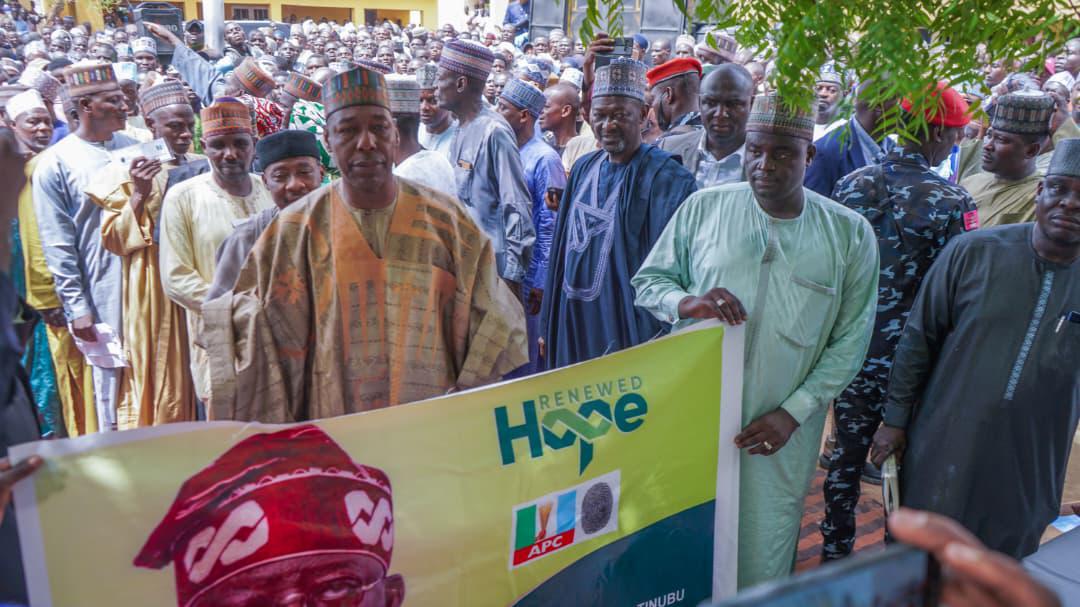
President Bola Ahmed Tinubu recorded a landslide victory in the All Progressives Congress (APC) presidential primary election in Mafa Ward of Borno State, securing all valid votes cast in the exercise held in the home ward of Governor Babagana Umara Zulum.
The direct primary election took place at Mafa Central Primary School under the supervision of the Chairperson of the Presidential Primary Election Committee, Hajiya Inna Alkali Imam.
According to the results announced at the ward level, Tinubu polled 2,175 votes, representing 100 per cent of the valid votes cast during the exercise. Out of the 2,277 registered APC members in the ward, 2,175 were accredited and participated in the voting process.
Tinubu’s challenger, Stanley Osifo, an APC chieftain and businessman from Edo State, failed to secure any vote in the ward.
Governor Zulum, who served as the Coordinator and Collation Officer for the presidential primary in the state, said he participated in the exercise as an indigene of Mafa Ward.
“I am from Mafa Ward, and that is why I am here to witness and participate in the exercise. We have two candidates, President Bola Ahmed Tinubu and Mr Stanley Osifo,” Zulum stated.
The governor also commended the peaceful conduct of the exercise and the turnout of party members.
“So far so good, we have conducted the presidential primary election for Mafa Ward, and I am very impressed with the turnout. We have a total of about 2,277 registered party members in Mafa Ward, out of which 2,175 were accredited for the voting, and all of them voted for President Bola Ahmed Tinubu, while the other candidate scored zero,” he said.
The APC presidential primary is ongoing in several states across the country, with the party expected to collate and announce final nationwide results at a later date.
Tinubu Sweeps Zulum’s Ward with 100% Votes in APC Presidential Primary

Gombe 2027: Pantamiyya Movement to galvanise grassroots support for Gwamna’s guber bid

APC Primary peaceful, as Tinubu clears vote in Adamawa South -Abbati

NIMC Pushes Digital Identity Reforms to Boost Service Delivery, Security

Roger Federer’s Shock as DNA Results Reveal Myla and Charlene Are Not His Biological Children

THE PLIGHT OF FARIDA

FAILED COUP IN BURKINA FASO: HOW TRAORÉ NARROWLY ESCAPED ASSASSINATION PLOT AMID FOREIGN INTERFERENCE CLAIMS
-
 News2 years ago
Roger Federer’s Shock as DNA Results Reveal Myla and Charlene Are Not His Biological Children
-
Opinions4 years ago
THE PLIGHT OF FARIDA
-
 News1 year ago
FAILED COUP IN BURKINA FASO: HOW TRAORÉ NARROWLY ESCAPED ASSASSINATION PLOT AMID FOREIGN INTERFERENCE CLAIMS
-

 News2 years ago
EYN: Rev. Billi, Distortion of History, and The Living Tamarind Tree
-
 Opinions4 years ago
POLICE CHARGE ROOMS, A MINTING PRESS
-

 ACADEMICS2 years ago
A History of Biu” (2015) and The Lingering Bura-Pabir Question (1)
-

 Columns2 years ago
Army University Biu: There is certain interest, but certainly not from Borno.
-

 Politics12 months ago
2027: Why Hon. Midala Balami Must Go, as Youths in Hawul and Asikira/Uba Federal Constituency Reject ₦500,000 as Sallah Gift
