
News
My Binoculars: Memo to Governor Zulum….2


My Binoculars: Memo to Governor Zulum….2
Still On The Annual Flooding of Maiduguri and Why Sleepy BOSEPA Must Be Reset to Face Contemporary Reality
By: Bodunrin Kayode
Your Excellency, it is quite unfortunate that in spite of your spirited drive to get a permanent solution to the perennial flooding in the metropolis of Maiduguri, very little has been achieved even with a standing flood committee of “experts” which is yet to please the flood wearied residents of the metropolis. As far as residents are concerned, there will surely be the usual flood this year 2026 because the appointed experts are yet to prescribe professional reticulation to redirect the flow of excess rain water in the metropolis out of the built up areas. And I don’t think they are being pessimistic. It’s just the kind of fair comment common to the common man.
In their loud thoughts, they will continue by saying: “They are too careful not to recommend the bulldozing of houses built on waterways to allow free flow whenever it rains heavily. They have also not been able to do the right thing which is to recommend for a massive reticulation of modern drainage network system in the known flash points.” However , for watchers like us, we feel you may need “at least 1000 km of modern drainage system at the danger zones in the metropolis. By building such concrete gutters within the next six months before you leave, you would be hitting the nail on the head. Anything less will invite another flood in 2028 and beyond. The committee must also hurry up and re-strategize their engineering skills in conjunction with the key ministries to please the residents of Maiduguri metropolis against the pending rainy season. This is because many people are unhappy with this annual floods and as I noted earlier they tell themselves that “it will come anyway and nobody will help us out. We will at least use our buckets to scoop the water out if we can to stay alive.”
NIMET prediction on Borno, the lingering causes of flooding in Maiduguri and solutions
With the prediction by the Nigerian Meteorological Agency (NIMET) that rainfall this year in Borno state will surely be above normal, we are definitely bound to have another cycle of flash floods in the city of Yerwa and the resultant backlash effects as usual. Nimet has already predicted that Borno is one of the states that would be affected by floods due to heavy rains this year and I don’t think we should take it for granted your Excellency. By now, the machinery to pull down illegal structures should have been activated so that houses standing on the paths of water flow would be cleared from existence. We are aware of work going on at Dala Kogi Tipper. The fact that it is over 70 percent completed is a sign that indeed Acresal is bent to reduce the damnation residents go through in that axis of greater Maiduguri. None of the wards within Maiduguri, here and konduga can be exempted from flash floods. The city centre is not exempted either because many mistakes where made while constructing roads before you came sir. Engineers disregarded the gradient of the topography and laid asphalt anywhere thinking that should do.
As a matter of fact, I don’t think that it is too late for stake holders to hurry up and be involved in the proactive push to save commuters around “baban cross” for instance which is a major gateway round about to the town by any one coming in from the international airport. That area needs complete overhauling to stop flood water taking over the roundabout while motorists struggle to cross from leventis area to the government house or to exit the city through Borno express terminus.
For as long as there is no active “underground” exit drainage system to protect commuters on foot and vehicles from the annual flood which used to take over the biggest roundabout whenever the rains are heavy, we should prepare for the same take over of the road by rain water before the end of July 2026. This one and many others may have nothing to do with bad garbage management but the inability of the flood committee to see the need to proactively recommend corrective engineering for the ministries concerned to correct. The roundabout is really an embarrassing flash point for floods every year and none of the engineers in the flood committee have been able to study the gradient of that place and suggest a redesign of a massive drainage to take the flood water to the nearby river Ngadda which passes by the zoo through maduganari.
This round about always becomes an eyesore at the peak of the rainy season when vehicles are halted halfway into their drive from the leventis feeder axis through the St Patrick’s Catholic Church axis possibly up to the govt house for instance. Vips may be immune to this heavy flood water which is bound to come in because most of them use SUV’s which navigates through such flood waters even if their entire tyres are submerged into the flood.
The second most striking cause of annual flooding in the metropolis is the inability of the Borno State Environmental Protection Agency BOSEPA Street cleaners to realize that they should not be moving garbage from the streets to the narrow gutters. Rather, garbages should be packed out of the gutters to cans and sent to organized dumps. This is what happens in cleaner capital cities in the country. The way the street cleaners send garbage and sand into the gutters in the suburbs of the city is unhygienic. Some of them have joined residents to dump anything into the narrow gutters found in so many suburbs of the city. My fear is that if they are not checked, we may soon become like Lagos which has one of the biggest slums in Nigeria and the worse example to emulate if we must get out of this lingering annual flooding. But come to think about it, if an illiterate sweeper dumps half a paint bucket of sand swept off Baga road for instance into a nearby gutter, it may not have been generating blockages over time if the drains were deep enough. By deep enough I mean the minimum of about half a metre deep to swallow heavy rains. But we keep on having this nightmare because most of the existing drainages are colonial gutters not more than a foot deep some of which has been covered by sand accumulated over the decades. And that is a big wrong which should be corrected.
Key stakeholders and their expected roles in dealing with basic causes of the flood.
Your Excellency, it is expected that if stake holders should contribute to stop this flooding, the standing flood committee should wake up and understand that the problem has been a fundamental one from the inception of the state capital. It also has to do with the behavioral pattern of residents who seem to hate gutters so they deliberately cover them up so it doesn’t accumulate mosquitoes where it is not properly built. I have lived in Mari Kuwait where on a scale of 1 to 10, I can say they are hanging around two and a half over 10, Bolori fits into a paltry 5/10, Baga road and Shagari low cost 4/10, Bama road 6/10, post office before the fly over 4/10 and most of the five major roads 5/10 averagely. They score these low marks in my understanding because as nice as pompomari bypass is for instance there is no serious drainage system on both sides of the shoulders. That itself is a mistake that should not be allowed to linger into this perennial mess.
Most parts of the state capital are below sea level as such we expect that massive drainages should have existed from inception. More than 50 percent of the heavily populated areas in Maiduguri are without proper drainages and sadly an agency like the Borno urban planning agency has not had the political will to call for the building of modern drainages in critical flash points in the metropolis even before the creation of Borno state geographic information service (BOGIS). Sadly too, were drainages do exist, some influential residents build homes on the routes of these shallow gutters and make commuter movements sometimes very painful across certain suburbs like Bolori and Baga road. Most of the houses on the second street behind Anser-ud-deen school in Bolori for instance were built on the only drainage in that area and nobody is doing anything about it.
Bolori junction is a typical example of engineering failure. In spite of the fact that a big drainage emptying system has been built on the left side of Baga road on the junction leading down to the Baga road market, flooding still continues because of this technical failure. This is a technical challenge beyond the ordinary resident or even the media which is also a stakeholder. It has to do with engineering failure within the ministerial bureaucracy which even your Excellency barely tolerates. Your Excellency, it is not too comforting to see residents continue to suffer such engineering failures while they keep complaining of flooding annually. These are some of the lapses that the initial flood committee you set up before the flood must continue to fix. It has to wake up to it’s responsibility if they do not want Borno to deteriorate into a state of despair like residents of some advanced slum states in the country. The removal of residents from the path of such critical drainages expected to serve the city of Maiduguri is more of policy matters beyond sleepy agencies like BOSEPA.
Sleepiness of BOSEPA and why it must be reset to modern realities
It is sad that BOSEPA itself is yet to realize it’s frailties and have resorted to looking out for short term solutions for the lingering garbage accumulation in the capital city which is equally contributing to massive flooding. In my opinion, BOSEPA is grossly backward and most of their staff live and operate as if they are orphans whose parents do not exist anymore. All they know your Excellency is to sweep streets and spray chemicals which is just 30 percent of what they should be doing. Even the law setting up the agency needs a review if that agency would live beyond 2036 or 2040. So many things are wrong with BOSEPA your Excellency and if they are not flogged into line, they will continue to embarrass themselves and the government. Their relationship with their parent ministry is highly convoluted with dangerous red tapes strapping them into almost a comatose agency which gets activated only during the week of environmental sanitation. The most painful discovery about them is that they walk around with that air of self righteousness indicating that they are doing their best when we all know that their best has never been good enough.
You invite them to clean gutters, they will heap the garbage up on the shoulder of the road for the rains to send same back to the gutters and cause flooding in that general area. They look as if they are a seemingly confused agency which has not been able to live up to its responsibilities simply because they have not had the right kind of direction in the last eleven years of pretending to clear garbage to assist in the management of flooding in Maiduguri. Your Excellency , these people don’t seem to have the capacity to envisage the future and plan for the city because most of their management staff lack the requisite exposure to take the agency from where it is now to where it should be. Above all they do not seem to have the political will to embark on a private sector collaboration to handle waste management.The worse challenge they seem to be grappling with is the right implement to work with. And independent BOSEPA should not have less than 200 trucks and a massive fuel dump to assist them with the job
Your Excellency, greater Maiduguri needs nothing less than 2000 waste containers to assist them to do their work. These should be placed in certain strategic areas of each ward and suburb to assist residents to dump their waste for onward ferrying. And for BOSEPA to be able to ferry these on a 24 hour basis, they need the assistance of the private sector because they can’t do it alone. There are hundreds of secondary streets tied around five major routes in Maiduguri. There are many idle young people that can be employed in the clean Maiduguri vanguard and they will be responsible for coordinating the cleaniness of their streets with special allowances. Once the bins are full, they will call BOSEPA vehicles to pick up even if it is less than 24 hours.
Enlightenment of residents about waste dumping and management using the Shara vanguards
Finally, we must concentrate on enlightenment of the people to direct their garbage into these trash cans placed on the roads. Hundreds of them can be manufactured locally. Your Excellency, you will need the services of the residents by way of the household heads, “Shara vanguards”, Ulamas, Chief imams, Christian Association of Nigeria
(CAN) Secretariat, Commissioners of information, environment, health, works, BOSEPA, NUJ and the NYSC. The great flood of 2024 showed that a lot of lapses exist in and around the way flood water can be managed by key stakeholders.
Sewage linkages to the gutters must be be stopped because that is one way to support the proliferation of cholera in the city. Dumping of wastes should be seen as a sacred duty whether or not it is raining. People should be enlightened in local languages to stop dumping it into flood water whenever it is raining because it will surely go and block one drain or the other in the city. New dumping sites should be created in conjunction with nesrea so that mistakes would not be made in terms of long term projections. So many things to be corrected. But not to bore you with too much emphasis, I will keep my binoculars clicking and seeing what your people are up to in the entire environment sector. Yours sincerely, Bodunrin.
My Binoculars: Memo to Governor Zulum….2


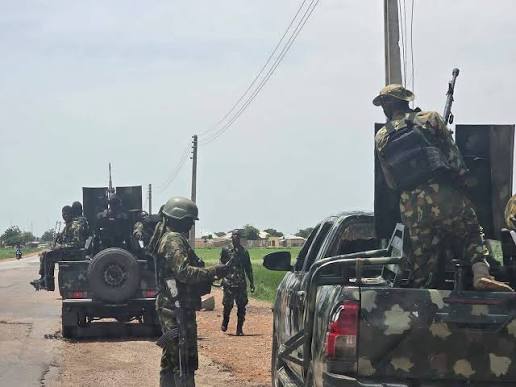
Operation Enduring Peace Conducts Show of Force, Secures Church Services in Jos
By Zagazola Makama
Troops of Operation ENDURING PEACE (OPEP), in collaboration with the Nigerian Air Force, Nigeria Security and Civil Defence Corps (NSCDC) and other security agencies, have conducted a show-of-force operation across major flashpoints in Jos and the Bukuru General Area of Plateau State.
The operation was conducted on Sunday, August 23, 2026, as part of measures to provide security for church services and prevent criminal elements from exploiting the period to carry out attacks.
According to a security source, personnel of OPEP, working with troops of 551 Nigerian Air Force Station, Keystone, NSCDC and other sister agencies, conducted the operation across identified flashpoints within Jos metropolis and the Bukuru General Area.
The show of force was aimed at reassuring residents and worshippers while denying criminal elements freedom of action during church services.
The security teams maintained visible patrols and presence around strategic locations to deter potential threats and ensure the safe movement of worshippers.
The operation was conducted successfully and without any reported security incident.
Security authorities said the situation remained calm throughout the exercise.
Operation Enduring Peace Conducts Show of Force, Secures Church Services in Jos
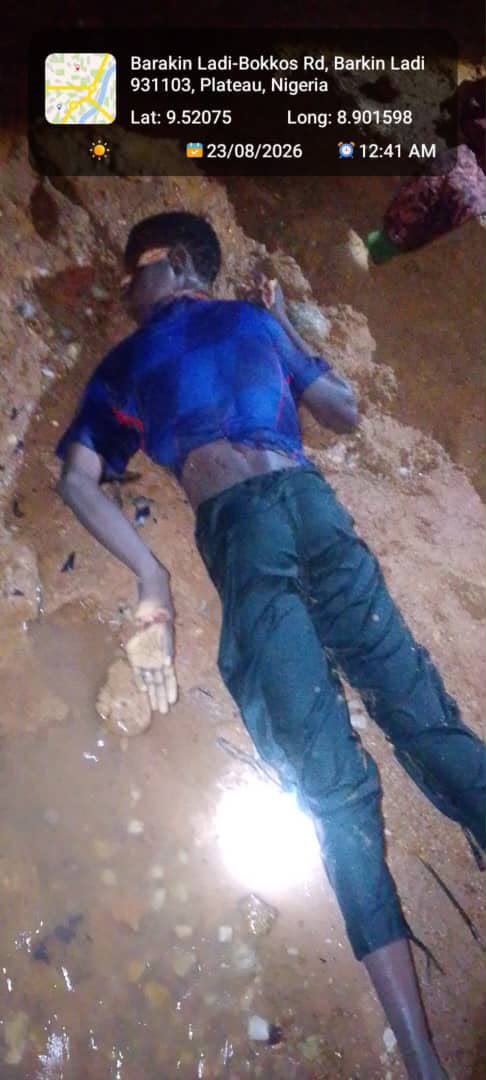
Man Killed in Attack by suspected Fulani Bandits at Illegal Mining Site in Plateau
By Zagazola Makama
A man has been killed in an alleged attack by suspected Fulani Bandits at an illegal mining site around Angwan Izalla village in Barkin Ladi Local Government Area of Plateau State.
The incident occurred at about 5:20 a.m. on Sunday, August 23, 2026, following a report of an attack allegedly involving suspected Fulani herders in the area.
According to a security source, troops of Sector 4, Operation ENDURING PEACE (OPEP), responded to the report and immediately moved to the scene.
Upon arrival, the troops discovered the corpse of a man identified as Abdulmumuni Ibrahim, who had sustained machete wounds to his head and hand.
The circumstances surrounding the attack and the identity of the assailants were not immediately established.
The deceased’s remains were subsequently evacuated by members of his family for burial.
Security personnel have commenced a manhunt for the suspected attackers, while efforts are ongoing to establish the motive for the killing and apprehend those responsible.
The incident is being investigated as security agencies continue to monitor the area.
Man Killed in Attack by suspected Fulani Bandits at Illegal Mining Site in Plateau
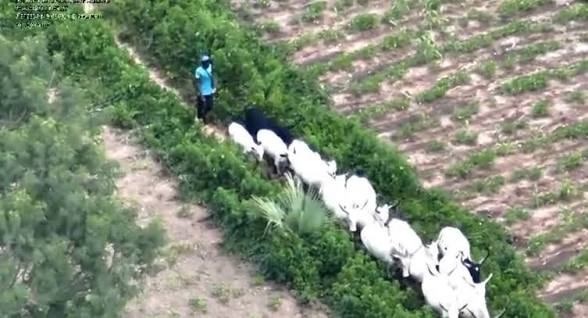
OPEP Troops Recover Cattle Rustled by Berom Militia, Return Livestock to Owners in Plateau
By Zagazola Makama
Troops of Sector 9, Operation ENDURING PEACE (OPEP), have recovered a herd of cattle reportedly rustled by Berom militia from Nteng village in Quan’pan Local Government Area of Plateau State.
The recovery followed a report of cattle rustling received by the troops at about 5:05 p.m. on August 22, 2025.
According to a security source, troops immediately commenced a pursuit of the suspected cattle rustlers and successfully traced the movement of the stolen livestock.
The troops also deployed a drone to monitor the movement of the rustled cattle from the air, enabling them to track the livestock until they were successfully recovered.
Following the recovery operation, the cattle were handed over to their rightful owners.
The operation highlights the continued efforts by Operation ENDURING PEACE to tackle cattle rustling and other forms of criminality threatening rural communities and livelihoods across Plateau State.
Security personnel are maintaining surveillance in the area to prevent further incidents and ensure the safety of residents and livestock owners.
OPEP Troops Recover Cattle Rustled by Berom Militia, Return Livestock to Owners in Plateau

Kidnappers Kill Two Locals, Abduct Doctor and Hakimi’s Wife in Kaduna

Operation Enduring Peace Conducts Show of Force, Secures Church Services in Jos

Man Killed in Attack by suspected Fulani Bandits at Illegal Mining Site in Plateau

Roger Federer’s Shock as DNA Results Reveal Myla and Charlene Are Not His Biological Children

THE PLIGHT OF FARIDA

FAILED COUP IN BURKINA FASO: HOW TRAORÉ NARROWLY ESCAPED ASSASSINATION PLOT AMID FOREIGN INTERFERENCE CLAIMS
-
 News2 years ago
Roger Federer’s Shock as DNA Results Reveal Myla and Charlene Are Not His Biological Children
-
Opinions5 years ago
THE PLIGHT OF FARIDA
-
 News1 year ago
FAILED COUP IN BURKINA FASO: HOW TRAORÉ NARROWLY ESCAPED ASSASSINATION PLOT AMID FOREIGN INTERFERENCE CLAIMS
-

 News2 years ago
EYN: Rev. Billi, Distortion of History, and The Living Tamarind Tree
-
 Opinions5 years ago
POLICE CHARGE ROOMS, A MINTING PRESS
-

 ACADEMICS2 years ago
A History of Biu” (2015) and The Lingering Bura-Pabir Question (1)
-

 Columns2 years ago
Army University Biu: There is certain interest, but certainly not from Borno.
-

 Politics1 year ago
2027: Why Hon. Midala Balami Must Go, as Youths in Hawul and Asikira/Uba Federal Constituency Reject ₦500,000 as Sallah Gift
