
Uncategorized
Neem Foundation: Women Discrimination and Disempowerment, Clog in the Wheel of A Nation

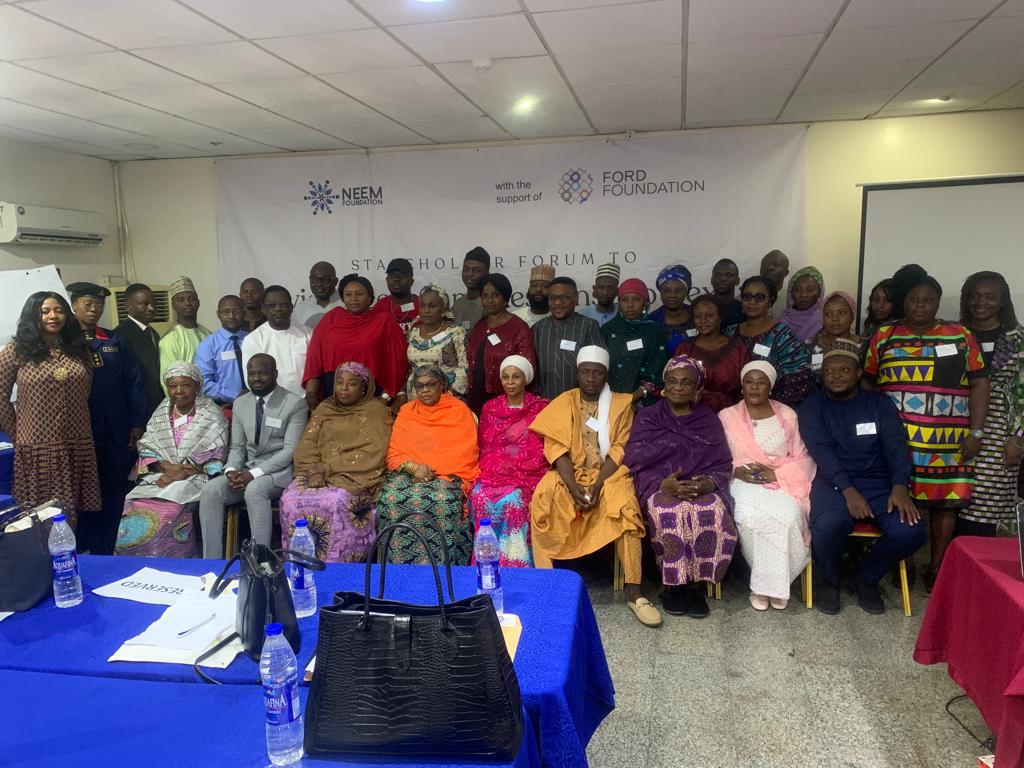
Neem Foundation: Women Discrimination and Disempowerment, Clog in the Wheel of A Nation
By Michael Mike
The discrimination and disempowerment of women and girls is a clog in the wheel of progress of a nation, the Executive Director, Neem Foundation, Dr Fatima Akilu has said.
Speaking at a Stakeholder Forum in Abuja organized by Neem and Ford foundations
to Review Access and Response to Sexual and Gender Based Violence (SGBV) in Northwest Nigeria, Akilu said: “The discrimination and disempowerment of women and girls threatens democracy, peace and security and is an obstacle to sustainable development. It weakens social cohesion, harmony, and justice and put a heavy burden on national economies.”
She however said that “despite the various challenges and gaps, progress has been seen in recent years which is attributed to the leadership of many stakeholders at the Abuja meeting.
Akilu told the gathering from stakeholders in Sokoto, Kaduna and Kano, that: “From being hidden in a culture of silence and impunity, eliminating violence against women has become a national priority, supported by a solid national and international framework.

She explained that “the VAPP and Child Protection Laws in the states obligate them to take responsibility for responding to violence against women and girls. Implementing and adopting these Laws is a strong foundation for women and girls’ rights to equality and freedom from violence. However, these documents remain inoperative and unenforceable if not properly implemented in the states that have adopted them.”
She however lamented: “That we are sitting here today discussing these issues means we still have a long way to go. We are here today to recognise that enhanced coordination and strategic partnerships can bridge the difference between despair and hope in a person who has experienced violence due to their sex or gender.”
She added that: “Although there have been setbacks, we have seen many good practices in recent years. It is essential to look at the evidence, at ‘what works’ to address violence against women. Such experiences can inspire and motivate others and serve as the engine for replication and scaling up. Most importantly, they must underpin the expanding global framework and consensus on ending violence against women and girls.
“Today’s engagement will be an opportunity to share evidence from the ground and to demonstrate that when Governments make adequate political and financial commitments, it is possible to see progress in eliminating violence against women. We hope to see new and improved laws and national action plans that provide for protection and provision of multi-sectoral services that include free hotline services, police and justice responses, shelters, legal aid, medical and health care services, including sexual and reproductive health services, and psycho-social counselling and support to women survivors of violence and their children. It is also essential that these services work together most efficiently and effectively to reduce the burden and impact on women and girls in reporting, response and recovery. These processes can be empowering for women.”
Akilu said: “We count on sensitisation/education programmes that teach human rights, equality and mutual respect. We need increasing numbers of women in politics, law enforcement, and peacebuilding architectures. We need adequate social protection, equal economic opportunities and decent jobs for women,” calling on all stakeholders present not to stop at words, insisting that: “We all must affirm a culture of zero tolerance for violence against women. At the centre of our discussions must be only one consideration – progress for women and girls everywhere.”
On her part, the Sokoto State Honorable Commissioner for Women and Children Affairs, Hajiya Kulu Abdullahi Sifawa commended the Neem and Ford foundations for a job well done in the execution of the 18 month-funded project “Prevent and Protect; Strengthening access and response to GBV in Sokoto, Kaduna, and Kano State”.
She attested to the change in the narrative in prevention and response to GBV and related issues that have impacted the lives of women and children in Sokoto state.
She disclosed that the Sokoto State has experienced 1,1 92 cases of gender-based violence since the Nanan Khadija Sexual Assault Referral Centre opened its doors in May 2020 with a total of 779 females and 413 males out of which 618 are females aged below 18 years while 388 are males that are minors.
She added that: “In the year 2022 alone, we have witnessed 476 cases of gender-based violence of which 85% are against women and girls.”
She said: “The Sokoto State Government has made giant efforts to both Prevent and respond to GBV through the passage of relevant laws, and policies, the establishment of structures, and the strengthening of systems that both prevents and responds to GBV and other related issues in the state. The fight has also been sustained to ensure justice for the survivors and their families.”



Troops arrest three Fulani men in Plateau after farmer’s killing
By: Zagazola Makama
Troops of Sector 6, Operation ENDURING PEACE (OPEP), have arrested three persons during a raid on two Fulani settlements in Bachi community, Riyom Local Government Area of Plateau State.
The operation, conducted on Sept. 13, 2026, followed a manhunt for criminal elements responsible for the killing of a farmer at Fang community in Riyom LGA on Sept. 12.
During the raid at Baggat and Shong 2 Fulani hamlets, troops arrested three residents identified as Anas Usman, Nuhu Mohammad and Haruna Ahmed.
Security sources said the three suspects are not necessarily the perpetrators of the killing, but their arrest is part of efforts to mount pressure on local Fulani leaders to assist security agencies in identifying and producing those responsible for the crime.
The suspects are currently in custody for further investigation and intelligence exploitation.
Troops arrest three Fulani men in Plateau after farmer’s killing
Uncategorized
Talata Mafara Attack: ISN Demands Intelligence Overhaul, Special Courts to Crush Banditry

Talata Mafara Attack: ISN Demands Intelligence Overhaul, Special Courts to Crush Banditry
The Institute of Security, Nigeria (ISN) has called for a fundamental overhaul of Nigeria’s approach to terrorism, banditry and kidnapping, warning that criminal groups are becoming increasingly organised and capable of challenging the authority of the state.
The institute made the call while reacting to the reported invasion of Talata Mafara market in Zamfara State, where non-state actors allegedly imposed a ₦50 million levy and demanded 100 livestock, giving residents a seven-day ultimatum.
The ISN said the development exposed the need for security agencies to move beyond reactive operations and adopt stronger intelligence-led strategies capable of identifying and dismantling criminal networks before they launch attacks.
In a statement signed by its Deputy President and Chief Executive Officer, Barr. Adebayo Akinade, the institute said the activities of terrorists and bandits were no longer limited to isolated attacks but increasingly involved the control of economic activities, collection of illegal levies and disruption of legitimate livelihoods.
It warned that such activities could gradually establish a parallel system of criminal authority in affected communities if left unchecked.
The institute consequently urged the Federal and state governments to establish a coordinated security framework bringing together federal security agencies, state security outfits and vetted community guards.
It also called for the creation of a National Security Fusion Centre, supported by state-level fusion desks, to facilitate real-time intelligence sharing and faster responses to emerging threats.
According to the ISN, security agencies should penetrate criminal networks operating around markets, cattle-rustling routes and illicit livestock value chains while targeting the logistics and financial structures sustaining banditry.
It recommended regulated livestock markets and improved tracking systems to prevent stolen cattle from being absorbed into legitimate commercial channels.
The institute further proposed special courts for terrorism, kidnapping and banditry cases, arguing that a faster judicial process would strengthen the fight against organised criminal groups.
It urged the government to deploy modern technologies, including forest geo-fencing, livestock tracking, drones and citizen-reporting platforms, alongside improved tactical mobility and air surveillance.
The ISN also called for a two-hour rapid-response mechanism in vulnerable areas and increased investment in night-vision equipment and other specialised capabilities.
Beyond security operations, the institute advocated stronger community-based early-warning systems and local peace and security forums involving traditional rulers, farmers, market unions, faith organisations and civil society groups.
It urged citizens to report threats rather than surrendering to ransom and illegal levy demands, while encouraging communities to document attacks and preserve evidence for investigations and prosecution.
The institute said professional training in terrorism studies, intelligence management and counter-banditry operations should be strengthened as part of efforts to build a more effective national security architecture.
The ISN reaffirmed its readiness to support government and security agencies through research, training, policy advisory services and professional certification, saying a coordinated response was essential to restoring public confidence and protecting national development.
Talata Mafara Attack: ISN Demands Intelligence Overhaul, Special Courts to Crush Banditry
Uncategorized
2026 Peace and Dialogue Awards: IPCR, Ufuk Foundation Call for Collective Investment in Peace

2026 Peace and Dialogue Awards: IPCR, Ufuk Foundation Call for Collective Investment in Peace
By: Michael Mike

The Director-General of the Institute for Peace and Conflict Resolution (IPCR), Dr. Joseph Ochogwu, has called on governments, businesses, civil society organisations, religious and traditional institutions, communities and individuals to invest deliberately in peacebuilding, warning that the cost of conflict far exceeds the resources required to prevent it.
Ochogwu made the call on Thursday, September 10, 2026, while delivering a lecture titled “Investing in Peace: A Collective Responsibility for Everyone” at the 2026 Peace and Dialogue Awards organised by the Ufuk Dialogue Foundation Nigeria in collaboration with the IPCR in Abuja.

He said the awards should go beyond recognising individuals and organisations contributing to peacebuilding, stressing that Nigeria must begin to treat peace as an investment requiring consistent resources, planning and accountability.
According to Ochogwu, global military expenditure exceeded $2.4 trillion in 2024, while peacebuilding expenditure remained below $60 billion, representing about 2.5 per cent of military spending.

He questioned why trillions of dollars could be mobilised for conflict and military expenditure while significantly smaller amounts remained difficult to commit to conflict prevention and peaceful societies.
Ochogwu said the message was consistent with the 2026 International Day of Peace and International Day of UN Peacekeepers, but noted that the IPCR had further domesticated it as “Invest in Peace for Everyone, Everywhere, Everyday.”
“Peace cannot be a seasonal product for September 21st; it must be deliberate, daily, and for all,” he said.

He identified early-warning systems, peace education, youth employment, interfaith literacy, justice reform, community mediation, psychosocial healing, and greater participation of women and young people as key areas requiring investment.
The IPCR Director-General noted that the benefits of peacebuilding were often measured by conflicts that never occurred, making its returns less visible than conventional security spending.
He stressed that peacebuilding interventions must reflect the specific causes of conflicts in different parts of Nigeria. He identified extremism in the North-East, banditry in the North-West and North-Central, resource-related conflicts across the Middle Belt, separatist agitation in the South-East and urban fragility as major security and conflict challenges.
He also said West Africa and the Sahel were facing a convergence of violent extremism, unconstitutional political transitions, farmer-herder tensions and climate-induced displacement.
“A blanket approach will fail,” he warned, urging policymakers to develop interventions based on the specific drivers of conflict in each community and region.

Ochogwu also linked economic development to sustainable peace, saying the Federal Government’s economic reforms under the Renewed Hope Agenda could contribute directly and indirectly to peacebuilding.
He said job creation, poverty reduction and addressing economic vulnerabilities could help prevent communities and young people from becoming susceptible to conflict and violent mobilisation.
“Economic renewal is not a separate track; it is the bedrock on which peace is sustained,” he said.
He identified a perception gap, fragmentation of interventions, funding misalignment and the absence of effective mechanisms for tracking peace expenditure and its impact as major obstacles to peace investment.
According to him, less than 0.5 per cent of the budgets of Ministries, Departments and Agencies (MDAs) were coded for peacebuilding, while corporate social responsibility (CSR) spending rarely reached peacebuilding initiatives.
He therefore called for a system to track who invests in peace, how much is invested, where resources are deployed and the results achieved.
Ochogwu warned that failure to invest in peace carries significant economic and humanitarian consequences. He cited an estimated $19.1 trillion global economic cost of violence in 2024, equivalent to about 13.5 per cent of global GDP.
He added that every dollar not invested in conflict prevention could ultimately cost significantly more in humanitarian response and reconstruction.
According to him, farmer-herder conflicts had resulted in losses estimated at more than $14 billion over five years, while infrastructure damage in the North-East had exceeded $9 billion, with about 2.2 million people displaced.
“The cost of not investing in peace far exceeds the cost of investing in it,” he said.
To address the challenges, Ochogwu proposed a five-point compact aimed at making peacebuilding a shared responsibility across Nigerian society.
He called for the speedy implementation of the National Peace Policy, the establishment of a National Peace Investment Fund, legislation for a minimum three per cent peacebuilding allocation across relevant MDAs, and stronger coordination and early-warning responsibilities for the IPCR.
He also proposed committing at least one per cent of CSR expenditure to peacebuilding initiatives, including mediation centres, school peace clubs, early-warning technology and youth employment programmes in vulnerable communities.
The IPCR boss urged faith, traditional and community leaders to institutionalise interfaith dialogue and community-level dispute-resolution mechanisms in every ward, saying vulnerable communities often need trusted local mediators more than externally organised workshops.
He further called for stronger action against hate speech and disinformation, the generation of locally relevant evidence and the development of a Peace Investment Tracker Dashboard at the IPCR.
Ochogwu urged individuals and communities to make peace part of their daily conduct by avoiding escalation, accommodating neighbours, reporting early-warning signs and mentoring vulnerable young people.
“Peace must become everyone’s business,” he said.
The Chairperson of the 2026 Peace and Dialogue Awards, Inspector-General of Police Olatunji Rilwan Disu, NPM, also said peace and democracy were mutually reinforcing, stressing the importance of peaceful engagement in strengthening Nigeria’s democratic development.
2026 Peace and Dialogue Awards: IPCR, Ufuk Foundation Call for Collective Investment in Peace

81st UNGA: Nigeria Will Be Guided By National Interest, Multilateralism, Tinubu’s Reform Agenda – VP Shettima

Abuja Turns into West Africa’s Deal Room as 60 Startups Chase $65,000 and $5m Jackpot

The growing role of local militias, criminal networks and possible external forces in the escalation of violence in Plateau State

Roger Federer’s Shock as DNA Results Reveal Myla and Charlene Are Not His Biological Children

THE PLIGHT OF FARIDA

FAILED COUP IN BURKINA FASO: HOW TRAORÉ NARROWLY ESCAPED ASSASSINATION PLOT AMID FOREIGN INTERFERENCE CLAIMS
-
 News3 years ago
Roger Federer’s Shock as DNA Results Reveal Myla and Charlene Are Not His Biological Children
-
Opinions5 years ago
THE PLIGHT OF FARIDA
-
 News1 year ago
FAILED COUP IN BURKINA FASO: HOW TRAORÉ NARROWLY ESCAPED ASSASSINATION PLOT AMID FOREIGN INTERFERENCE CLAIMS
-

 News3 years ago
EYN: Rev. Billi, Distortion of History, and The Living Tamarind Tree
-
 Opinions5 years ago
POLICE CHARGE ROOMS, A MINTING PRESS
-

 ACADEMICS3 years ago
A History of Biu” (2015) and The Lingering Bura-Pabir Question (1)
-

 Columns3 years ago
Army University Biu: There is certain interest, but certainly not from Borno.
-

 Politics1 year ago
2027: Why Hon. Midala Balami Must Go, as Youths in Hawul and Asikira/Uba Federal Constituency Reject ₦500,000 as Sallah Gift
