
National News
Nigerians should forge a new contract with nature, advises UN Resident Coordinator

Nigerians should forge a new contract with nature, advises UN Resident Coordinator
By: Michael Mike
United Nations Resident and Humanitarian Coordinator for Nigeria, Mr Matthias Schmale has called on all Nigerians to forge a new contract with nature in order to combat the danger of desertification and drought, and its growing threat to lives and livelihoods across Nigeria and the rest of Africa.
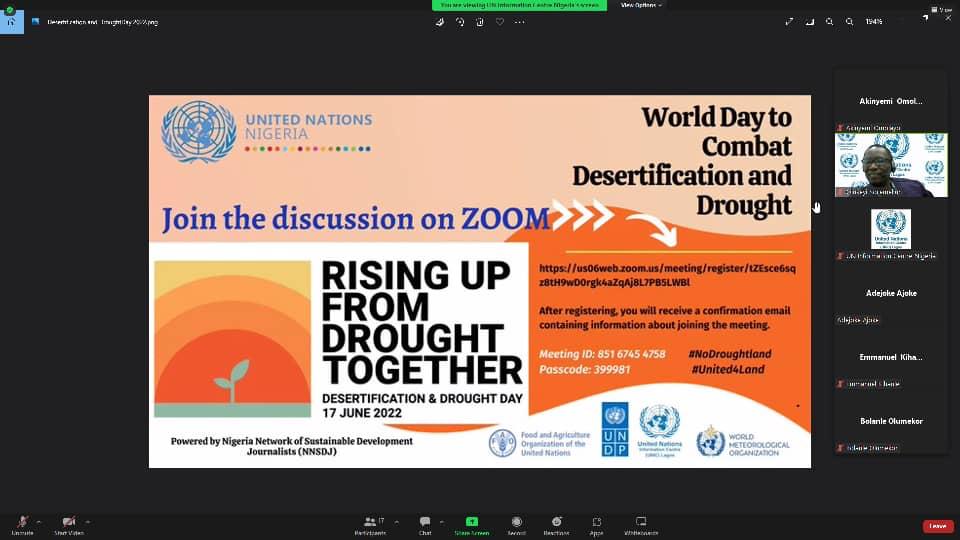
Schmale gave the advice on Friday at the virtual observance of the World Day to Combat Desertification and Drought 2022, under the theme, “Rising up from drought together”, organised by the United Nations Information Centre (UNIC), Food and Agriculture Organisation (FAO), United Nations Development Programme (UNDP) and the World Meteorological Organisation (WMO). He said: “Together we can build a more inclusive and sustainable world that leaves no one behind. On this day, let’s begin to see ourselves as caretakers of the precious resource that is land.”
He explained that we could forge a new contract with nature that would ensure a healthy and prosperous Nigeria for future generations, and noted that restoring nature was the great test of our generation, a test that could not be failed.
The Resident Coordinator advocated for a more inclusive, balanced and sustainable world that leaves no one behind, while further calling for actions to be taken at all levels, from citizens, businesses, governments and UN partners.
He said: “Everyone can come on board and lend a helping hand to rise up from drought together.”
In his welcome remarks, the WMO Representative, Mr Benard Gomez, who was represented by the National Professional Officer, Mr Roland Abah, emphasized that the State of the Global Climate 2021 report released in May 2022 by the UN Community through WMO, indicated that the past seven years had been the warmest seven years on record, and drought affected many parts of the world, including parts of Africa.
Abah disclosed that: “UN Agencies support programmes and projects to combat drought, desertification and other extreme climate-related events in Nigeria. These programmes cover meteorological and hydrological observation, data infrastructure, monitoring and forecast products from satellite and data processing centres, information services, and early warning systems, emergency response and recovery.”
Also Read: June 20 deadline for land vendors’ registration stands…
FAO Representative, Mr Fred Kafeero, represented by FAO Assistant Representative, Mr Abubakar Suleiman, disclosed that “FAO’s large-scale landscape restoration activities were carried out in 15 communities with a total of 2,240 Ha of drylands put under restoration through the planting of native woody and herbaceous fodder species including 2,757 Ha farmland areas that were naturally regenerated for biodiversity conservation and protection.”
Abubakar emphasised that FAO was promoting nature-based approach through sustainable land management practices and restoration of degraded dry lands in three states of Bauchi, Jigawa and Sokoto in Northern Nigeria.
He further emphasized the commitment of FAO to transformation of the food system and sustainable management of Nigeria’s natural resources.
In her presentation on “Fostering Sustainability and Resilience for Food Security in the Savannah Zones of Northern Nigeria”, the Project Manager, UNDP-GEF-IAP- FS Project Nigeria, Ms. Rhoda Dia, explained how UNDP have worked with small holder farmers to build resilience to climate risks (Desertification and Drought inclusive) and other shocks that drives food insecurities.
She cited the introduction of different erosion control measures such as use of cover crops, earth and stones bund and use of sandbags; and disclosed that “So far, 17.14 % (84.4 hectares) of eroded land was reclaimed in farmers plots. Planted /grew 180,747 seedlings/tree at farmer’s plots, school compounds, orchards and household gardens.”
Ms Dia further informed that the project provided linkages to research institution to access foundation for Seed multiplication; Established over 97 orchards with economic tree species in schools and communities; Trained over 38,000 beneficiaries on: Integrated pest & weed Management, and different erosion control techniques; among others. Explaining the remedy for drought management, the Coordinator, Northern Zone, Natural Eco Capital, Mr Umar Saleh Anka, said that “Reliance on ground water and surface water are viable option for reducing the impact of drought.” On the other hand, Irrigation as an option, according to him, will increase cost of production, but will definitely save farmer from drought induced total loss or crop failure.
Nigerians should forge a new contract with nature, advises UN Resident Coordinator



Nigeria, IEA Solidify Partnership, Sign Pact On Energy Policy, Security
**It’s a justification of President Tinubu’s policy choices, gains of his economic reforms – VP Shettima
By: Our Reporter
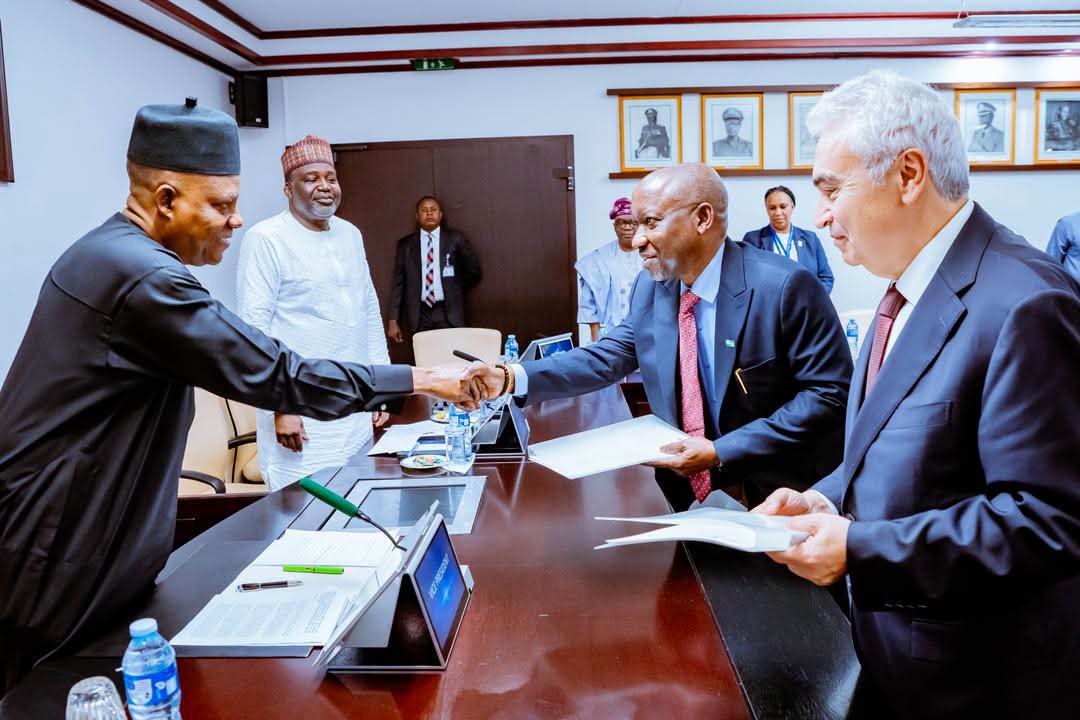
Nigeria and the International Energy Agency (IEA) have signed an agreement for a Joint Work Programme to strengthen strategic partnership in the development of data for energy policy and investment across the value chain for economic growth and energy security.
This is just as the Vice President, Senator Kashim Shettima, has said Nigeria’s formal admission into the IEA as an Association Country is a significant milestone for the country and another testament to the gains of the economic reforms of the administration of President Bola Ahmed Tinubu.
Senator Shettima stated this on Thursday during the signing of the agreement for the Joint Work Programme between Nigeria and IEA, signaling the formal commencement of the partnership.
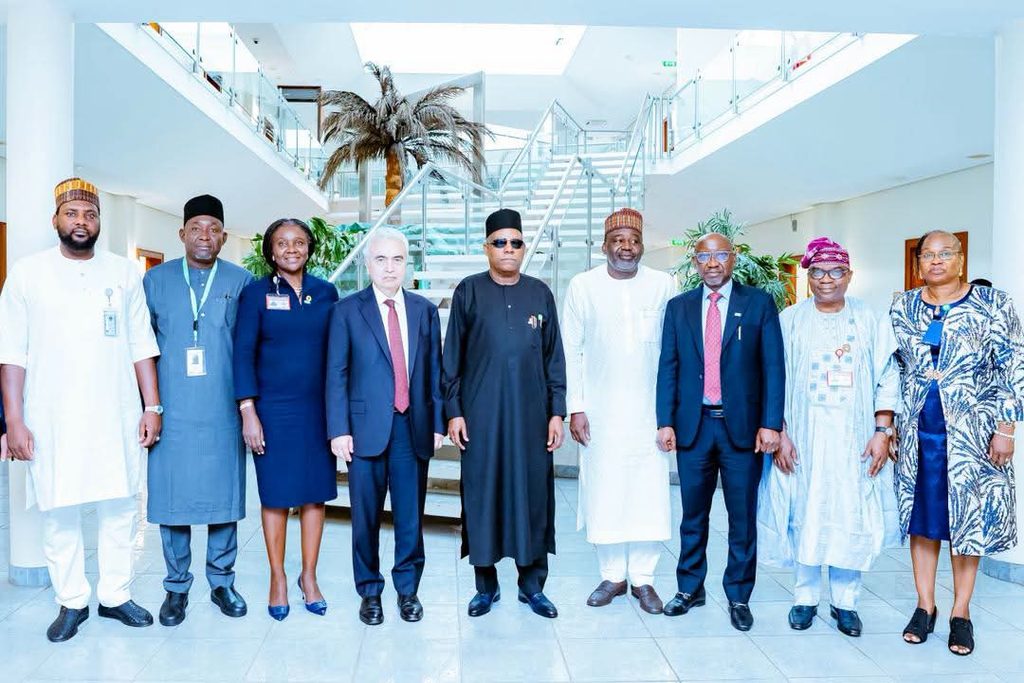
Speaking on behalf of President Tinubu, the Vice President noted that Nigeria’s formal entry into the fold of the Paris-based non-governmental organisation justifies his administration’s policy choices and efforts aimed at leveraging the country’s abundant energy resources scattered across the nation.
Commending the IEA for the important role it is playing in shaping global energy landscape, he said the effort of the agency in the global energy conversation and in supporting countries to navigate the challenges of energy security, affordability, sustainability and economic development, cannot be overstated.
His words: “Nigeria’s admission as an association country with the IEA is a significant milestone for our country and it reflects Nigeria’s strategic importance in the global energy landscape and the confidence that IEA has placed in our commitment to constructive international energy cooperation.”
VP Shettima added that given Nigeria’s potential, “the country will benefit from IEA’s institutional knowledge, the intellectual resources, the reach and expertise to support our nation’s ambitions in this sector.”
He acknowledged Nigeria’s abundant renewable energy resources and his commitment to repositioning the economy leveraging available resources which are already manifesting across different sectors of the economy.
The Vice President assured the IEA team of his administration’s commitment to continue to partner with other stakeholders within the setting to contribute to the global energy debate on a fair and just energy transition.
Earlier, leader of the IEA delegation, Dr. Fatih Birol explained that his organisation is an organisation of governments that covers all technological fields, including oil, gas, solar, nuclear power, artificial intelligence and electric cars based in Paris.
Working with top 500 energy experts of the world in terms of giving policy advice, sharing data and expertise, he said to be a member of the IEA family is not an easy task, as it requires a lot of considerations and tests.
According to Dr. Birol, after detailed discussions with the Minister of State for Petroleum and Gas, Mr. Ekperikpe Ekpo, the Board comprising the governments of the United States, Japan, Germany, Italy, and UK voted and accepted Nigeria unanimously as a member.
“The IEA will accompany the Nigerian energy sector for the next few years to come for a much better energy future. We will provide policy advice from clean cooking to gas markets, from gas markets to training Nigerian experts at the IEA on our own,” he assured.
Earlier, Minister of State Petroleum Resources (Gas), Mr Ekperikpe Ekpo, stressed that Nigeria’s admittance into the IEA was based on the performance of the Tinubu administration reflected in the reforms undertaken in the economy.
He said the signing of the Joint Work Programme, which portends the involvement of the technical team of the IEA with Nigeria in the development of data for energy policy and investment across the value chain and targeted for economic growth and energy security.
On his part, the Minister of State for Foreign Affairs, Ambassador Sola Enikanoaiye, described IEA’s partnership with Nigeria as strategically important, noting that the Nigerian Mission in Paris played a critical role in ensuring its success.
Pledging the commitment of the Minister of Foreign Affairs, Mrs. Bianca Odumegwu-Ojukwu, towards the process, “Our role is to ensure that whatever government does at home is projected effectively in advancing and promoting the interest of Nigeria.
“We take this as a critical component of our national interest and we will not fail in ensuring that we assist, as facilitators and coordinators, in ensuring that the maximum benefit of this endeavor is derived for the benefit of the Nigerian people.”
Also, the Director General of Energy Commission of Nigeria, Dr. Mustapha Abdullahi, said the Commission’s relationship with IEA led to the joint sponsorship of Nigeria’s last National Energy Master Plan, even though there was no structure to their relationship.
He expressed optimism that Nigeria’s formal joining of the IEA and the agreement will strengthen the Commission’s relationship with the organisation.
Nigeria, IEA Solidify Partnership, Sign Pact On Energy Policy, Security

60th Birthday: VP Shettima Opts For Low-Key Celebration
By: Our Reporter
As Vice President Kashim Shettima marks his 60th birthday on September 2, 2026, he has appealed to friends, associates and well-wishers to refrain from placing congratulatory advertisements in newspapers or airing celebratory messages on radio, television and digital platforms.
VP Shettima said his decision to keep the milestone low-key reflects his conviction that public attention should remain focused on the serious work of national development rather than on personal celebrations.
“To ensure absolute propriety, I respectfully appeal that there should be no public birthday celebrations, congratulatory gatherings or goodwill advertorials across print, broadcast and digital media platforms,” the Vice President said.
Rather than celebrate him through elaborate events or paid advertisements, VP Shettima urged well-wishers to channel their goodwill into prayers for Nigeria and for the administration of President Bola Ahmed Tinubu.
He specifically called for prayers for the success of the administration’s economic reforms, lasting solutions to the nation’s security challenges, greater national unity, and the peace and prosperity of all Nigerians.
For VP Shettima, the occasion should serve less as a celebration of a personal milestone and more as an opportunity for reflection, gratitude and renewed commitment to the service of the country.
60th Birthday: VP Shettima Opts For Low-Key Celebration

NHRC Demands Arrest, Prosecution of Kuje Chairman Over ‘Leave If Not APC’ Threat
By: Michael Mike
The National Human Rights Commission (NHRC) has demanded the immediate arrest and prosecution of the Chairman of Kuje Area Council, Hon. Samuel Danjuma Shekwolo, over his alleged directive that residents who do not support the All Progressives Congress (APC) should leave the council.
The Commission described the chairman’s remarks as an unconstitutional assault on citizens’ fundamental rights and a dangerous threat to democratic participation ahead of the 2027 general elections.
The NHRC Executive Secretary, Chief Tony Ojukwu, SAN, said the statement, which has circulated in a video online, amounted to intimidation and an attempt to weaponise public office against citizens holding political views different from those of the council chairman.
In a video that is now viral, Shekwolo is heard saying that residents must either support the APC or leave the area council, adding that he would not accept opposition to the party during the election.
Reacting to the development, Ojukwu said the position was incompatible with the 1999 Constitution, which guarantees citizens’ freedom of association, movement and protection from discrimination on the basis of political opinion.
He specifically cited Sections 40, 41 and 42 of the Constitution, which respectively protect the right to freedom of association, freedom of movement and freedom from discrimination.
According to him, no council chairman, governor or even the President has the constitutional power to banish Nigerians from their communities because of their political affiliation or opinions.
The NHRC chief human rights officer further argued that the alleged remarks could have criminal implications, citing provisions of the Electoral Act 2022, the Penal Code and the Cybercrimes Act dealing with threats, intimidation, incitement and communications capable of causing public disorder.
He warned that political rhetoric that creates an “us versus them” environment could escalate into violence, particularly as the country approaches another highly contested election cycle.
“History has shown that such rhetoric often begins with words and ends in blood, and the NHRC will therefore not wait for it to escalate,” Ojukwu said.
The Commission also rejected any suggestion that federal or FCT government projects should be used as instruments for securing political loyalty.
Ojukwu maintained that Shekwolo, having sworn an oath of office, was bound to serve every resident of Kuje without discrimination, regardless of political affiliation.
The NHRC consequently called on the Nigeria Police Force to immediately arrest and prosecute the council chairman.
It also urged the Department of State Services (DSS), the police and the Independent National Electoral Commission (INEC) to investigate the matter and introduce measures to protect Kuje residents from harassment, political profiling, intimidation or possible disenfranchisement ahead of the 2027 elections.
The Commission further called on the APC leadership and the FCT Administration to publicly dissociate themselves from the alleged statement and affirm that membership or support for any political party cannot be a condition for residing in Kuje or accessing public services.
The NHRC assured residents of Kuje that their constitutional rights remain protected and stressed that Nigerians are free to belong to any political party of their choice without fear of expulsion, discrimination or denial of public services.
It urged anyone facing threats or intimidation in connection with the controversy to contact the Commission through its toll-free line, 6472, or visit its nearest FCT office.
The controversy comes at a politically sensitive period as parties and political actors intensify mobilisation ahead of the 2027 general elections, raising fresh concerns over the use of public institutions and local government structures to exert political pressure on citizens.
NHRC Demands Arrest, Prosecution of Kuje Chairman Over ‘Leave If Not APC’ Threat

Operation Hadin Kai intensifies campaign against ISWAP, Boko Haram, records major gains in August

Niger: Fresh attacks in Tillabéri follow mutiny in Niamey

Troops dislodge terrorists, recover PKT machine gun, rifles, motorcycles in Sokoto

Roger Federer’s Shock as DNA Results Reveal Myla and Charlene Are Not His Biological Children

THE PLIGHT OF FARIDA

FAILED COUP IN BURKINA FASO: HOW TRAORÉ NARROWLY ESCAPED ASSASSINATION PLOT AMID FOREIGN INTERFERENCE CLAIMS
-
 News2 years ago
Roger Federer’s Shock as DNA Results Reveal Myla and Charlene Are Not His Biological Children
-
Opinions5 years ago
THE PLIGHT OF FARIDA
-
 News1 year ago
FAILED COUP IN BURKINA FASO: HOW TRAORÉ NARROWLY ESCAPED ASSASSINATION PLOT AMID FOREIGN INTERFERENCE CLAIMS
-

 News2 years ago
EYN: Rev. Billi, Distortion of History, and The Living Tamarind Tree
-
 Opinions5 years ago
POLICE CHARGE ROOMS, A MINTING PRESS
-

 ACADEMICS3 years ago
A History of Biu” (2015) and The Lingering Bura-Pabir Question (1)
-

 Columns3 years ago
Army University Biu: There is certain interest, but certainly not from Borno.
-

 Politics1 year ago
2027: Why Hon. Midala Balami Must Go, as Youths in Hawul and Asikira/Uba Federal Constituency Reject ₦500,000 as Sallah Gift
