News
NIS Deploys AI, Digital Audit Trails to Track Border Officers, Curb Abuse

NIS Deploys AI, Digital Audit Trails to Track Border Officers, Curb Abuse
15m migration records integrated as FG moves to close identity gaps, strengthen security
By: Michael Mike
The Nigeria Immigration Service (NIS) is deploying artificial intelligence-assisted tools and digital audit trails to strengthen border surveillance, detect suspicious migration patterns and hold officers accountable for their decisions, as the Federal Government intensifies efforts to close information gaps exploited by criminals.
Under the new system, officers’ activities can be reviewed through digital records, while alerts generated by technology must be verified by personnel before operational decisions are taken, the Comptroller-General of Immigration, Kemi Nandap, has said.

The initiative, which integrates more than 15 million migration records into the Border Management Information System (BMIS), is intended to transform the management of Nigeria’s borders from fragmented, largely reactive operations into a coordinated, intelligence-supported process.
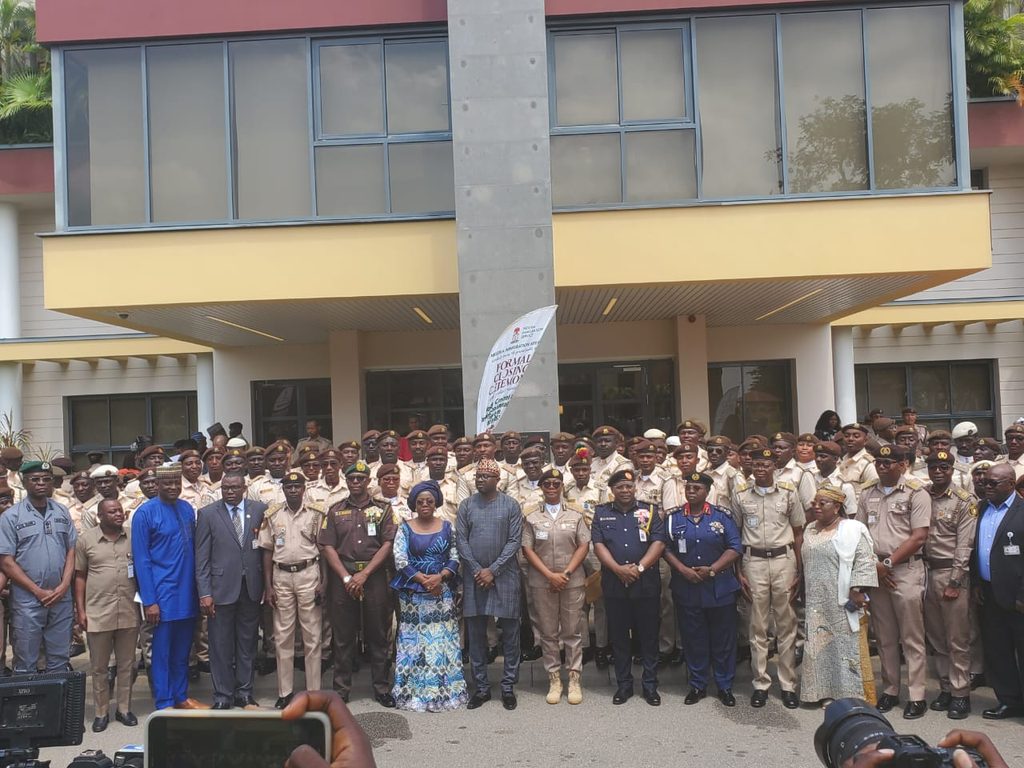
But Nandap’s message at the closing ceremony of specialised training for 87 immigration officers in Abuja was as much a warning to personnel as it was an announcement of technological advancement: access to the system must not be abused, information must not be manipulated, and no officer should mistake a computer-generated alert for proof of wrongdoing.

“An alert is not a verdict. A risk indicator calls for careful, proportionate examination. It never replaces evidence, professional judgement or respect for the rights of the travellers standing in front of you,” she said.
The warning underscores the challenge facing the service as it adopts artificial intelligence-assisted tools and secure mobile devices to improve identity verification and border checks while safeguarding travellers against arbitrary decisions and the misuse of sensitive information.
Nandap said every action taken on the platform could be reviewed through digital audit trails, placing a greater responsibility on officers to ensure that their decisions comply with established procedures.
“Your access to this system is a position of trust, not a personal privilege,” she said, warning that officers who share their credentials, access records out of curiosity or manipulate the platform to grant favours, settle personal scores or facilitate improper passage would face investigation and punishment.
The reforms come against the backdrop of concerns over identity fraud, migrant smuggling, trafficking in persons and other transnational crimes that exploit weaknesses in information sharing among government institutions and border commands.
Nandap said the integration of the BMIS with the Migration Information and Data Analysis System (MIDAS) had brought together more than 15 million migration records, enabling authorised officers to access a more coordinated picture of identity, movement and potential security risks.

She said the achievement was not simply the number of records held but the ability to make previously scattered information available when required for operational decisions.
“Fragmented records, isolated decisions and outdated methods cannot meet these demands,” she said, adding that modern migration management required connected information, capable officers and accountable leadership.
The service is also deploying secure mobile devices to extend verification beyond fixed terminals. Nandap, however, cautioned that mobility must not weaken confidentiality or security standards, insisting that officers must apply the same safeguards to handheld devices as they do to office-based systems.
She said artificial intelligence tools would be used to flag patterns for further examination, not to make final decisions independently.
“No technology is infallible. Poor data produces poor analysis. Unchecked alerts cause harm,” she said.
The comptroller-general identified accuracy, integrity, judgement, readiness and accountability as five non-negotiable standards for the 87 officers who completed the specialised training.
Under the standards, officers must ensure that entries into the system are accurate, correct errors only through approved procedures, protect their access credentials, maintain assigned equipment and escalate suspicious cases through established channels.
She also charged supervisors to ensure that officers were properly deployed, equipment remained operational and reports were completed as required.
Nandap said the success of the programme would be measured by its effect on actual border operations rather than the number of officers trained or devices distributed.
She listed improved record accuracy, consistent checks, prompt escalation of alerts, reliable system availability and lawful treatment of travellers among the indicators by which the reforms would be judged.
FG targets fragmented databases
In his remarks, the Minister of Interior, Olubunmi Tunji-Ojo, said the immigration reforms formed part of a broader government initiative to connect information systems across agencies under the ministry and reduce the weaknesses created by disconnected databases.
He said the government had developed a 10-year technology roadmap and established a data centre with a capacity exceeding eight petabytes, supported by a solar farm that enables the data control centre to operate off-grid.
The minister said the wider Centralised Interior Management System was intended to integrate relevant information systems across the ministry, including correctional and fire administration platforms, while improving coordination with identity management institutions.
He argued that managing migration in a country of more than 200 million people through analogue processes was no longer sustainable, particularly when authorities needed reliable information on the identities and status of people entering, leaving or residing in Nigeria.
Tunji-Ojo questioned official records that reportedly put the number of foreign nationals working in the country at about 40,000, arguing that the figure illustrated the need for more comprehensive data and stronger coordination among government agencies.
“When you do not have the data of those foreigners residing in your country, then how do you manage their affairs? And how do you monitor them?” he asked.
The minister cited the September 11, 2001 attacks in the United States as a warning about the security consequences of intelligence that fails to reach the relevant authorities because information systems are disconnected.
He said Nigeria should address such weaknesses before they contribute to a major security failure.
Government seeks local technical capacity
Tunji-Ojo also warned technology vendors against withholding technical knowledge from government personnel, declaring that the ministry would prioritise knowledge transfer to reduce dependence on external contractors.
He said the government wanted Nigerian officers to acquire the expertise required to operate and maintain critical systems, rather than leave public institutions vulnerable when vendors were unavailable or unwilling to provide support.
“The era when any vendor will hold the service of government to ransom is gone,” he said.
“If you cannot transfer knowledge, then you have no business in government business.”
The minister said the initiative was intended to build an immigration service capable of developing local expertise and eventually assisting other countries with border management and migration technology.
He pledged continued investment in training, saying improved performance could not reasonably be demanded from officers who had not received the necessary technical preparation.
The two officials urged the graduating officers to translate their training into measurable improvements at their duty posts, with Nandap stressing that the credibility of the entire initiative would ultimately depend on how responsibly the technology was used.
The central test, she said, was whether Nigeria could strengthen its security, facilitate legitimate movement and ensure that every border control decision was supported by reliable information, professional judgement and public trust.
NIS Deploys AI, Digital Audit Trails to Track Border Officers, Curb Abuse