
News
Ramadan School Closures: CAN Urges Fair Balance

Ramadan School Closures: CAN Urges Fair Balance
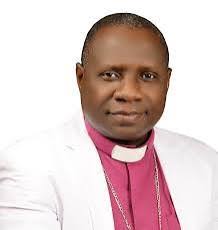
By: Archbishop Daniel Okoh
The Christian Association of Nigeria (CAN) views with grave concern the directives by the governments of Bauchi, Katsina, Kano, and Kebbi States mandating the closure of all schools—public and private—for up to five weeks to observe the Ramadan fast, effective from late February to early April 2025. While we honor the religious diversity of our nation and recognize the significance of faith, these decisions raise serious issues of equity, educational continuity, and the welfare of all citizens, regardless of their religious beliefs.
Education is a fundamental right and the bedrock of progress. The closure of schools across these states, ranging from nursery to tertiary levels, for an extended period disrupts academic schedules and threatens the educational advancement of millions of students. These states—Bauchi, Katsina, Kano, and Kebbi—already face alarming rates of out-of-school children, averaging 44% according to recent data, far exceeding the national average. Such prolonged breaks risk deepening this crisis, undermining efforts to ensure access to quality education for all.
Moreover, the apparent lack of broad consultation in Bauchi, Katsina, Kano, and Kebbi prior to these directives is troubling. CAN leadership in these states has not been adequately engaged, despite claims of stakeholder involvement. Policies impacting diverse populations—Muslims, Christians, and others—demand transparent, inclusive dialogue with parents, educators, religious leaders, and school proprietors. The absence of such engagement erodes trust and unity in our pluralistic society.
Globally, nations like Saudi Arabia and the United Arab Emirates—where Islam is central and Ramadan deeply revered—do not shut down schools for the entire fasting period. Instead, they adapt schedules, shortening hours or offering flexibility, to balance education with religious practice. If these Islamic heartlands can maintain this equilibrium, Nigeria’s northern states should strive for similar pragmatism. A month-long closure, or five weeks in Bauchi’s case, is excessive and departs from sensible precedent.
We call on the people of Bauchi, Katsina, Kano, and Kebbi—Christians, Muslims, and all residents—to remain calm and peaceful as we address this matter. CAN is dedicated to promoting harmony across faiths, and we urge our members and the public to avoid actions that could heighten tensions. Yet, we cannot overlook the potential violation of the rights of students and families who do not observe Ramadan, nor the dangerous signal this sends for equitable governance.
We therefore request that Governors Bala Mohammed, Dikko Umar Radda, Abba Kabir Yusuf, and Nasir Idris open channels of dialogue with key stakeholders—religious bodies, school owners, parents, and civil society—to reassess these directives and pursue inclusive solutions. Transparency is essential, and we expect these governments to act in good faith by promptly engaging all parties. The education of our children and the unity of our states are at stake.
Should these rights face further jeopardy or dialogue fail to deliver justice, CAN is prepared to seek legal recourse. We will pursue restraining orders through the courts to safeguard the constitutional rights to education and freedom of conscience. Our pursuit of peace does not diminish our commitment to justice.
Let us unite as Nigerians to forge a society where faith and progress harmonize, where no child’s education is compromised, and where every community is valued. We urge the governors to reconsider these policies in the spirit of fairness and national cohesion.
May God bless the Federal Republic of Nigeria.
Ramadan School Closures: CAN Urges Fair Balance



Fubara: Nigeria Needs God-Fearing Leaders to Tackle Corruption, Drive National Progress
By: Michael Mike
Rivers State Governor, Sir Siminalayi Fubara, has said Nigeria’s quest for sustainable development and good governance depends largely on the emergence of leaders guided by the fear of God, arguing that the country’s socio-economic challenges stem from a deficit of integrity and moral leadership.
The governor made the remarks on Thursday at the Government House in Port Harcourt while receiving the World President of the Seventh-day Adventist Church, Erton Köhler, alongside his wife, Andriene Marques Köhler, their daughter, Mariana Marques Köhler, and other senior church officials.

Fubara said leaders who are conscious of their accountability before God would be less inclined to abuse public trust, noting that the absence of such values has fuelled corruption, inequality, poverty and rising criminality across the country.
“Our country is where it is today because we lack the fear of God,” the governor said. “If you have the fear of God, there should be a limit to what you can do because you understand the supremacy of God. But when God is not in your equation, you’ll go beyond the line, and that is what has brought us to where we are today.”
He praised the Seventh-day Adventist Church for its long-standing investment in education, describing its schools and universities as critical platforms for nurturing competent and morally upright future leaders.
According to the governor, the church’s commitment to education demonstrates that religion should extend beyond preaching and denominational identity to making tangible contributions to national development through human capital development.
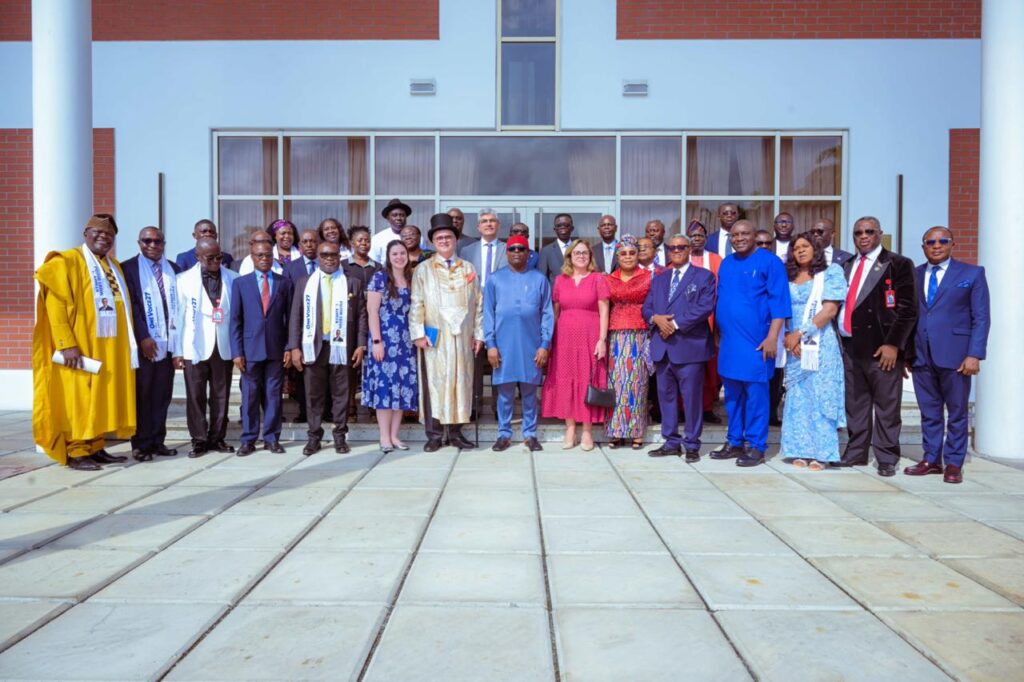
Fubara noted that by establishing and sustaining educational institutions, the church has continued to support Nigeria’s efforts to produce graduates equipped with knowledge, character and leadership values.
“We need the right people being in the right place, prepared properly with good minds. That is what we need, not just in Nigeria but around the whole world,” he said.
The governor also linked many of the country’s security and economic challenges to weak social welfare systems, stressing that citizens are less likely to resort to crime when they have access to quality education, affordable healthcare, decent wages and opportunities for a secure future.
He advocated a system where average-income earners can educate their children, access quality healthcare and own homes after years of productive service, insisting that such conditions would significantly reduce insecurity and other social vices.
Fubara thanked the church delegation for visiting Rivers State and for praying for the state, assuring them of his administration’s continued support for their activities.
Speaking earlier, Köhler said he was in Nigeria for a major church conference that would bring together thousands of Seventh-day Adventist ministers for leadership and empowerment training aimed at strengthening their pastoral work and service to society.
He expressed appreciation for the warm reception accorded his delegation by the Rivers State Government, describing the visit as one that would remain memorable.
The church leader also highlighted the global reach of the Seventh-day Adventist Church, revealing that it has more than 24 million members and over 182,000 places of worship spread across 212 countries and territories worldwide.
Fubara: Nigeria Needs God-Fearing Leaders to Tackle Corruption, Drive National Progress
News
Troops Prevent Fulani Reprisal attack after Rustling of Livestock by Suspected Local Militia in Mangu in Plateau
Troops Prevent Fulani Reprisal attack after Rustling of Livestock by Suspected Local Militia in Mangu in Plateau
By: Zagazola Makama
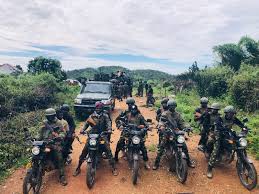
Troops of Operation Enduring Peace (OPEP) have repelled suspected Fulani Bandits during a rapid response operation following reports of sporadic gunfire around Banasu High Ground in Mangu Local Government Area of Plateau State.
Intelligence sources told Zagazola Makama that the incident occurred at about 1:52 p.m. on July 2, when troops of Sector 8, Sub-Sector 81, deployed at Gyambwas, received reports of intermittent shootings around the Banasu High Ground.
Security sources said that the planned attack was in response to previous attack on hardees and rustling of their livestock by Militia men in Mangu.
Acting swiftly on the distress report, the troops moved to the area and engaged the armed criminals in a firefight.
According to the sources, the superior firepower of the troops forced the assailants to abandon their mission and retreat towards the surrounding high ground.
No casualties were reported among the troops during the encounter.
Security sources said the troops have sustained surveillance and monitoring of the area, while efforts are ongoing to track down the fleeing suspects and prevent any further attacks.
The operation forms part of ongoing security efforts by Operation Enduring Peace to prevent any armed militia activities and enhance security across Plateau State.
Troops Prevent Fulani Reprisal attack after Rustling of Livestock by Suspected Local Militia in Mangu in Plateau
Troops Clear Zamfara Highway of Explosive Threats, Recover Police Vehicle Damaged by IED
By: Zagazola Makama
Troops of the 1 Brigade have successfully cleared the Bagega–Anka major supply route in Zamfara State of explosive threats, restoring safe movement along the road after a comprehensive route scanning operation.
Intelligence sources told Zagazola Makama that the operation was carried out at about 9:30 a.m. on July 2 by troops of the brigade in conjunction with a Quick Response Force (QRF) and an Explosive Ordnance Disposal (EOD) team.
According to the sources, the troops conducted a thorough route scanning exercise along the Bagega–Anka Main Supply Route (MSR) in Anka Local Government Area to detect and neutralise any improvised explosive devices (IEDs) or other explosive hazards.
At the conclusion of the operation, the route was confirmed free of explosive threats and was subsequently reopened to vehicular traffic.
During the exercise, the troops also recovered a Nigeria Police Counter-Terrorism/Counter-Strike (NP CSK) vehicle that had recently struck an improvised explosive device along the same route.
The operation was completed without incident, and no casualties were recorded among the troops.
Security sources said the route clearance forms part of sustained counter-insurgency and counter-banditry efforts aimed at ensuring the safety of motorists, security personnel and residents travelling along strategic roads in Zamfara State.
They added that troops will continue aggressive route clearance patrols and surveillance operations to deny criminal elements the opportunity to emplace explosive devices on major highways within the theatre of operations.
Troops Clear Zamfara Highway of Explosive Threats, Recover Police Vehicle Damaged by IED

The Blood We Have Normalised

ECOWAS Commissions Landmark Abuja Headquarters, Nigeria and China Renew Commitment to Regional Integration

FG Evacuates 593 Nigerians from South Africa, Denies Extortion Claims

Roger Federer’s Shock as DNA Results Reveal Myla and Charlene Are Not His Biological Children

THE PLIGHT OF FARIDA

FAILED COUP IN BURKINA FASO: HOW TRAORÉ NARROWLY ESCAPED ASSASSINATION PLOT AMID FOREIGN INTERFERENCE CLAIMS
-
 News2 years ago
Roger Federer’s Shock as DNA Results Reveal Myla and Charlene Are Not His Biological Children
-
Opinions4 years ago
THE PLIGHT OF FARIDA
-
 News1 year ago
FAILED COUP IN BURKINA FASO: HOW TRAORÉ NARROWLY ESCAPED ASSASSINATION PLOT AMID FOREIGN INTERFERENCE CLAIMS
-

 News2 years ago
EYN: Rev. Billi, Distortion of History, and The Living Tamarind Tree
-
 Opinions5 years ago
POLICE CHARGE ROOMS, A MINTING PRESS
-

 ACADEMICS2 years ago
A History of Biu” (2015) and The Lingering Bura-Pabir Question (1)
-

 Columns2 years ago
Army University Biu: There is certain interest, but certainly not from Borno.
-

 Politics1 year ago
2027: Why Hon. Midala Balami Must Go, as Youths in Hawul and Asikira/Uba Federal Constituency Reject ₦500,000 as Sallah Gift
