
News
Random Thoughts On Gov. Zulum @54.

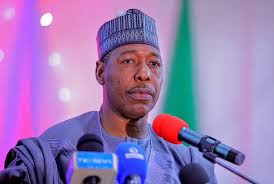
Random Thoughts On Gov. Zulum @54.
By: Inuwa Bwala
At his 52nd birthday, I wrote a piece on Borno State Governor, Professor Babagana Umara Zulum in which I made some philosophical allussions to trends in the birth of successful men in life.
Now 54, I have a very strong urge to reproduce that write up, with slight modifications in the order of narrative, but retaining the central theme of celebrating the man.
In that piece I wrote, that, “most successful people in life are often those who have known suffering, who have known loss, who have met failures, defeats and general challenges and have found their ways out of those depths of abandonment.
I am familiar with the adage that, “success has many parents, but failure is an orphan”and I feel that, maker of above statement seem to have Borno State Governor, Professor Babagana Umara Zulum at the back of his mind.
Perhaps, there was no significant landmark at his birth in that obsecure Mafa environment, typical of a rural setting. There might not have been signs either, that, a unique child had been born. But as the saying goes, “The year you were born marks only your entry into the world. Other years when you prove your worth are the ones worth celebrating.
What people are celebrating today is not his birth, rather his rise from obsecurity to walk in the corridors of power and affluence. Here is a man who was born into poverty, unnoticed by the world , but who turned around his fortunes for the best through sheer personal efforts.
Professor Babagana Umara Zulum’s exploits in life today have given him so many parents and siblings, each of whom want to identify with him, not only on occasions like this, but all the time.
I dare say, that, from a humble but noble background, Zulum rose from the obsecure Mafa town of Borno State to walk in the corridors and pull the reins of power in a manner that is uncommon in the country’s history.
So, I woke up this morning at a labyrinth: with the urge to write something and be amongst the many fans of Professor Zulum, knowing today marks his fifty fourth birthday, but not knowing at which point to take off.
It is further compounded by the fact that, there is no language one can use as accolade on the Governor that has not already been used by others.
The story of Professor Babagana Umara Zulum is no longer new; one unique thing about it however, is the fact that, behind the fine and impressive stories told about the man is a very expensive sacrifice, which many leaders may not be able to offer, for the service of other men and the country.
Professor Zulum’s life story often elicits emotions looking back at where he came from, compared to where God has catapulted him today.
No story can be more expensive than the story of a man who had to ferry firewood from the bush, serve as motor boy, commercial bus driver and performed other minimal jobs in order to survive and to pay for his way through school to the point of Professorship.
I could imagine as a young man, when he trekked in the hot sands of Maiduguri to attend lectures from where he worked for others on empty stomach.
Everytime I mention Zulum, I never fail to pay special tribute to his predecessor, Senator Kashim Shettima, whom God blessed with the exceptional foresight to promote his candidature. Many people did not believe Kashim Shettima when he told stakeholders, before picking Zulum, that he was giving Borno the best. Events have vindicated him.
Of all the sacrifices Zulum has to offer, the most expensive remains his offer to die, but so that peace will come to Borno and that his people are bailed out of so many years of suffering.
Fifty times they tried to take his life and fifty times he survived. At every instance, Zulum returns to the enclave where attempts were made on his life, giving people a sense of citizenship and offers of livelihood.
Very often, his lieutanants are reluctant going with him to some of the dangerous spots across the state, but very often too, such spots are his favourite places to visit.
I do not want to delve into his developmental projects, as I believe the compendium on his media outings has adequately captured that. I also know that documentaries have covered all areas, but I could not resist mentioning some of those attributes that stand him out.
I believe that Zulum’s successes are not measured by his accomplishments alone, but by the opposition he encountered and the courage with which he maintained the struggle for peace, justice and equity in Borno state.
These could be seen in many of his actions and utterances, which have also served as the compass for members of his cabinet and his other aides.
Perhaps, his quest for a peaceful Borno remains one of the legacies Governor Zulum shall always be remembered for.
His passion for the return peace and the relocation of citizens to their ancestral abodes remain uncompromising. This perhaps informed his often dangerous forays into hitherto very dangerous enclaves.
I would have continued, but that will take me into areas, I earlier tried avoiding, but it remains an irresistible desire to always join millions of Nigerians on whose lips the name of Professor Zulum as always been the sweetest song.”
At the time I was r one above piece, I read the Governor from a distance. Having come closer, as a council Chairman under his tutelage, it is almost irresistible praising him to near point of psychophancy.
His re-election for a second time: which a walkover remains the most eloquent testimony of the love his people have for him.
The second d stanza of his leadership promises to bring for more interesting stories.
I wish our Governor a happy 54th birthday and pray, that, the God who gave him grace to succeed and who saved him from the hands of those who wished him dead, will uphold him
Random Thoughts On Gov. Zulum @54.



Chad Accuses Sudanese Forces of Crossing Border, Bombing Convoy Deep Inside Chadian Territory
By Zagazola Makama
The Chadian General Staff has accused the warring parties in Sudan of violating Chad’s territorial integrity after aircraft and drones allegedly pursued and bombarded a convoy more than 100 kilometres inside Chadian territory.
The incident reportedly occurred at about 8 p.m. on Thursday, August 20, 2026, near Chad’s common border with Sudan, particularly around the Mourdi Department in the Ennedi-Est Province.
In a communiqué issued to the national and international public, the Chadian General Staff said aerial and ground assessments conducted throughout Friday, August 21, confirmed that the fighting in Sudan had once again spilled into Chadian territory.
According to the military authorities, aircraft and drones identified as belonging to the Sudanese Armed Forces (SAF) and/or forces supporting them were involved in the pursuit of a convoy.
The Chadian military said the operation initially took place on Sudanese territory but subsequently extended deep into Chad, with the convoy reportedly pursued and bombarded more than 100 kilometres inside Chadian territory.
The military authorities did not provide details on the identity of the convoy, the nature of its cargo, or the circumstances that led to the pursuit across the border.
However, the Chadian General Staff described the incident as a fresh violation of the country’s territorial integrity and warned all parties involved in the Sudan conflict against attempting to extend the war into Chad.
“Although no Chadian casualties have been recorded to date,” the military said, it strongly condemned what it described as the latest violation of Chad’s territorial integrity.
The General Staff issued a stern warning to the Sudanese belligerents, saying continued attempts to expand the Sudanese conflict into Chadian territory could have serious consequences.
It described such actions as a “suicidal risk” for those seeking to bring the Sudanese war onto Chadian soil.
The latest incident comes amid the continuing conflict in Sudan between the Sudanese Armed Forces and the paramilitary Rapid Support Forces, which has increasingly generated security concerns for neighbouring countries.
Chad shares a long and porous border with Sudan, particularly along its eastern frontier, where the security situation has remained fragile due to the movement of armed groups, refugees, weapons and combatants fleeing the Sudanese conflict.
The Chadian military said its defence and security forces remain on the highest level of alert to prevent further violations and protect the country’s population.
It further assured citizens that the security forces are prepared to respond forcefully to any threat capable of undermining the peace and security of the Chadian people.
The statement did not indicate whether Chad had identified the specific aircraft or drones involved through direct visual confirmation, radar data or other intelligence means, but said assessments conducted through aerial and physical means established that the operation had crossed into Chadian territory.
The development raises concerns over the potential regionalisation of the Sudan conflict, particularly as fighting and military operations continue to take place close to Sudan’s borders with Chad and other neighbouring countries.
For Chad, the alleged incursion represents a particularly sensitive security issue given the country’s proximity to the conflict and the potential for cross-border military operations to trigger a broader confrontation.
The Chadian authorities have therefore placed their forces on heightened alert while warning the Sudanese belligerents that further violations of its territory could provoke an energetic response.
The Chadian General Staff stressed that its priority remains the protection of the country’s territorial integrity and the safety of its citizens amid the continuing instability along its eastern border.
Chad Accuses Sudanese Forces of Crossing Border, Bombing Convoy Deep Inside Chadian Territory
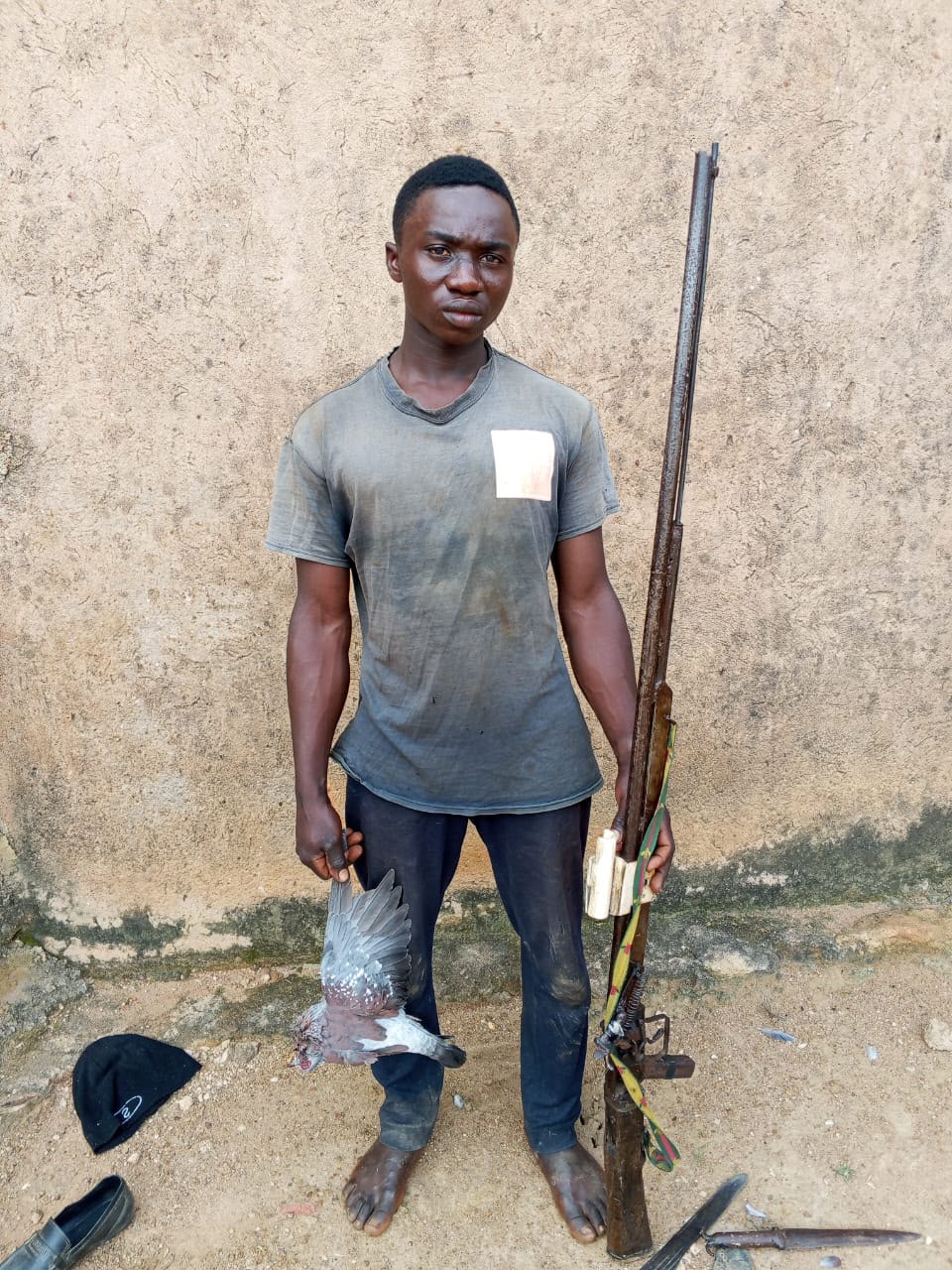
Troops Arrest 24-Year-Old Hunter With Dane Gun After Gunshots Report in Plateau
By Zagazola Makama
Troops of Sector 3, Operation ENDURING PEACE, have arrested a 24-year-old man and recovered a Dane gun following a report of gunshots in the DTV general area of Bassa Local Government Area of Plateau State.
The incident occurred at about 1:15 p.m. on Saturday, August 22, 2026, when troops deployed at DTV responded to reports of gunshots in the area.
According to military sources, the troops arrived at the scene and arrested the suspect, identified as Emmanuel Daniel, 24, who was found in possession of one Dane gun.
Preliminary investigation revealed that the suspect claimed to have fired the shots while hunting in the area.
The suspect and the recovered weapon are currently in military custody for further investigation and necessary action.
The arrest followed the prompt response of troops to reports of gunfire as security forces continue efforts to maintain peace and security across communities in Plateau State.
Troops Arrest 24-Year-Old Hunter With Dane Gun After Gunshots Report in Plateau
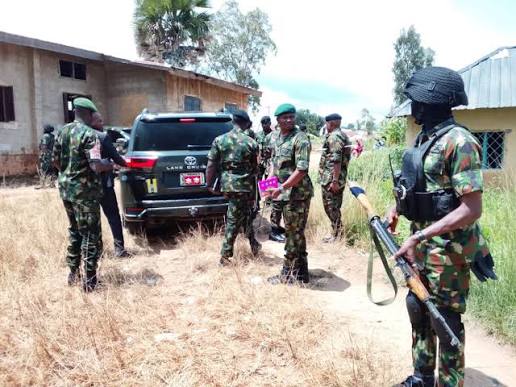
GOC 3 Division Urges Irigwe Stakeholders to Embrace Dialogue, Peaceful Coexistence
By Zagazola Makama
The General Officer Commanding (GOC) 3 Division and Commander, Operation ENDURING PEACE, Major General W.M. Dangana, has urged the Irigwe community in Bassa Local Government Area of Plateau State to embrace dialogue and peaceful coexistence in resolving differences and restoring lasting peace.
Dangana made the call on Friday, August 22, 2026, during a stakeholders’ engagement held at Miango community in Bassa LGA.
The engagement was attended by the Chief of Staff and Commander, Sector 3, Operation ENDURING PEACE, the entire Irigwe leadership and other stakeholders.
During the meeting, participants discussed critical security issues affecting the community and measures required to address the challenges and prevent further escalation of tensions.
The GOC emphasized the importance of dialogue as a means of resolving differences, urging the stakeholders to pursue peaceful solutions to issues affecting the community.
He also called on the Irigwe leadership and residents to promote peaceful coexistence, stressing the need for collective efforts towards restoring lasting peace in the community and Plateau State at large.
The engagement further illustrates the importance of cooperation between the security agencies, traditional institutions and local communities in addressing security challenges and strengthening peace-building efforts.
The meeting was hitch-free.
GOC 3 Division Urges Irigwe Stakeholders to Embrace Dialogue, Peaceful Coexistence

Chad Accuses Sudanese Forces of Crossing Border, Bombing Convoy Deep Inside Chadian Territory

Troops Arrest 24-Year-Old Hunter With Dane Gun After Gunshots Report in Plateau

Three Cows Die After Suspected Poisoning in Plateau

Roger Federer’s Shock as DNA Results Reveal Myla and Charlene Are Not His Biological Children

THE PLIGHT OF FARIDA

FAILED COUP IN BURKINA FASO: HOW TRAORÉ NARROWLY ESCAPED ASSASSINATION PLOT AMID FOREIGN INTERFERENCE CLAIMS
-
 News2 years ago
Roger Federer’s Shock as DNA Results Reveal Myla and Charlene Are Not His Biological Children
-
Opinions5 years ago
THE PLIGHT OF FARIDA
-
 News1 year ago
FAILED COUP IN BURKINA FASO: HOW TRAORÉ NARROWLY ESCAPED ASSASSINATION PLOT AMID FOREIGN INTERFERENCE CLAIMS
-

 News2 years ago
EYN: Rev. Billi, Distortion of History, and The Living Tamarind Tree
-
 Opinions5 years ago
POLICE CHARGE ROOMS, A MINTING PRESS
-

 ACADEMICS2 years ago
A History of Biu” (2015) and The Lingering Bura-Pabir Question (1)
-

 Columns2 years ago
Army University Biu: There is certain interest, but certainly not from Borno.
-

 Politics1 year ago
2027: Why Hon. Midala Balami Must Go, as Youths in Hawul and Asikira/Uba Federal Constituency Reject ₦500,000 as Sallah Gift
