Connect with us

News

Shock As Landlord’s Skeleton Is Found On His Bed 4 Years After He Was Last Seen In Oyo

Published

on

Shock As Landlord’s Skeleton Is Found On His Bed 4 Years After He Was Last Seen In Oyo
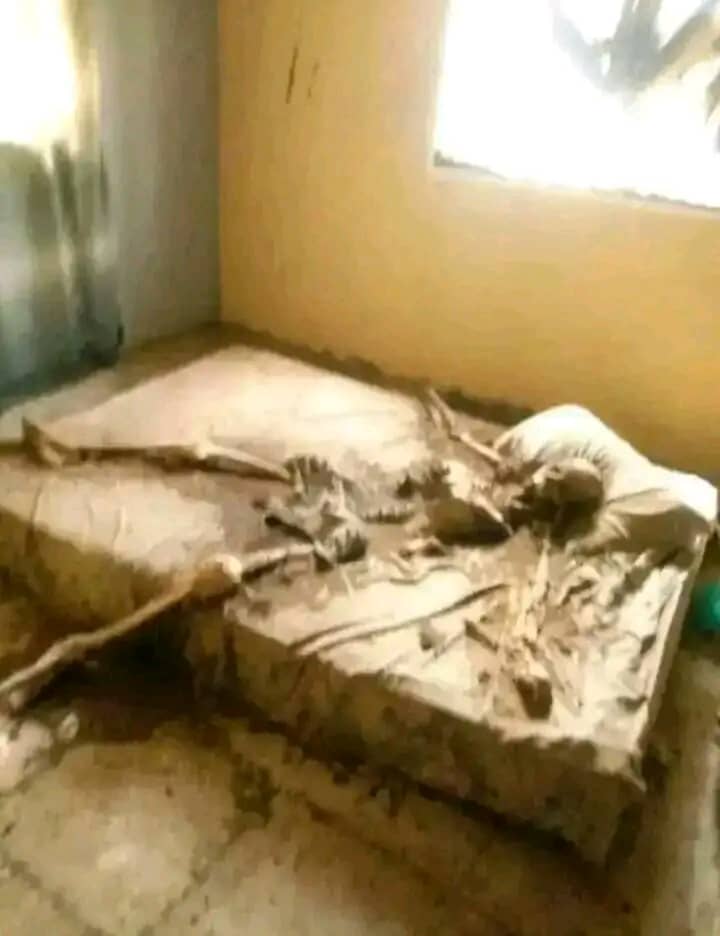
Shock As Landlord’s Skeleton Is Found On His Bed 4 Years After He Was Last Seen In Oyo

The Adeosun/Idi Orogbo Community in Ido Local Government Area of Oyo State was thrown into shock recently when they found one of their landlords, Mr John Aderemi Abiola, in his room, almost four years after he was last seen in December 2018.

The discovery was made after the community decided, with the approval of the police authorities, to go into his compound to clear the bush in his compound which had overgrown his fence into the next house, causing invasion by reptiles.

As 2019 crept into 2020, the residents started wondering where the man could be. Though he told about two of those he used to communicate with of his intention to go to Port Harcourt, Rivers State, and be back for Ileya ceremony in 2018, not seeing him for the festivity and thereafter made them to think he was staying back where he initially came from.

Nigerian Tribune reports that calls to his phone lines were not going through. After it was noticed that the weeds in his compound had grown bushy, the community landlords were said to have decided in a meeting to find a means of getting access to the premises to clear the bush.

From then to 2021, till 2022 is getting to the end, the residents of the community who did not know his whereabouts decided again to go and clear the bush.

It is reported that laborers who went to clear the bush noticed that the window of Mr Abiola’s room was open, and his Volkswagen car was covered in bush which prompted curiosity.

One of the landlords, Mr Mohammed Ademola, who also worked for and used to interact with Mr Abiola, decided to check what was in the room. He was however shocked when he saw the skeleton on the bed of the house owner.

The eyewitnesses decided not to tamper with his remains because the community did not want to risk anything. They were told by security personnel to slow so the environmental authorities handle the matter.

Mr. Ademola noted that the deceased was not known with any of his family members and it was difficult to trace his family.

Shock As Landlord’s Skeleton Is Found On His Bed 4 Years After He Was Last Seen In Oyo

Continue Reading
Click to comment

Leave a Reply

Your email address will not be published. Required fields are marked *

News

Berom youths issue ultimatum over grazing after seven die in Barkin Ladi attack in Plateau

Published

on

Berom youths issue ultimatum over grazing after seven die in Barkin Ladi attack in Plateau

By: Zagazola Makama

Berom youths in Barkin Ladi Local Government Area of Plateau have issued a strong warning to government and security agencies in the state, declaring that they “cannot guarantee peace and safety on the Plateau if Fulani continue grazing on our land.”

The warning followed the killing of seven persons in Dorowa Babuje village on Feb. 22 after gunmen suspected to be Fulani bandits opened fire on residents at a local relaxation spot.

Security sources said troops of Sector 4 under Operation Safe Haven responded to a distress call at about 7:30 p.m., discovering seven persons dead and two others critically injured.

The corpses were evacuated to Barkin Ladi General Hospital mortuary, while the injured were rushed to the same facility for treatment. Troops subsequently launched aggressive patrols across Dorowa Babuje, Dong and Lugere communities to prevent further escalation and track the attackers.

However, hours after news of the killings spread, another violent episode unfolded along the Nding axis of Barkin Ladi LGA.

Security sources confirmed that youths suspected to be local indigenes mounted a road blockade and intercepted a passenger Opel Vectra conveying civilians. Four persons were reportedly selected and killed on the spot, while a fifth later died from injuries. Two of the victims were identified as Hausa indigenes of Jos North, heightening tension in parts of Jos metropolis, including Terminus and Gangare areas.

The retaliatory attack prompted swift deployments of troops in flashpoints across Barkin Ladi and adjoining districts. Joint patrols and stop-and-search operations have also been intensified along major roads. But despite the efforts by security agencies, youths barricaded road for many hourz in protest and addressed government officials who visited the area.

In a series of emotionally charged remarks, a representative of the Berom youths alleged systematic attacks by Fulani militias and accused them of manipulating narratives to justify violence.

“This is another round of terrorism and we want the security to have it on record that our lives are not to be killed by the so-called Fulani,” the youth leader said.

“These are terrorists and it must be admitted that Fulani that are killing us are terrorists.” He further alleged that herders frame incidents to justify reprisals. We are aware that they have been framing up reports that cows have been attacked, poisoned or their people have been attacked, thereby justifying these killings,” he said.

The youth leader issued a direct warning to authorities. “If Fulani are not designated as terrorists, if Fulani are not stopped from grazing on our land, nobody should come and arrest anybody,” he said.

He added: “Sir, stop this Fulani from grazing on our land. Our land is not for any grazing. Declaring that the community felt pushed to the wall, he stated: “We have been pushed to the wall… we will not take it.”

He also said: “We stand to defend our land. We stand to defend our lives and our heritage is not to be shared with the Fulani.” The youth leader further cautioned: “We cannot guarantee PEACE and SAFETY on the PLATEAU if Fulani continue grazing on our land.”If they poisoned their livestock, does that justify this act?” If they poisoned their cows, who did the poisoning? Is it our people or the Fulani?”

“We are aware that they have been framing up reports that cows have been attacked, their people have been attacked, thereby justifying these killings. Sir, you are the eye of the government here. I swear to God, we will not take it.”

“If Fulani are not designated as terrorists, if Fulani are not stopped from grazing on our land, nobody should come and arrest anybody. The terrorists are there, they are killing people. They come with their cows, graze our lands and allege that we are the ones killing their people by laying ambush to shift the blame on us and come with this terror attack on us.”

“We are not fighting with anybody; we are law-abiding citizens. We are not fighting with any Hausa or anybody, but we stand to defend our land.” We stand to defend our lives and our heritage is not to be shared with the Fulani. They own their cows, we own our land. If Fulani want to acquire land, they should follow the lawful means, not to come and hijack land by force and then use it as a base to launch attacks.”

“We have information that bandits have been brought in and are being led by YELLOW, and nobody is doing anything. There must be something done about these people that have been killed.”

As at yesterday, we got on credible authority that Fulani are saying that we have been killing their people and they brought out some list. Who killed them and at what point?” These people were killed in their homes. Let us know where Fulani have ever been killed in his homes.”

“We are aware that anytime Fulani already plan an attack on our people, they will scheme it. They will go and poison their cows and start killing their own and then shift the blame on us.”
They will go and kill people that are not in support of what they are doing and then shift the blame on us.” he said.

He also called for action against Miyetti Allah, alleging that the group was encouraging violence and spreading unverified claims. “I want to believe they are the ones encouraging these things.” You went on air and alleged that it was Berom militia, we don’t have Berom militia and no Fulani settlement has been attacked.”

“So it is us that are meant to be killed simply because they have the propaganda machine and some backing of political office holders.”
If you don’t invest in us, if you don’t invest in our wellbeing, don’t come for us for anything.” We cannot continue to be killed like this.”he declared.

Meanwhile, security sources indicated that the Dorowa Babuje killings were being investigated as a possible reprisal linked to weeks of targeted assaults on pastoralist communities in parts of Barkin Ladi and neighbouring Riyom Local Government Areas.

On Feb. 19, three Fulani youths, Tahiru Muhammad, Jibrin Salisu and Abdulmumin Isyak were reportedly ambushed and killed near Jong community while returning from Dorowa Babuje axis, by suspected Berom militia. One of the assailants reportedly beheaded a victim, while the others were shot dead. Empty 7.62mm Special cartridges and a motorcycle were recovered at the scene.

Less than 24 hours before the Barkin Ladi attack, armed men suspected to be Berom militia reportedly attacked herders in Jol community of Riyom, killing one Muhammed Sani while another victim, identified as Faruq Jamilu, was abducted. An unspecified number of cattle were also reportedly killed or injured during the assault.

On Feb. 11 at about 8:30 a.m., six cows belonging to Alhaji Bello Haruna and Iliya Yusuf, both of Rwam Village in Mushere District, Bokkos LGA, were reportedly poisoned at Tulus and Rwam villages. Two of the cows died instantly, while four others were slaughtered after showing signs consistent with poisoning.

In the same development, Militia suspected to be from the Birom ethnic group attacked a Fulani settlement in Tulus Village, Horop, setting ablaze two houses belonging to Kadiri Adamu and Hashimu Adamu. The Bokkos incident followed an earlier case in Riyom LGA. The Fulani community in Riyom reported that a cow belonging to Anas Likita, a resident of Luggere in Jol Ward, was attacked and seriously injured by individuals suspected to be youths from Jol community.

Abdullahi Yusuf, the Leader of the Fulani community in Riyom, while calling for calm, condemned the act. “Such incidents only increase tension and undermine ongoing efforts toward peace and stability in Riyom LGA,” the community said in a statement signed by Abdullahi Yusuf on Feb. 9.

On Feb. 2, one cow was shot dead at Weren Camp, Riyom LGA, while three others were poisoned in Kwi Village. Reports said toxic substances were concealed inside oranges and deliberately placed along grazing fields. The attack occurred in the afternoon.

Data from recent incidents indicate that both agrarian and pastoral communities have suffered casualties within weeks. While Dorowa Babuje recorded seven deaths attributed to suspected Fulani militias, preceding attacks had claimed Fulani lives in Riyom and Barkin Ladi, including killings within or near their settlements.

This pattern of attack to retaliation draw attention to a “cycle of mutual victimhood,” where each side cites prior losses to justify fresh violence against the other.

As tension lingers in Barkin Ladi and parts of Jos, stakeholders warn that inflammatory ultimatums and retaliatory actions risk widening the conflict beyond local flashpoints.

For now, security forces remain on high alert, racing to contain violence that once again threatens to engulf Plateau in another cycle of bloodshed.

Berom youths issue ultimatum over grazing after seven die in Barkin Ladi attack in Plateau

Continue Reading

News

New civil service association wants Ogun governor to halt hurried implementation of contributory pension scheme until…

Published

on

New civil service association wants Ogun governor to halt hurried implementation of contributory pension scheme until…

By: Bodunrin Kayode

The entire members of the Association of New Ogun Civil and Public Service Retirees have called on Governor Dapo Abiodun to halt any further accelerated action on the proposed contributory pension scheme (CPS) for civil servants.

The association which comprises more than 600 members and still counting as people are retiring wants Prince Dapo Abiodun, to consider their plights by shifting the proposed hurried implementation of the CPS forward to a later year when all vexatious aspects of the law that established the CPS would have been properly fixed.

In a release signed by about five of the worried retirees, led by Shadrach Omopariola, the members maintain we that “inline with this, we plead with His Excellency Prince Dapo Abiodun CON to order the payment of our monthly pension as from January 1st 2026 to bring back the hope of living in us and put smile on our faces.

“Your Excellency Sir, we heard that your Government is planning to introduce a new idea that is known as ‘Additional Pension Benefits’ This in itself is nothing to be compared with the gains and benefits of the Old Pension Scheme.

” Sir, the payment of our monthly pension would in no small measure improve not only the economic growth of our immediate families but would be a moral booster for the good people of Ogun State inline with Your Excellency’s Mantra of ‘Igbega ipinle Ogun Ajose Gbogbo wa Ni’.

“We will patiently wait for the payment of our gratuity with faith in the government of Ogun State to pay us as soon as possible.

“We remain law-abiding senior citizens of Ogun State even in this difficult situation where we have no money to take care of ourselves, our children, our aged parents, and other dependent relatives.

“We believe in your kind heartedness and goodwill that you will not close your eyes to our pleading but you will come to our rescue within the shortest time possible to bring happiness and joy to all of us.”

The release was jointly signed by Omopariola Shadrach, Adeyanju Joseph, Falola Kayode, Obasan Olufolake and Kayode Mulikat.

The contributory pension scheme is a new scheme first introduced by the fed government in June 2004 following the enactment of the pension reform act by President Olusegun Obasanjo.

The act was later repealed and replaced by the pension reform Act of 2014 which updated the terms of the scheme by exempting employees who had three years or less to retire, those who retired before the enactment, judicial officers, members of the armed forces and the secret service.

Teachers who should have led the list of these exemptions because of their thankless services to humanity like that of the military were completely ignored.

Sub nationals now trying to domesticate the scheme have equally refused to give teachers that special exemption they are entitled to for their thankless services.

New civil service association wants Ogun governor to halt hurried implementation of contributory pension scheme until…

Continue Reading

News

At a Time of Fracture, Akpabio Frames AfCFTA as West Africa’s Last Best Shield Against Marginalisation

Published

on

At a Time of Fracture, Akpabio Frames AfCFTA as West Africa’s Last Best Shield Against Marginalisation


…ECOWAS Parliament President Pushes for Bold Economic Shift
… Odumegwu-Ojukwu Calls for Accelerated Regional Economic Integration, Strengthen Institutional Cooperation

By: Michael Mike

In a region shaken by coups, economic strain and rising global protectionism, President of the Senate Godswill Akpabio has delivered what may be his most forceful case yet for urgent regional consolidation — casting economic integration not as an option, but as West Africa’s survival strategy.

Addressing lawmakers at the Extraordinary Session of the ECOWAS Parliament in Abuja, Akpabio framed the moment in stark terms: a world increasingly defined by hardened borders, supply-chain nationalism and geopolitical rivalry leaves little room for fragmented economies.

His message was unmistakable — West Africa must integrate or risk irrelevance.

At the centre of his argument is the full and uncompromising implementation of the African Continental Free Trade Area (AfCFTA). But beyond ceremonial endorsements, Akpabio challenged lawmakers to confront the uncomfortable truth that trade agreements without legislative alignment, infrastructure readiness and security guarantees remain symbolic.

He warned that if goods cannot move seamlessly from Lagos to Accra or Dakar to Abidjan without bureaucratic bottlenecks, then regional integration remains rhetorical.

More pointedly, Akpabio, who was represented by the Deputy Senate President, Barau Jibrin, linked insecurity directly to stalled economic progress, describing instability as the silent saboteur of intra-African trade. In a region where constitutional disruptions have tested ECOWAS cohesion, he suggested that economic interdependence could become a stabilising force — binding member states not only by treaties but by shared prosperity.

Observers say the Senate President’s remarks signal a shift in tone: from aspirational integration to enforceable integration.

He urged parliaments across the bloc to harmonise national laws with regional commitments, dismantle regulatory contradictions and invest in infrastructure that physically and digitally connects markets. Without such coherence, he warned, West Africa risks remaining a supplier of raw materials while importing finished dependency.

For Nigeria — the region’s largest economy — the speech carried added weight. Akpabio acknowledged that Nigerian growth cannot be insulated from regional fragility, implying that leadership now demands shared uplift rather than dominance.

The underlying message was clear: AfCFTA must move from conference halls into factories, ports, farms and fintech platforms. It must empower small traders, protect cross-border commerce from corruption and unlock value-added production within West Africa.

At a time when global trade blocs are consolidating power, Akpabio’s address positions ECOWAS at a crossroads — either deepen integration and negotiate the global arena collectively, or confront it divided and diminished.

On her part, the President of the ECOWAS Parliament, Mémounatou Ibrahima, called for decisive, measurable action to transform West Africa into a competitive economic bloc, warning that regional integration must move from declarations to delivery.

She declared that the Parliament’s mandate goes beyond representation — it is about responding to the expectations of over 400 million West Africans seeking peace, security and shared prosperity.

At the heart of the session is the implementation of the African Continental Free Trade Area (AfCFTA), which she described as a historic instrument capable of reshaping the region’s economic destiny — but only if fully embraced and effectively executed.

“The AfCFTA has entered its operational phase. Our responsibility is clear: to make it a lever for structural transformation in West Africa,” she said.

Ibrahima stressed that with nearly five decades of integration experience, ECOWAS must not merely follow continental reforms but lead and harmonize them, particularly as the region hosts the AfCFTA Secretariat.

However, she acknowledged stark realities confronting the bloc. Intra-regional trade remains below 10 percent of total trade, industrial capacity is weak, and most member states continue exporting raw commodities such as cocoa, cotton, palm oil and timber with minimal value addition.

“Our economies often compete rather than complement each other,” she noted, adding that delayed ratifications and the absence of clear national strategies in some member states risk slowing coordinated implementation.

Despite these constraints, she highlighted key strengths: a harmonized macroeconomic framework, a Common External Tariff, innovative trade facilitation tools like the Pan-African Payment and Settlement System (PAPSS), and a youthful population representing nearly one-third of Africa’s total demographic strength.

But for AfCFTA to deliver, she insisted, parliamentarians must act decisively — harmonizing legal frameworks, dismantling non-tariff barriers, overseeing community resources and ensuring inclusive participation of women, youth and private sector actors.

Beyond trade, Ibrahima outlined three strategic priorities for 2026: consolidating democracy and constitutional order, strengthening regional security cooperation, and advancing women’s leadership.

She welcomed the lifting of sanctions against Guinea following its December 2025 presidential election and urged peaceful electoral processes in Cape Verde, The Gambia and Benin, while encouraging dialogue in Guinea-Bissau.

On security, she warned that terrorism, violent extremism and transnational crime remain persistent threats that demand intelligence sharing, coordinated action and effective deployment of the ECOWAS Standby Force.

She also called for stronger implementation of gender inclusion commitments, urging the ECOWAS Female Parliamentarians Association to move from advocacy to measurable impact.

In declaring the seminar and Extraordinary Session open, Ibrahima challenged lawmakers to ensure that integration becomes tangible — measured not by speeches, but by expanded intra-regional trade, harmonized policies and improved livelihoods.

“Integration must not merely be proclaimed; it must be implemented,” she said.

Nigeria’s Minister of State for Foreign Affairs, Ambassador Bianca Odumegwu-Ojukwu, in her intervention asked West African states to accelerate regional economic integration and strengthen institutional cooperation to confront emerging political, economic and security challenges across the sub-region.

Odumegwu-Ojukwu, who was represented by the Head ECOWAS National Unit at the Ministry of Foreign Affairs, Ambassador Nonyelum Afoekelu, in her opening remarks at the First Parliamentary Seminar and First Extraordinary Session of the ECOWAS Parliament, an event which was part of activities marking the Golden Jubilee of the Economic Community of West African States (ECOWAS), stated that regional leaders should use the platform to recommit to the future of integration and shared prosperity.

She said the programme comes at a critical time when West Africa must consolidate its integration agenda, strengthen institutional coherence and collectively respond to socio-economic and security threats affecting the region.

She described the seminar as a strategic platform for reflection, renewed commitment and practical policy dialogue aimed at deepening regional cooperation, harmonizing legislation and accelerating the realisation of ECOWAS objectives.

She also described the keynote theme of the seminar, “Deepening Regional Integration through the African Continental Free Trade Area (AfCFTA): Opportunities and Challenges for the Expansion of Intra-Community Trade within the ECOWAS Region,” was described as highly relevant to the region’s development trajectory.

She noted that declining regional trade has been aggravated by insecurity, unconstitutional changes of government, climate change impacts and other transnational threats that continue to disrupt cross-border commerce.

However, she emphasized that the African Continental Free Trade Area presents a historic opportunity for West Africa to expand trade, attract investment and strengthen regional value chains.

Odumegwu-Ojukwu stressed that ECOWAS is not starting AfCFTA implementation from scratch, noting that the region already has a strong foundation through the ECOWAS Trade Liberalization Scheme (ETLS), which promotes the free movement of goods originating within Member States.

She explained that the ETLS provides a tested institutional and legal framework that can be harmonised with continental trade structures to accelerate economic integration across Africa.

By leveraging existing regulatory instruments and dispute resolution mechanisms, she said ECOWAS can become a continental leader in operationalising AfCFTA and improving the global competitiveness of West African businesses.

She however emphasised that the ECOWAS Parliament must play a central role in translating regional agreements into domestic policies.

She said the Parliament serves as a bridge between regional commitments and national implementation by working with national governments and legislatures to ensure trade policies are aligned with AfCFTA objectives.

In practical terms, she called for: Ratification and harmonisation of trade-related legislation; Adequate budgetary allocations for AfCFTA implementation; Strong oversight of executive compliance; Increased engagement with private sector actors, customs authorities and civil society organisations

Through legislative diplomacy and policy scrutiny, she said the Parliament can help remove regulatory bottlenecks and eliminate non-tariff trade barriers that hinder regional commerce.

Odumegwu-Ojukwu urged delegates to actively participate in deliberations to ensure the session produces practical and actionable outcomes for regional development.

She expressed confidence that the seminar would help strengthen West Africa’s integration agenda and support long-term economic prosperity for the region’s citizens.

As ECOWAS celebrates its 50th anniversary, regional leaders say the focus remains on transforming integration commitments into real economic opportunities for businesses, traders and young entrepreneurs across West Africa.

At a Time of Fracture, Akpabio Frames AfCFTA as West Africa’s Last Best Shield Against Marginalisation

Continue Reading

Trending

Verified by MonsterInsights