
Feature
The Map Does Not Lie: How AES Failed the Sahel Five years of military rule in Burkina Faso, Mali, and Niger have produced not sovereignty but collapse. No propaganda can survive the evidence of the May 2026 security map

The Map Does Not Lie: How AES Failed the Sahel Five years of military rule in Burkina Faso, Mali, and Niger have produced not sovereignty but collapse. No propaganda can survive the evidence of the May 2026 security map
By Oumarou Sanou
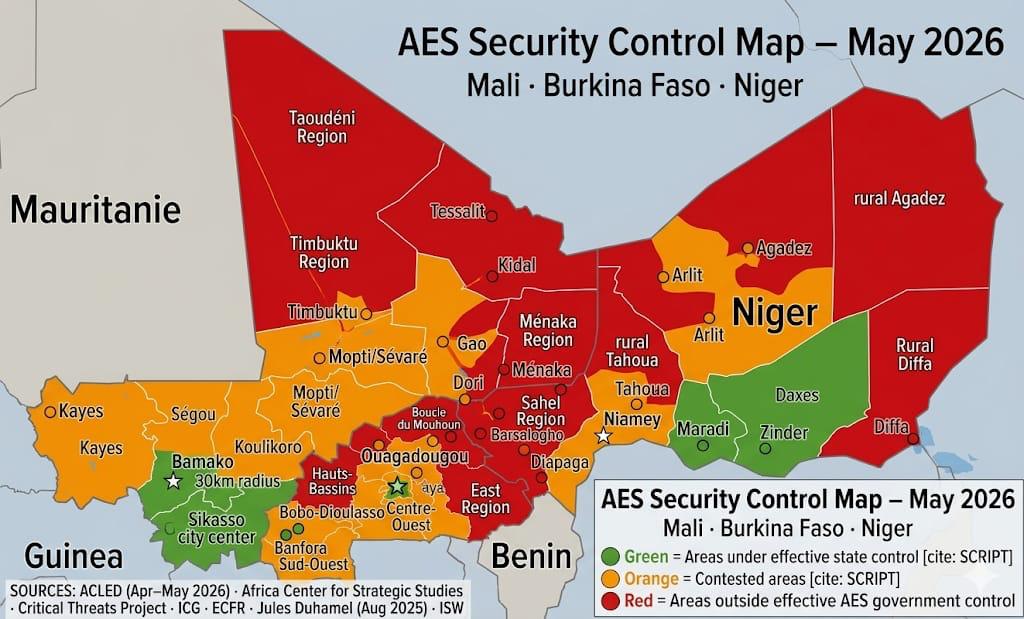
There is one document that no junta press conference can censor, no hired influencer can spin, and no state television anchor can reframe. It is the current security map of the Sahel, compiled from open-source intelligence platforms and conflict-monitoring organisations, including the Africa Centre for Strategic Studies, ACLED, the Critical Threats Project, the International Crisis Group, and the Institute for the Study of War.
That map tells a devastating story. In the blunt, unsparing language of colour-coded territory, it shows that the Alliance of Sahel States (AES) project has failed: not partially, not temporarily, but systematically and comprehensively. It does not argue. It does not editorialise. It simply shows.
The country-by-country picture is alarming in its specificity. Burkina Faso is the most catastrophic case. Over 90 per cent of the national territory is either under the control of jihadist groups or actively contested. The entire northern, eastern, and central belt, including the Sahel Region, the East Region, and the Boucle du Mouhoun, is red or deeply contested.
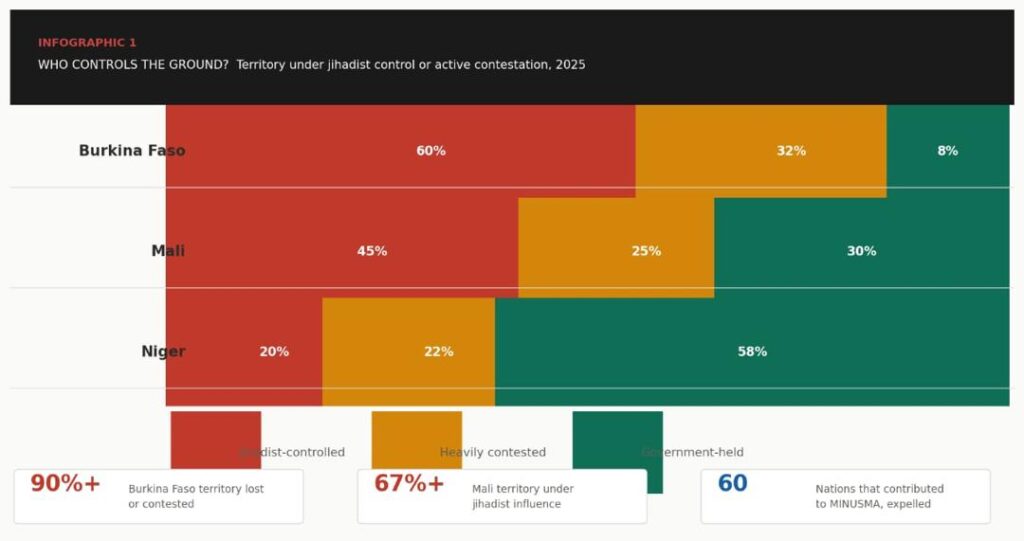
Captain Ibrahim Traore’s government retains authority in the Ouagadougou city centre, Bobo-Dioulasso, and a scattering of southern towns; nothing more. This is not a government losing ground. It is a government that has already lost it. In practical terms, this is state collapse, even if not yet formally declared.
Mali has crossed a point of strategic irreversibility in the north. Taoudeni, Timbuktu, and Menaka are gone. Bamako’s security perimeter has contracted to a 30-kilometre radius, a damning indicator of how drastically the capital’s envelope has shrunk. The centre, covering Mopti and Gao, remains a deeply contested warzone, with the state and armed groups competing for territorial authority.
Only a narrow western strip around Bamako and Kayes, and Sikasso in the south, remains under effective government control. Niger is the relative exception: Niamey, Zinder, and Maradi remain in the green zone. But rural Diffa and rural Agadez are already red, and Tahoua is contested. Niger is following the same trajectory as its neighbours, running roughly two to three years behind.
The overarching reality of the security landscape across all three AES states is the same: the juntas promised security and delivered the opposite — fragmentation. Secondly, isolationist militarism has failed to contain a transnational threat.
Thirdly, propaganda can no longer conceal the widening gap between rhetoric and reality. When soldiers seized power in Mali in 2020, Burkina Faso in 2022, and Niger in 2023, they advanced the same essential argument: that civilian governments had failed, that foreign partners had become liabilities, and that only military rule could restore sovereignty, dignity, and territorial integrity. Five years later, the verdict is written across the map. The Sahel is not stabilising. It is fragmenting. And the junta bears direct responsibility for accelerating that fragmentation. LP
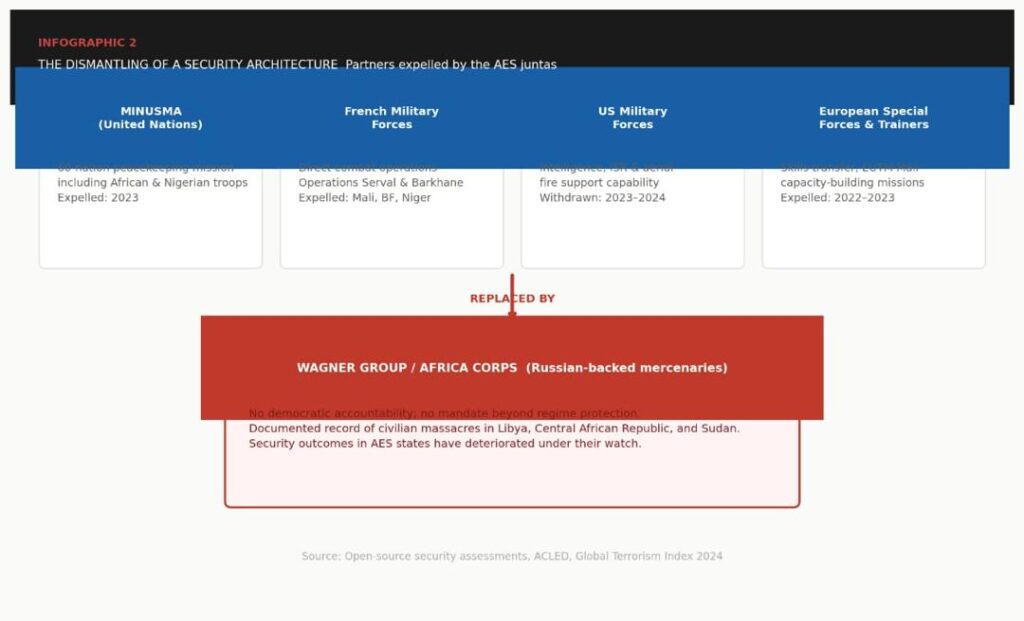
One of the most consequential failures of the AES project lies in the belief that a deeply complex, transnational security crisis could be defeated through isolation, militarised nationalism, and anti-Western rhetoric. The junta did not merely fail to improve on their predecessors; they dismantled the cooperative security architecture painstakingly constructed over the years to contain extremist expansion.
MINUSMA, the United Nations stabilisation mission in Mali, incorporated contributions from dozens of countries, including African and Nigerian contingents; it was expelled in 2023. French military operations were terminated. American intelligence and aerial support structures were withdrawn.
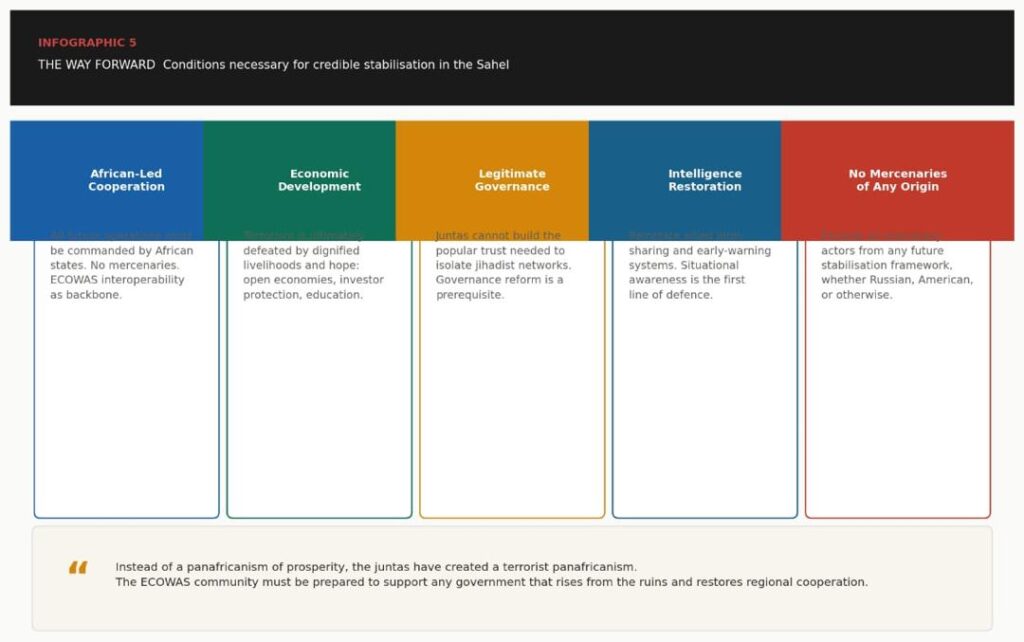
European special forces and training missions ended. In their place came the Wagner Group, later rebranded as Africa Corps: a mercenary network with no democratic accountability, no long-term development agenda, and an established record of civilian abuses stretching from Libya to the Central African Republic and Sudan.
The fall of Kidal crystallised the contradiction with brutal clarity. Celebrated in 2023 as proof that expelling Western forces and embracing Moscow was an act of strategic genius, Kidal instead became a monument to strategic illusion: Africa Corps personnel reportedly negotiated their own withdrawal, while Malian troops were left isolated and exposed.
The city, once paraded as evidence of restored sovereignty, became evidence of betrayed sovereignty. Years of carefully constructed propaganda collapsed in a single moment of contact with the battlefield.
Yet the failure runs deeper than military reversals. Terrorism has never been solely a military problem. It thrives where governance collapses, economies deteriorate, institutions weaken, and citizens lose hope. Poverty, unemployment, corruption, weak border control, and absent public services remain the central drivers of extremist recruitment across the Sahel. On every one of these fronts, the juntas have failed to deliver any measurable improvement. Pp
Economic uncertainty has deepened. Investor confidence has evaporated. Media freedoms have been extinguished. Civil society increasingly operates under direct pressure. Democratic institutions, already fragile, have been fully subordinated to barracks authority. Regimes that promised the discipline and efficiency of emergency governance have instead exposed, with painful consistency, that soldiers without governing experience do not know how to govern.
Moreso, there is a profound irony in the junta’s claim to Pan-Africanism. The doctrine, as conceived by its founding thinkers, was rooted in solidarity, integration, and shared prosperity; not a licence for paranoid nationalism that severs ties with African neighbours, rejects regional cooperation, and sustains itself through information control and manufactured grievance. One can hold an audience captive on anger and resentment for a time. People ultimately require food, security, healthcare, and a future. Slogans, as the map makes plain, do not fill granaries or secure borders.
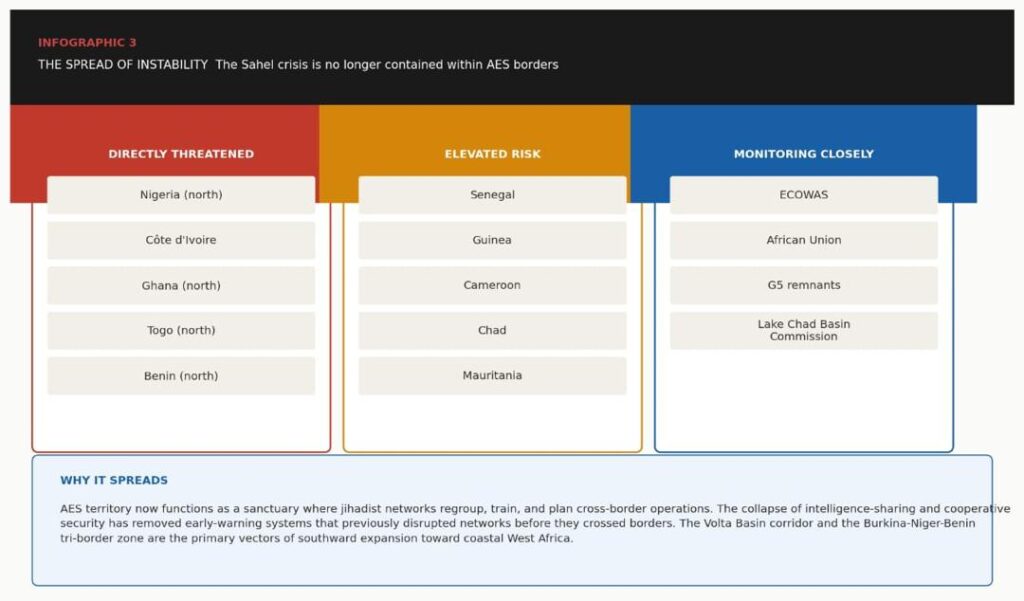
The consequences of this failure have long since ceased to respect national boundaries. The Sahel is now a sanctuary in which jihadist organisations regroup, recruit, train, and plan operations far beyond the AES perimeter. Benin, Togo, Ghana, and Côte d’Ivoire face mounting pressure along their northern frontiers. Nigeria, already confronting multiple security emergencies, faces heightened risks from arms trafficking, militant mobility, and cross-border radicalisation flowing freely across porous boundaries.
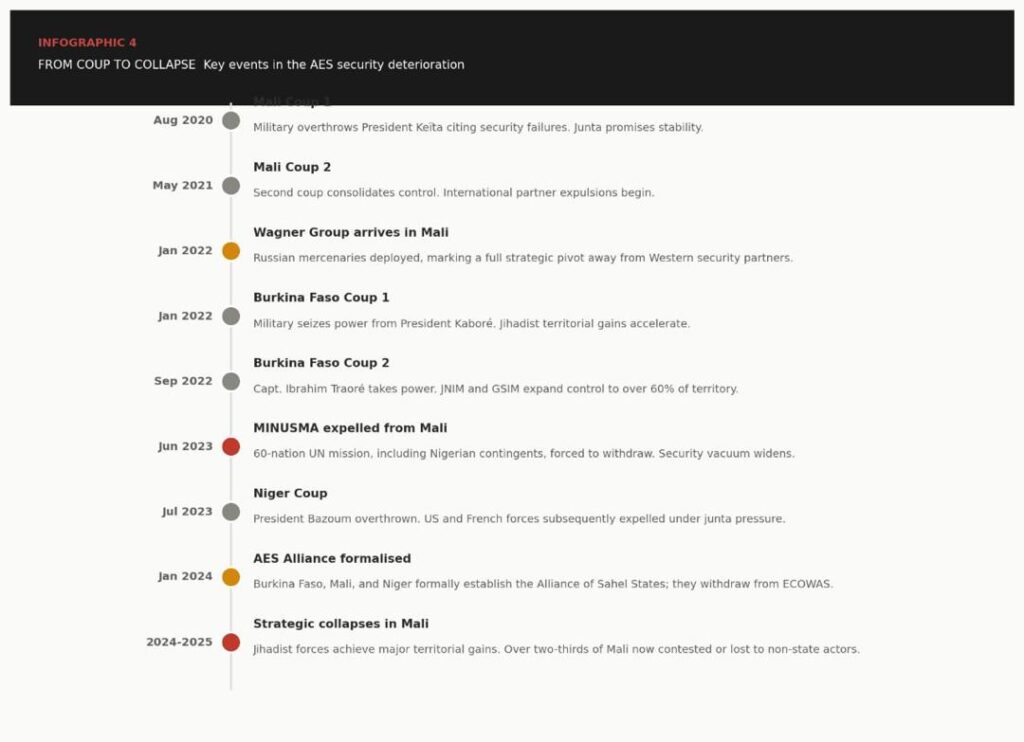
What was once dismissed as alarmist conjecture, the emergence of a contiguous Islamist corridor across the Sahel, is now discussed by serious analysts not as a remote possibility but as a live and advancing threat. Instead of a Pan-Africanism of prosperity, the juntas have produced what must plainly be called a terrorist Pan-Africanism: a transnational network of instability exported to an entire neighbourhood.
None of this means previous international interventions were without fault; they were not. France, ECOWAS, the United Nations, and Western partners made consequential errors, and many Africans held entirely legitimate grievances about the terms of external engagement.
But replacing imperfect cooperation with strategic isolation and mercenary dependence has produced demonstrably worse outcomes for the very populations those juntas claimed to liberate. That is not an argument for foreign dominance; it is an argument for African-led, accountable, and genuinely cooperative security of the kind that authentic Pan-Africanism has always demanded.
ECOWAS and the international community cannot afford to wait for this trajectory to run its course. The immediate priorities are clear: reinforce the security capacity of coastal states, restore regional intelligence-sharing frameworks, and develop credible contingency plans for scenarios that are no longer theoretical.
The longer-term priority is equally plain: support any government that emerges from the ruins of these juntas with the legitimacy, institutional capacity, and regional relationships needed to rebuild. That support must be conditioned on African leadership, civilian accountability, and the categorical exclusion of mercenaries, of every nationality and flag, from any future stabilisation architecture in West Africa.
Sovereignty is not measured by the vehemence of anti-Western slogans, the spectacle of military parades, or the confidence of televised communiques. It is measured by whether a state can protect its citizens, secure its territory, and offer its people a future worth believing in. The security map of the Sahel in May 2026 delivers that verdict with clarity and honesty that no junta broadcast has matched.
The question now is whether this region’s leaders and the broader African community are finally prepared to read it honestly and act accordingly, before the cost of continued inaction becomes truly irreversible.
Oumarou Sanou is a social critic and researcher specialising in governance, security, and political transitions in the Sahel. He writes on geopolitics, regional stability, and African leadership dynamics.
Contact: sanououmarou386@gmail.com
The Map Does Not Lie: How AES Failed the Sahel Five years of military rule in Burkina Faso, Mali, and Niger have produced not sovereignty but collapse. No propaganda can survive the evidence of the May 2026 security map



Twelve years on: A tribute to Braimoh, Hedima and other fallen heroes
By Edward Gabkwet
The month of September 2026 marks 12 years since two Nigerian Air Force (NAF) pilots took to the skies on a mission from which one would never return, while the other would disappear into the uncertainty of war.
Group Captain Abdulrasheed Bamidele Braimoh and Wing Commander Chimda Hedima were flying an Alpha Jet aircraft, NAF 466, on a combat mission against Boko Haram terrorists in the Northeast when their aircraft went down near Kauri in Konduga Local Government Area of Borno State on September 12, 2014.
Hedima was subsequently captured and killed by the terrorists, while Braimoh has since been declared killed in action, in line with the provisions of the Armed Forces of Nigeria.

Twelve years later, their story deserves more than a passing mention. It deserves to be remembered. More importantly, it should compel us to confront an uncomfortable question: How much do Nigerians truly appreciate the men and women who stand between the nation and those who seek to destroy it?
Many would agree that we have become too accustomed to casualty figures involving soldiers killed or maimed, aircraft lost or another funeral taking place. This is a sad reality that risks making tragedies appear ordinary.
But it must not be so.
Behind every military or para-military casualty is the story of a child who will grow up without a parent, parents who will bury their sons or daughters, spouses who suddenly become widows or widowers, and comrades who must return to the battlefield knowing that the colleague who stood beside them yesterday will not be there tomorrow.
Oftentimes, Nigerians criticise military operations, especially when there are setbacks. Such criticism is understandable, particularly in a democratic society like ours. However, in the intensity of these arguments, we sometimes forget the men and women at the centre of these operations.
The pilot who straps himself into a combat aircraft does not know with certainty whether the mission will end with a safe landing. In the same way, the soldier or sailor who moves into a forward position cannot be certain that he or she will return home to family.
Yet, they proceed.
They serve with honour and courage, accepting the enormous burden and consequences that come with their duty. The willingness to place one’s life in danger for the survival and security of others is one of the noblest obligations a citizen can undertake.
Braimoh and Hedima did precisely that on September 12, 2014.
Nigeria’s counterterrorism and counterinsurgency efforts have produced heroes whose names are well known, as well as many others whose sacrifices have barely entered the national consciousness.
Some died in heroic battles, while others paid the supreme price in ambushes, improvised explosive device attacks or assaults on isolated outposts, with their stories receiving little national attention.
Neglecting the legacies of such heroes who paid the supreme price strikes at the heart of a nation’s sense of responsibility. A nation that ignores its fallen heroes risks losing its sense of national obligation, and the consequences of such neglect can extend far beyond the immediate grief of their families.
Honouring our heroes must therefore go beyond ceremonies associated with the annual Armed Forces Remembrance Day or occasions when their coffins are draped in the national flag.
There should be a permanent and accessible national record of Nigeria’s fallen military personnel. Their names, photographs and stories should be preserved. Their families should be recognised, and their sacrifices should form part of our national history.
Perhaps most importantly, young Nigerians should be taught that citizenship is not only about what one receives from the nation, but also about what some citizens have sacrificed for its survival.
As we evoke the memories of Group Captain Abdulrasheed Bamidele Braimoh and Wing Commander Chimda Hedima, we should also remember the many other Nigerian military and para-military personnel who have made the ultimate sacrifice.
Twelve years after NAF 466 disappeared from the skies over the Northeast, the memories of Braimoh, Hedima and many others should remind us that the fight against terrorism has never been merely about recovering lost territory or counting casualties.
It has always been about those who leave home in uniform, venture into dangerous environments so that others can remain safe, and sometimes do not return.
Today, let us pause and remember the pilots, soldiers, airmen, sailors and para-military personnel who sacrificed their lives for our safety. Let us also remember their families, who continue to live with their absence.
And let us remember that behind every military casualty is a Nigerian life given in the service of our nation.
May we never become so accustomed to the sacrifices of our Armed Forces and other security agencies that we cease to be moved by them.
May we never forget Braimoh, Hedima and the many others who went before and after them.
And may Nigeria always remain worthy of the sacrifices made in her defence.
Gabkwet, an Air Vice Marshal, writes from Abuja.
Twelve years on: A tribute to Braimoh, Hedima and other fallen heroes
Feature
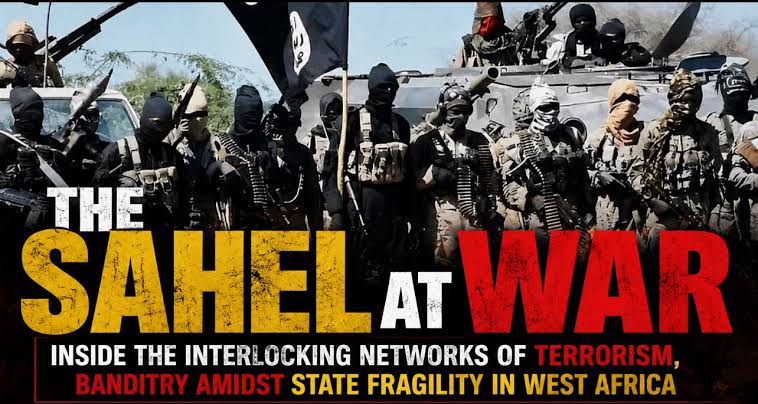
The Sahel at War: Inside the Interlocking Networks of Terrorism, Banditry Amidst State Fragility in West Africa
The Sahel at War: Inside the Interlocking Networks of Terrorism, Banditry Amidst State Fragility in West Africa
By Zagazola Makama
West Africa and the Central Sahel are no longer confronting isolated insurgencies. They are confronting the emergence of an integrated conflict ecosystem stretching from the shores of Lake Chad through the Sahelian heartland to the northern fringes of the Gulf of Guinea. The violence that once appeared compartmentalized Boko Haram in northeastern Nigeria, jihadists in northern Mali, criminal bandits in Zamfara, or communal clashes between farmers and pastoralists has evolved into a mutually reinforcing network of terrorism, organized crime, illicit finance, governance failure, and regional geopolitical competition.
Today’s conflict cannot be understood just by counting attacks or measuring how much land militants control. The real fight is happening in areas where the government is absent, where illegal businesses replace official systems, and where extremist groups are stepping in to provide security, justice, taxes, and economic opportunities more effectively than the state.
This evolution has transformed the security crisis from a collection of national emergencies into one of Africa’s most consequential strategic challenges.
The current conflict is driven by three distinct but increasingly interconnected actors: violent extremist organizations, criminal syndicates, and state or quasi-state military actors.
Each operates differently. Yet each increasingly influences the operational environment of the others.
The Jihadist Expansion
Among violent extremist organizations, Jama’at Nusrat al-Islam wal-Muslimin (JNIM) has emerged as arguably the most adaptive insurgent movement in the region. Unlike earlier extremist organizations whose campaigns depended primarily upon spectacular terrorist attacks, JNIM has steadily shifted toward governance-oriented insurgency. It exploits local grievances, negotiates with communities, arbitrates disputes, regulates commerce, and selectively employs violence to consolidate influence. Its operational success derives less from superior firepower than from political agility.
Where governments disappear, JNIM frequently arrives with its own version of administration.
This explains its steady expansion beyond Mali into Burkina Faso, Niger and increasingly toward the northern territories of Benin, Togo and, potentially, Ghana. Rather than conquering cities, JNIM captures strategic corridors transport routes, border crossings, grazing areas and commercial networks that gradually reshape political authority. Its principal competitor, the Islamic State Sahel Province (ISSP), formerly known as ISGS, pursues a markedly different strategy.
ISSP emphasizes uncompromising violence.
Its campaigns frequently involve mass killings, collective punishment and deliberate intimidation designed to destroy resistance rather than cultivate legitimacy. Competition between JNIM and ISSP has itself become one of the defining characteristics of Sahelian instability, with both organizations fighting each other almost as frequently as they confront state forces.
Meanwhile, farther east, the Lake Chad Basin remains dominated by the Islamic State West Africa Province (ISWAP) and the residual Boko Haram faction known as Jama’atu Ahlis Sunna Lidda’awati wal-Jihad (JAS). Unlike the fluid insurgencies of the western Sahel, ISWAP has developed an increasingly sophisticated quasi-state structure. Its taxation systems, logistical networks, intelligence apparatus and shadow governance enable it to maintain influence despite years of sustained military pressure by regional forces.
Criminality Without Ideology
Running parallel to the jihadist insurgencies is another formidable threat: organized armed banditry. Northwestern and North-central Nigeria have become the epicentre of highly militarized criminal networks whose objectives are economic rather than ideological.
These groups increasingly possess military-grade capabilities. Rocket-propelled grenades, anti-aircraft weapons mounted on technical vehicles, heavy machine guns and sophisticated communications equipment have transformed what once resembled rural criminal gangs into mobile armed organizations capable of overwhelming isolated security positions.
Kidnapping has evolved into an industrial enterprise. Unlike earlier phases of criminal abduction that focused primarily on expatriates or wealthy elites, today’s bandits conduct mass kidnappings involving schoolchildren, farming communities, religious institutions and entire villages. Ransom payments generate enormous revenue. That revenue fuels arms purchases, recruitment, logistics and territorial expansion.
Banditry has therefore become not merely a criminal phenomenon but a strategic destabilizing force with regional implications.
The greatest danger confronting West Africa lies not in any single organization but in the growing convergence between extremist violence and organized criminality. The relationship is best understood as a marketplace rather than an alliance. Bandits generate money. Extremists generate military expertise. Both benefit.
JNIM, for example, has increasingly exchanged tactical instruction, weapons handling and operational knowledge for logistical access, intelligence and freedom of movement provided by criminal groups. This arrangement does not require ideological alignment. It requires only mutual benefit. The distinction between terrorist financing and organized crime has therefore become progressively blurred. Weapons purchased with ransom proceeds frequently circulate across multiple armed actors. Traffickers move guns, ammunition, fuel, narcotics and gold using identical smuggling routes. The same criminal infrastructure serves jihadists, bandits and transnational organized crime simultaneously. The result is a conflict economy capable of sustaining violence indefinitely.
The Fulani Question: Identity, Marginalization and Manipulation
Perhaps no issue within the regional security debate has generated more misunderstanding than the relationship between Fulani pastoralists and armed violence. Reducing the crisis to ethnicity obscures its deeper structural foundations. The overwhelming majority of Fulani communities remain peaceful pastoralists. Yet prolonged environmental degradation, climate change, shrinking grazing corridors, cattle rustling, weak governance and chronic insecurity have created conditions under which segments of marginalized pastoral youth became progressively militarized. What began in many areas as localized self-defence groups gradually transformed into organized criminal formations.This evolution did not occur in isolation. It emerged within environments where state institutions failed to provide security, resolve disputes or regulate access to land and water. As farmer-herder conflicts intensified, collective punishment frequently replaced targeted law enforcement. Communities perceived to share ethnic identity with criminal actors increasingly became targets themselves.
It is within this environment that JNIM has demonstrated remarkable strategic sophistication. Rather than recruiting primarily through ideology, it recruits through protection.
When communities believe they are abandoned or worse, indiscriminately targeted extremist organizations present themselves as defenders.
Protection gradually becomes allegiance. Allegiance becomes recruitment. Recruitment becomes insurgency. The conflict therefore evolves from a dispute over grazing land into participation in transnational jihad. This cycle represents one of the most significant strategic challenges confronting governments throughout the Sahel. Military victories alone cannot dismantle recruitment systems built upon unresolved grievances.
Gold: The Conflict’s Hidden Currency
If kidnapping finances today’s bandits, artisanal gold increasingly finances tomorrow’s insurgencies. The discovery and rapid expansion of informal gold mining across Mali, Burkina Faso, Niger and parts of Nigeria fundamentally altered the economics of regional conflict. Extremist organizations rarely conduct mining themselves. Instead, they regulate it.
By controlling access to remote mining sites, imposing taxes on miners, charging transit fees and monopolizing protection, armed groups have established remarkably resilient revenue streams. Gold possesses advantages that narcotics and conventional financial transfers do not. It is anonymous. It is portable. It is difficult to trace. It retains value internationally.
Smuggled through regional trading hubs and international markets, illicit gold enters legitimate global supply chains with relative ease. Revenue subsequently returns to conflict zones as cash, fuel, vehicles and weapons.
Mining camps simultaneously function as recruitment centres, logistics hubs and operational sanctuaries. As long as these informal economies remain outside effective government regulation, they will continue to finance insurgency irrespective of battlefield outcomes.
A Fragmented Security Architecture
The security landscape has become further complicated by changing regional alliances.
The emergence of the Alliance of Sahel States (AES) comprising Mali, Burkina Faso and Niger has fundamentally altered West Africa’s collective security framework. The withdrawal of these states from ECOWAS and their shift toward closer security cooperation with Russian military elements have introduced new political realities into regional counterterrorism efforts.
Although the AES governments emphasize sovereign security strategies and aggressive military operations, political fragmentation has simultaneously weakened regional intelligence coordination. This fragmentation creates opportunities for extremist organizations.
Terrorist groups do not recognize political disagreements between governments. They exploit them. The absence of seamless intelligence sharing across borders enables armed groups to attack in one jurisdiction before relocating into another beyond immediate pursuit. No counterterrorism campaign can succeed while terrorists enjoy greater operational mobility than the states pursuing them.
Why Military Success Alone Is Not Enough
Military operations remain indispensable.
No government can negotiate away organizations committed to systematic violence against civilians. Yet experience across the Sahel demonstrates that battlefield victories alone rarely produce durable stability.
Territory may be retaken. Governance often is not. Where governments fail to restore justice, education, healthcare, infrastructure, markets and policing, insurgents frequently return. The vacuum persists. Only the actors occupying it change. Counterterrorism therefore requires simultaneous security, governance and economic interventions. Without this integration, tactical victories risk becoming temporary interruptions rather than strategic success.
Building an Integrated Regional Response
A sustainable security strategy requires far more than increased troop deployments. First, regional intelligence cooperation must be restored regardless of political disagreements.
Functional information-sharing mechanisms between the AES, ECOWAS and Lake Chad Basin states remain essential if cross-border insurgent mobility is to be disrupted. Second, governments must formalize the artisanal mining economy. Licensing miners, establishing transparent state purchasing systems and regulating mineral exports would significantly reduce extremist access to illicit gold revenues.
Third, pastoralist integration must become a security priority rather than solely an agricultural issue. Protected grazing corridors, modern livestock infrastructure, impartial dispute-resolution mechanisms and equal legal protection for farmers and herders are not simply development initiatives they are counterterrorism measures. Finally, security institutions must prioritize precision over collective punishment. Every indiscriminate operation risks creating tomorrow’s recruits.
Every community protected strengthens the legitimacy of the state. Counterinsurgency succeeds not when insurgents fear the government, but when civilians trust it more than they trust armed groups.
Conclusion: Winning the Governance War
The future of West Africa’s security will not be determined solely on battlefields. It will be determined in villages where governments either return or fail to return. The central contest is no longer simply between states and terrorists.
It is between competing systems of governance.
Violent extremist organizations understand this reality. Their objective is not merely to kill soldiers but to replace governments. Military operations can destroy camps. They cannot, by themselves, replace institutions. The challenge confronting West Africa and the Central Sahel is therefore not only defeating insurgencies, dismantling criminal economies or securing borders. It is rebuilding the legitimacy of the state itself. Until governance fills the vacuum now occupied by violence, instability will continue to migrate across borders, adapt to new pressures and regenerate in new forms.
The battle for the Sahel is ultimately a battle over political authority, economic opportunity and public trust. Whoever succeeds in providing those three elements will shape the future security architecture of West Africa for decades to come.
Zagazola Makama is a Counter Insurgency Expert and Security Analyst in the Lake Chad Region
The Sahel at War: Inside the Interlocking Networks of Terrorism, Banditry Amidst State Fragility in West Africa
The Blood We Have Normalised
By U.K. Umar
It happens in many parts of Nigeria, particularly across the North-West and North-Central, but I write this from the perspective of someone who has spent considerable time on the frontlines in Plateau and Benue States. I have walked through communities still smelling of burnt homes. I have spoken with soldiers who had barely returned from operations before heading out again. I have sat with grieving families whose only crime was waking up on the wrong side of an endless cycle of violence. The stories differ only in names and locations. The pain is identical.
Almost every week, another community buries its dead. Men, women and children are killed in attacks and reprisal attacks, many hacked to death in ways that defy human conscience. Yet the official response has become painfully predictable. Government condemns the killings. Officials promise that perpetrators will be brought to justice. Security agencies launch investigations. Then everyone waits until the next massacre. We have repeated this script for years while the cemeteries continue to expand.
What worries me even more is that much of the country seems to have adjusted to this reality. It is as though the killings in Plateau, Benue, Zamfara, Katsina, Sokoto or parts of Kebbi have become distant headlines rather than a national emergency. But all is not well with Nigeria. Not even close. A nation that becomes comfortable with burying dozens of its citizens every other week is a nation slowly losing its collective humanity.
In the past few weeks alone, we have witnessed renewed violence around the National Institute for Policy and Strategic Studies (NIPSS) in Kuru, Plateau State. Security forces have had to repel repeated attacks targeting one of the country’s foremost strategic institutions. Before that came attacks around Vom, deadly assaults on security personnel, and fresh recoveries of military weapons stolen from fallen soldiers. Across the border in Benue State, communities continue to count their dead after successive attacks, with entire settlements displaced and livelihoods destroyed. These are not isolated incidents. They are symptoms of a much deeper crisis.
Having recently visited military formations in both Plateau and Benue States, one truth became impossible to ignore. The Nigerian Armed Forces are carrying a burden that no military alone can solve. I met exhausted officers and soldiers who spend weeks away from their families, operating under difficult terrain and enormous psychological pressure. Many have paid the ultimate price. Others continue to fight despite losing colleagues in brutal ambushes. Their sacrifices deserve recognition, not constant vilification.
But another truth also confronted me.
In community after community, I found fear. I found anger. I found suspicion. Most painfully, I found a hatred that has become deeply entrenched between many indigenous farming communities and Fulani pastoralists. It is a hatred born from years of killings, displacement, cattle rustling, destruction of farms, revenge attacks and mutual distrust. Both sides have suffered losses that cannot simply be measured in statistics. Every family seems to have a story of someone murdered, displaced or permanently scarred.
That reality makes peace infinitely harder.
When grief is inherited from one generation to another, revenge begins to masquerade as justice. Every fresh attack becomes justification for another reprisal. Every funeral plants the seeds for another burial.
This is why simplistic narratives do not help.
Reducing the crisis to farmers versus herders, Christians versus Muslims, or indigenes versus settlers ignores the complex web of criminality, historical grievances and political failures that sustain the violence. Criminals exploit genuine community fears. Communities, in turn, increasingly shield criminals whom they perceive as protectors of their own people.
Perhaps one of my biggest observations from these visits is the alarming proliferation of arms in civilian hands. There are simply too many sophisticated weapons circulating among non-state actors. These weapons are not manufactured in villages. They arrive through organised trafficking networks and remain hidden within communities.
Unfortunately, many community members know who possesses these arms. They know who participates in attacks. They know who provides logistics and intelligence. Yet they remain silent, often out of fear, ethnic loyalty or expectation of future retaliation. That silence has become one of the greatest obstacles confronting security agencies.
No intelligence operation can succeed where communities refuse to cooperate.
Equally disturbing is the conduct of some political and community leaders whose public utterances sometimes amount to subtle calls to arms. In moments that demand restraint, they choose inflammatory rhetoric. They cast security forces as enemies rather than partners. They reinforce ethnic victimhood while carefully avoiding any condemnation of criminals operating within their own constituencies.
Words matter.
Every careless speech delivered from a podium has consequences in villages where emotions already run dangerously high. Every attempt to delegitimise the military without evidence weakens public confidence and emboldens armed groups.
This is not to suggest that the Armed Forces are infallible. Like every human institution, mistakes occur. Allegations of misconduct should always be investigated transparently and professionally. But there is an important distinction between demanding accountability and deliberately undermining the very institution standing between communities and complete anarchy.
The military can only do so much.
The larger solution sits on the tables of elected leaders—from the President to state governors and local government authorities. They alone possess the constitutional powers to drive coordinated political, economic and social interventions capable of addressing the roots of these conflicts.
Security operations must continue with greater intelligence support and improved inter-agency coordination. But security alone cannot heal communities where trust has collapsed.
Justice must be impartial.
Compensation must not depend on ethnicity.
Prosecution must not depend on political convenience.
Victims deserve equal recognition regardless of whether they are farmers or herders, Christians or Muslims, indigenes or settlers.
Government must reward those who choose peace and punish those who profit from violence without fear or favour. Anything less simply reinforces the perception that violence works.
The country also needs an aggressive programme for arms recovery, community reconciliation, youth engagement and economic revitalisation in the affected areas. Entire generations are growing up knowing nothing except conflict. That should frighten every Nigerian.
Nigeria cannot continue to normalise mass burials.
We cannot continue issuing statements while villages disappear.
We cannot continue allowing children to inherit hatred as though it were family property.
The bloodshed in Plateau and Benue is not just their tragedy. It is Nigeria’s tragedy.
History will not judge us by the number of condolence messages we issued. It will judge us by whether we found the courage to stop the killing while there was still a country united enough to save.
The Blood We Have Normalised

81st UNGA: Nigeria Will Be Guided By National Interest, Multilateralism, Tinubu’s Reform Agenda – VP Shettima

Abuja Turns into West Africa’s Deal Room as 60 Startups Chase $65,000 and $5m Jackpot

The growing role of local militias, criminal networks and possible external forces in the escalation of violence in Plateau State

Roger Federer’s Shock as DNA Results Reveal Myla and Charlene Are Not His Biological Children

THE PLIGHT OF FARIDA

FAILED COUP IN BURKINA FASO: HOW TRAORÉ NARROWLY ESCAPED ASSASSINATION PLOT AMID FOREIGN INTERFERENCE CLAIMS
-
 News3 years ago
Roger Federer’s Shock as DNA Results Reveal Myla and Charlene Are Not His Biological Children
-
Opinions5 years ago
THE PLIGHT OF FARIDA
-
 News1 year ago
FAILED COUP IN BURKINA FASO: HOW TRAORÉ NARROWLY ESCAPED ASSASSINATION PLOT AMID FOREIGN INTERFERENCE CLAIMS
-

 News3 years ago
EYN: Rev. Billi, Distortion of History, and The Living Tamarind Tree
-
 Opinions5 years ago
POLICE CHARGE ROOMS, A MINTING PRESS
-

 ACADEMICS3 years ago
A History of Biu” (2015) and The Lingering Bura-Pabir Question (1)
-

 Columns3 years ago
Army University Biu: There is certain interest, but certainly not from Borno.
-

 Politics1 year ago
2027: Why Hon. Midala Balami Must Go, as Youths in Hawul and Asikira/Uba Federal Constituency Reject ₦500,000 as Sallah Gift
