
News
The People’s Choice: Olumide Akpata Surges Ahead, Leaving PDP in the Dust as Edo Election Heats Up


The People’s Choice: Olumide Akpata Surges Ahead, Leaving PDP in the Dust as Edo Election Heats Up
By Oshiobugie John
In an astonishing turn of events, Olumide Akpata has emerged as a formidable force in the Edo State political landscape. With his people-centric approach and grassroots acceptability, Akpata has managed to secure a significant number of electorates from Edo South and is making impressive inroads into Edo North and Central. His candidacy, which initially faced considerable skepticism, has gained unstoppable momentum, causing palpable anxiety within the ranks of the People’s Democratic Party (PDP).
Olumide Akpata’s rise to prominence is no accident. His deep connection with the people and commitment to addressing their concerns have endeared him to voters across the state. From urban centers to rural communities, Akpata’s campaign has been characterized by direct engagement and genuine dialogue with the electorate. This approach has not only won him admiration but also a loyal following that is rapidly expanding.
Edo South, traditionally a crucial battleground in state elections, has seen a significant shift in favor of Akpata. His ability to resonate with the everyday struggles of the people and provide tangible solutions has translated into substantial support. But Akpata’s appeal is not confined to the South. His strategic outreach to Edo North and Central has been equally effective, securing bloc support and further solidifying his position.
When Akpata first announced his candidacy, many viewed it as a long shot. The established political machinery of the PDP seemed insurmountable. However, Akpata’s relentless campaign, marked by transparency and sincerity, has turned the tide. His rise has been nothing short of meteoric, spreading like wildfire across the state. The initial doubts surrounding his candidacy have dissipated, replaced by a groundswell of support that is reshaping the political dynamics of Edo State.
The dramatic rise of Olumide Akpata has not gone unnoticed by the PDP. The party, which once considered itself unchallenged, is now facing a formidable opponent. Akpata’s popularity and the widespread acceptance of his vision have rattled the PDP, leading to a series of desperate attacks aimed at undermining his credibility.
The party’s attempts to discredit him are a clear indication of their fear. The PDP’s anxiety is rooted in Akpata’s ability to connect with the electorate in ways they have failed to do. His surging popularity is seen as a direct threat to their political dominance, and their aggressive tactics reflect their desperation to retain power.
As the election approaches, Olumide Akpata’s campaign continues to gain traction. His vision for a better Edo State, coupled with his unwavering dedication to the people’s welfare, has set him apart from his rivals. With every passing day, his support base grows stronger, making it increasingly likely that he could uproot the PDP from the government house.
In conclusion, Olumide Akpata’s surge in popularity is a testament to the power of a people-centric approach and genuine grassroots engagement. Despite the odds and the relentless attacks from the PDP, Akpata’s candidacy is flourishing. As the momentum builds, it is clear that the people of Edo State are rallying behind a new leader who promises to bring about meaningful change. The People’s Choice, indeed, appears poised to redefine the political landscape of Edo State.
The People’s Choice: Olumide Akpata Surges Ahead, Leaving PDP in the Dust as Edo Election Heats Up



Two fulani herders arrested after attack on farmers in Plateau
By: Zagazola Makama
Troops of Sector 8, Operation Enduring Peace (OPEP), deployed at Sabon Layi under Operation Hard Knock, have arrested two suspected herders following an alleged attack on residents harvesting crops in Sabon Layi village, Mangu Local Government Area of Plateau State.
According to sources, the incident occurred at about 1:30 p.m. on Monday, Aug. 24, 2026, when the troops responded to a distress call over an attack allegedly carried out by Fulani herders.
The sources said that upon arrival at the location, the troops found an elderly woman with injuries sustained during the incident.
The troops arrested two suspected herders, while other members of the group reportedly fled the area.
The injured woman was evacuated to the Missionary Hospital in Sabon Layi for medical attention.
The suspects were subsequently handed over to the Keystone Mangu Divisional Police Command for further investigation and necessary legal action.
Security forces are continuing efforts to maintain peace and prevent further escalation in the area.
Two fulani herders arrested after attack on farmers in Plateau
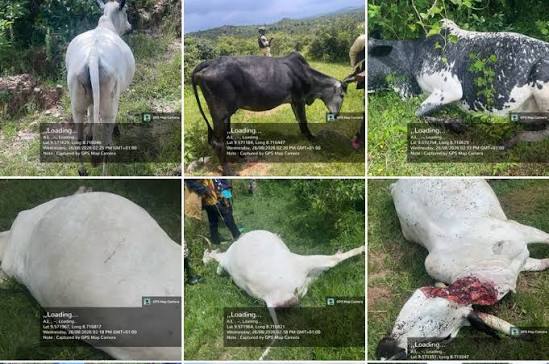
Berom militia allegedly kill 21 cows in targeted attack in Riyom, Plateau
By: Zagazola Makama
Twenty-one cows belonging to a herder have allegedly been killed by suspected Berom militia in targeted attack in Riyom Local Government Area of Plateau State.
The incident reportedly occurred at about 1 p.m. on Wednesday, Aug. 26, 2026, in the Bangai area of Riyom.
The livestock were said to belong to Alhaji Jeji Abdullahi, a resident of Bangai Village.
Sources said the animals were allegedly killed by armed men identified as Berom militia from Torok Village.
The incident has raised fresh concerns over the safety of pastoralists and their livestock in parts of Riyom, amid recurring tensions between farming and herding communities.
The development is also likely to heighten concerns over the destruction of livelihoods and the potential for retaliatory attacks if not promptly addressed by security authorities.
Security agencies are expected to investigate the incident, identify those responsible and take appropriate legal action to prevent further escalation.
Community leaders have also been urged to encourage restraint and peaceful resolution of disputes while authorities work to establish the circumstances surrounding the killing of the livestock.
Berom militia allegedly kill 21 cows in targeted attack in Riyom, Plateau

Cuba advances home-grown cancer drug as 2C12 enters human trials
…Experimental immunotherapy modelled on PD-1 treatment to be tested in advanced melanoma patients
By: Michael Mike
Cuban scientists have reached a potentially significant milestone in the country’s long-running effort to develop home-grown cancer treatments, with an experimental drug known as 2C12 ready to enter clinical testing in patients suffering from advanced melanoma.
The candidate was developed by researchers at Cuba’s Center for Molecular Immunology (CIM) and is designed around an approach similar to that used by pembrolizumab, an established immune-checkpoint therapy used internationally against several cancers, including unresectable or metastatic melanoma.
The development is attracting attention because 2C12 is moving beyond laboratory research towards testing in human beings — the stage at which its safety, tolerability and potential therapeutic benefit must be established before any claim can be made about its effectiveness.
According to information released by the CIM and subsequently reported by Cuban and international media, the initial clinical study will target patients with advanced melanoma that cannot be removed surgically or has spread to other parts of the body. The study will involve specialist oncology centres in Havana and Villa Clara.
The participating institutions include Cuba’s National Institute of Oncology and Radiobiology and Hermanos Ameijeiras Clinical Surgical Hospital in Havana, as well as the Dr Celestino Hernández Robau Territorial University Oncology Hospital in Villa Clara.
The significance of the Cuban project extends beyond the development of another cancer medicine.
Cancer treatment has become an increasingly sophisticated but expensive field, with access to modern therapies varying sharply between countries. The World Health Organisation (WHO) said cancer caused nearly 10 million deaths worldwide in 2024, making it one of the leading causes of death globally. It also warns of major inequalities in access to cancer prevention, diagnosis and treatment between countries and income groups.
For Cuba, the challenge has an additional dimension. The country said difficulties obtaining some imported medicines, together with the high international cost of oncology products, have strengthened the case for developing domestic alternatives.
That backdrop has made biotechnology and pharmaceutical self-reliance a strategic priority for Cuban scientists.
The CIM has consequently positioned 2C12 as a potential locally produced alternative to expensive imported immunotherapy. But the scientific test is now much tougher: the molecule must demonstrate in clinical trials that it is safe and actually benefits patients.
Pembrolizumab, the drug to which 2C12 has been compared, belongs to a class of medicines known as PD-1 inhibitors.
PD-1 is a receptor involved in regulating the immune system. Tumours can exploit this pathway to suppress immune responses, effectively helping cancer cells evade attack. Blocking the PD-1 pathway can restore part of the immune system’s ability to recognise and fight malignant cells.
The US Food and Drug Administration currently lists pembrolizumab as a PD-1-blocking antibody indicated for patients with unresectable or metastatic melanoma, among other cancers.
That makes the Cuban approach scientifically significant, but the similarity does not mean 2C12 has already been shown to work as well as pembrolizumab.
The Cuban molecule remains an investigational candidate. Its performance will have to be established through properly conducted clinical research.
Melanoma develops from melanocytes, the cells responsible for producing the pigment melanin. Although melanoma accounts for only a small proportion of skin cancers, it can be particularly aggressive and can spread to distant organs when diagnosis and treatment are delayed.
The FDA described unresectable or metastatic melanoma as an aggressive disease that can be fatal and notes that modern treatment can include PD-1 immunotherapy and targeted treatment for patients whose tumours carry particular BRAF mutations.
The treatment landscape is also continuing to evolve. In August 2026, the FDA granted accelerated approval to another therapy, the genetically modified oncolytic virus vusolimogene oderparepvec, in combination with nivolumab for certain patients with advanced melanoma whose disease has progressed after PD-1-based treatment.
The developments underline the intensity of the global race to find more effective options for patients whose cancers stop responding to existing therapies.
For Cuban researchers, 2C12 could eventually represent an important achievement in pharmaceutical independence. For patients, however, the immediate significance should be viewed with measured optimism.
The drug has not been established as a cure for cancer, nor has it yet been demonstrated to be equivalent to pembrolizumab.
Researchers will need to determine how well patients tolerate the treatment, what adverse effects occur, whether the drug produces measurable tumour responses and how durable any responses may be. Larger and more rigorous studies would then be needed to establish its effectiveness and place in cancer treatment.
That distinction is crucial because promising laboratory candidates frequently fail to become successful medicines once tested in humans.
The Cuban development also carries a broader message for countries, including Nigeria, that continue to rely heavily on imported medicines and medical technologies.
Developing a cancer drug requires far more than discovering a molecule. It demands scientific expertise, biotechnology infrastructure, clinical research capacity, regulatory oversight, pharmaceutical manufacturing and sustained financing.
Nigeria has a large and growing cancer burden, while access to sophisticated oncology services remains uneven. The WHO has emphasised that major disparities persist globally in access to cancer care, particularly across countries with different levels of health-system resources.
Cuba’s 2C12 project therefore offers an example of how investment in domestic scientific capacity can potentially be translated into locally developed medical products.
For now, 2C12 is best understood as a Cuban cancer-treatment candidate entering an important clinical-testing phase — not a proven cure.
If the trials establish that it is safe, effective and capable of producing meaningful benefits for patients, the development could mark a major step in Cuba’s biotechnology programme and potentially add another weapon to the global fight against advanced cancer.
For millions of cancer patients watching the worldwide search for more affordable and effective treatments, that is a development worth following closely.

Two fulani herders arrested after attack on farmers in Plateau

Berom militia allegedly kill 21 cows in targeted attack in Riyom, Plateau

Cuba advances home-grown cancer drug as 2C12 enters human trials

Roger Federer’s Shock as DNA Results Reveal Myla and Charlene Are Not His Biological Children

THE PLIGHT OF FARIDA

FAILED COUP IN BURKINA FASO: HOW TRAORÉ NARROWLY ESCAPED ASSASSINATION PLOT AMID FOREIGN INTERFERENCE CLAIMS
-
 News2 years ago
Roger Federer’s Shock as DNA Results Reveal Myla and Charlene Are Not His Biological Children
-
Opinions5 years ago
THE PLIGHT OF FARIDA
-
 News1 year ago
FAILED COUP IN BURKINA FASO: HOW TRAORÉ NARROWLY ESCAPED ASSASSINATION PLOT AMID FOREIGN INTERFERENCE CLAIMS
-

 News2 years ago
EYN: Rev. Billi, Distortion of History, and The Living Tamarind Tree
-
 Opinions5 years ago
POLICE CHARGE ROOMS, A MINTING PRESS
-

 ACADEMICS2 years ago
A History of Biu” (2015) and The Lingering Bura-Pabir Question (1)
-

 Columns2 years ago
Army University Biu: There is certain interest, but certainly not from Borno.
-

 Politics1 year ago
2027: Why Hon. Midala Balami Must Go, as Youths in Hawul and Asikira/Uba Federal Constituency Reject ₦500,000 as Sallah Gift
