
Politics
The Persistent Political Scar on Nigeria: Fulani Ethnic Groups as the New Target of Demonization

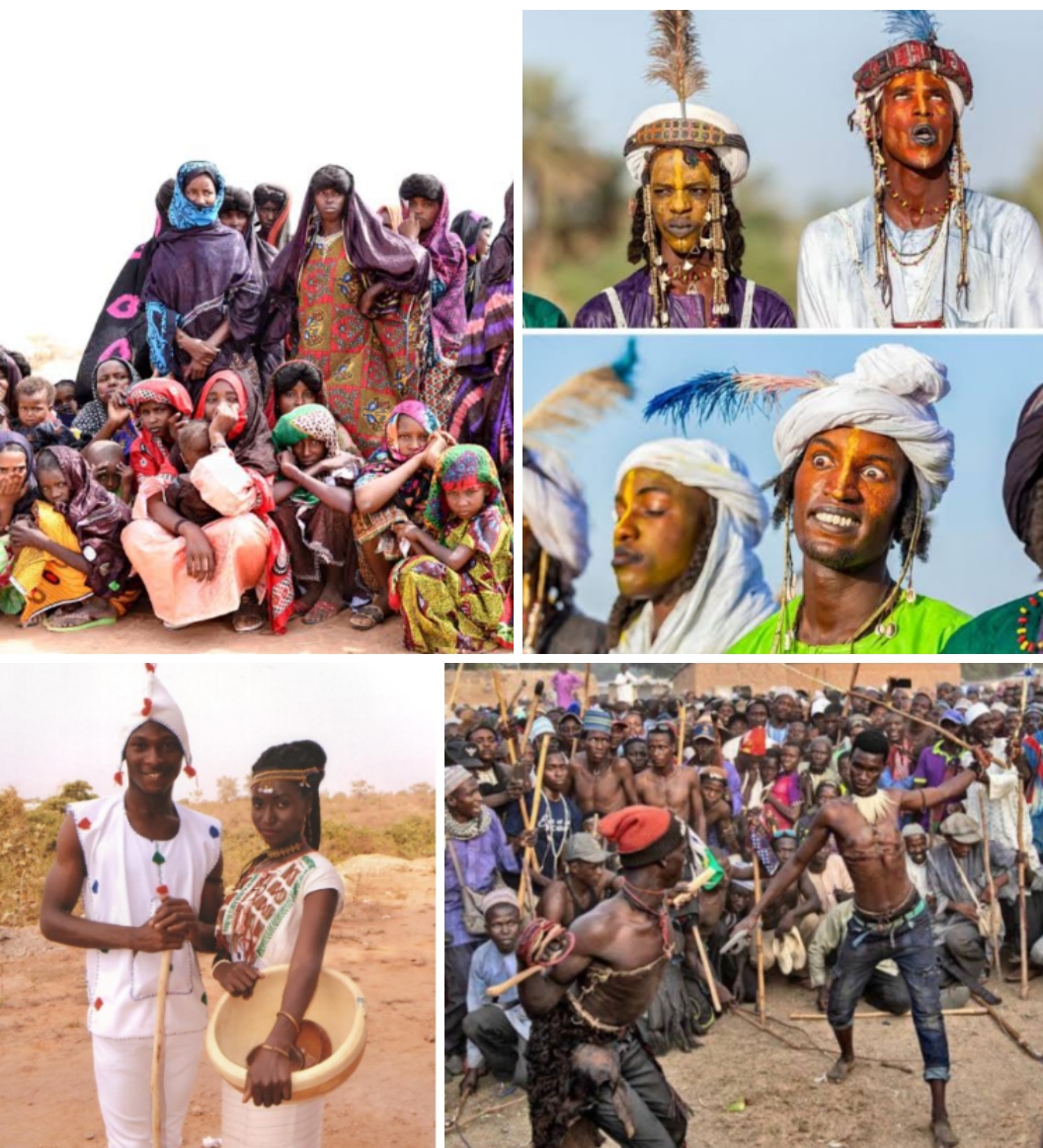
The Persistent Political Scar on Nigeria: Fulani Ethnic Groups as the New Target of Demonization
By: Dr. James Bwala
The political games and ethnic scapegoating that kicked off in the post-independence era, especially during the Nigerian civil war and its aftermath, have repeatedly chipped away at national unity. This has shown up as tribal biases, religious divides, and the recent targeting of certain ethnic groups. These ongoing issues point to a deep-rooted failure to tackle the core problems, leaving Nigeria at risk of further division and a possible return to the chaos of its past. The shift from the early targeting of the Igbo people to the current fears surrounding Fulani communities highlights a troubling trend where political figures exploit identity for their own gain, effectively “eating Nigeria in bits and pieces.”
The period starting in 1960, which led to the nation’s first military coup, set a troubling precedent for instability that has, in many ways, continued to tear the country apart. The initial excitement of independence quickly faded into the harsh realities of power struggles, ethnic distrust, and the exploitation of these divisions for political advantage. What began as a hopeful new democracy with regional rivalries soon spiraled into a cycle of military takeovers. And when those ended, even more severe forms of social fragmentation emerged.
READ ALSO: https://newsng.ng/civil-defence-the-silence-accountability-and-death-of-miners-in-niger/
From the very beginning of Nigeria’s independence, political maneuvering has been rife, marked by the scapegoating of various ethnic groups, the manipulation of religious sentiments, and the rise of new divisions. This has gradually eroded the strength of the Nigerian state, resulting in a widespread feeling of insecurity and an ongoing cycle of crises that no government seems willing to tackle. The portrayal of the Igbo as a problematic group, the heightened focus on religious divides, and the current vilification of the Fulani are not just random occurrences; they reflect a deeper, systemic political issue that threatens to tear apart the nation’s delicate unity and could even lead to a repeat of the traumatic events of the past.
In the early days of independence, Nigeria was caught in a complex web of ethnic loyalties and a fierce battle for political power. The colonial past had, to a large degree, brought together various ethnic groups into one political framework, but it also unintentionally fueled regionalism and highlighted existing differences. The political elite, primarily from the major ethnic groups—the Igbo, Yoruba, and Hausa Fulani—struggled to create a unified national identity. Instead, the emerging political parties often formed around ethnic lines, deepening regional mistrust. Unfortunately, the political conversation began to label certain ethnic groups as inherently hostile or untrustworthy. For example, the Igbo were frequently depicted in some political circles as overly ambitious, expansionist, or even treacherous, especially concerning their economic success and political clout in certain areas. While this narrative wasn’t universally accepted, it became a powerful weapon for politicians looking to rally support or undermine their opponents. This fostered an environment of suspicion and animosity, setting the stage for future conflicts.
READ ALSO: https://newsng.ng/civil-defence-the-silence-accountability-and-death-of-miners-in-niger/
The parliamentary elections and the struggle for federal power became a zero-sum game where perceived threats from other ethnic groups were amplified to secure political advantage. The rhetoric employed often demonized the “other,” reducing complex political and economic issues to ethnic conflicts. This early phase of political maneuvering, marked by the labeling of the Igbo as a problematic entity, was a critical juncture, planting the seeds of division that would germinate into more profound crises. The political elite’s failure to foster genuine national unity, opting instead for ethnic calculations, proved to be a self-inflicted wound that began to erode the foundations of the new nation.
Following the initial ethnic-driven political antagonisms, religion emerged as another potent, and arguably more intractable, fault line in Nigeria’s political landscape. While religious differences, primarily between the predominantly Christian South and the largely Muslim North, existed prior to independence, they were amplified and weaponized by political actors. The competition for political power and resource control became increasingly intertwined with religious identity. Politicians adeptly exploited religious sentiments to mobilize their constituents, often framing political opponents as threats to their religious faith. This led to the politicization of religious institutions and the demonization of adherents of different faiths. Incidents of religious intolerance and communal violence, which might have once been localized disturbances, were increasingly drawn into the broader political arena, becoming instruments of political leverage. The framing of political issues through a religious lens created a deep chasm, making cross-ethnic and cross-religious dialogue and cooperation significantly more challenging.
READ ALSO: https://newsng.ng/civil-defence-the-silence-accountability-and-death-of-miners-in-niger/
The narrative shifted from purely ethnic grievances to a perceived struggle for dominance between religious communities. This contributed to a growing sense of insecurity, particularly among minority religious groups in certain regions, and fueled a cycle of retaliatory actions. The political game, in this context, became less about policy and more about asserting religious identity and safeguarding perceived religious interests. The manipulation of religious fervor by political elites proved to be a powerful divisive force, further fracturing the nation and making it more susceptible to instability. The legacy of this period is evident in the ongoing challenges of religious extremism and sectarian violence that continue to plague Nigeria.
In recent years, the political discourse has witnessed a disturbing shift, with the Fulani ethnic group increasingly becoming the target of demonization and vilification. This contemporary phenomenon is not entirely novel, as the Fulani have, at various times, been subjects of suspicion, particularly in relation to their nomadic lifestyle and historical migrations. However, the current intensity and scope of this narrative are particularly alarming. The narrative portrays the Fulani as an invasive force, responsible for widespread insecurity, farmer-herder conflicts, and acts of banditry and terrorism across the country. While the challenges posed by farmer herder clashes and banditry are undeniably real and have devastating consequences, the tendency to generalize and attribute these issues solely to the Fulani ethnic group represents a dangerous form of collective punishment and ethnic scapegoating. This discourse often ignores the complex socio-economic factors contributing to these conflicts, such as land degradation, climate change, population growth, and the breakdown of traditional conflict resolution mechanisms.
READ ALSO: https://newsng.ng/civil-defence-the-silence-accountability-and-death-of-miners-in-niger/
Instead, it feeds into a simplistic and dangerous narrative of an ethnic group being a “virus” to be purged. This rhetoric is not only unjust but also incredibly divisive. It risks alienating a significant segment of the population, fostering resentment, and potentially fueling retaliatory actions. It distracts from the need for comprehensive and nuanced solutions to the security challenges facing the country, solutions that address the root causes of conflict rather than targeting an entire ethnic group. The political elite, by actively or passively endorsing or participating in this demonization, are once again playing a dangerous game, exacerbating existing fault lines and threatening to push the nation towards further fragmentation. This contemporary narrative mirrors past patterns of ethnic scapegoating, demonstrating a disturbing continuity in the nation’s political pathologies.
The continuous cycle of ethnic and religious demonization in Nigeria’s political arena evokes a profound sense of déjà vu, echoing the instability that characterized the decades following the first coup. The nation has witnessed periods of intense political crisis, culminating in military rule, and the subsequent return to democracy in 1999 has not eradicated these underlying issues. Instead, the period since 1999 has seen a proliferation of vices, including corruption, ethnic nationalism, and a persistent inability to address fundamental socio-economic inequalities. The predicted divisions and the potential for the “next major tribe” to fall under the weight of such political games are not mere hypotheticals but plausible outcomes if the current trajectory continues. The experiences of the 1960s, 1970s, 1980s, and 1990s, marked by coups, counter-coups, civil war, and widespread political repression, serve as stark reminders of the fragility of the Nigerian state when its unity is undermined by divisive politics.
READ ALSO: https://newsng.ng/civil-defence-the-silence-accountability-and-death-of-miners-in-niger/
The return of democracy was meant to bring about a time of accountability, inclusivity, and healing for the nation. Yet, the ongoing reliance on ethnic and religious rhetoric for political gain, along with the failure to promote fair development and address long-standing grievances, has left the country exposed and vulnerable. The current discussions around the Fulani, reminiscent of past patterns of scapegoating, hint at a troubling repetition of historical errors. If Nigeria continues down this road, it risks not only deepening existing divides but also sparking new conflicts, potentially leading to the fragmentation that many fear. The predictions of division could turn into a self-fulfilling prophecy if the political leaders don’t learn from the past and actively pursue true national unity and fair governance. The issues we’ve seen over the last 26 years are just symptoms of a deeper problem that calls for a significant change in political strategy and a dedication to building an inclusive nation.
For Nigeria to escape this crippling cycle, its leaders need to rise above ethnic and religious affiliations and truly commit to national integration, fair resource distribution, and upholding the rule of law. The current path, marked by the ongoing vilification of certain groups, threatens the very fabric of the nation’s unity and stability. The lessons from Nigeria’s tumultuous history should guide a more responsible and inclusive governance approach—one that values the common good over fleeting political interests and nurtures a sense of shared purpose among all its diverse communities. Without a significant shift in political awareness and practice, the fear of division may indeed come true, leaving behind a fractured and weakened nation.
- James Bwala, PhD, writes from Abuja
The Persistent Political Scar on Nigeria: Fulani Ethnic Groups as the New Target of Demonization


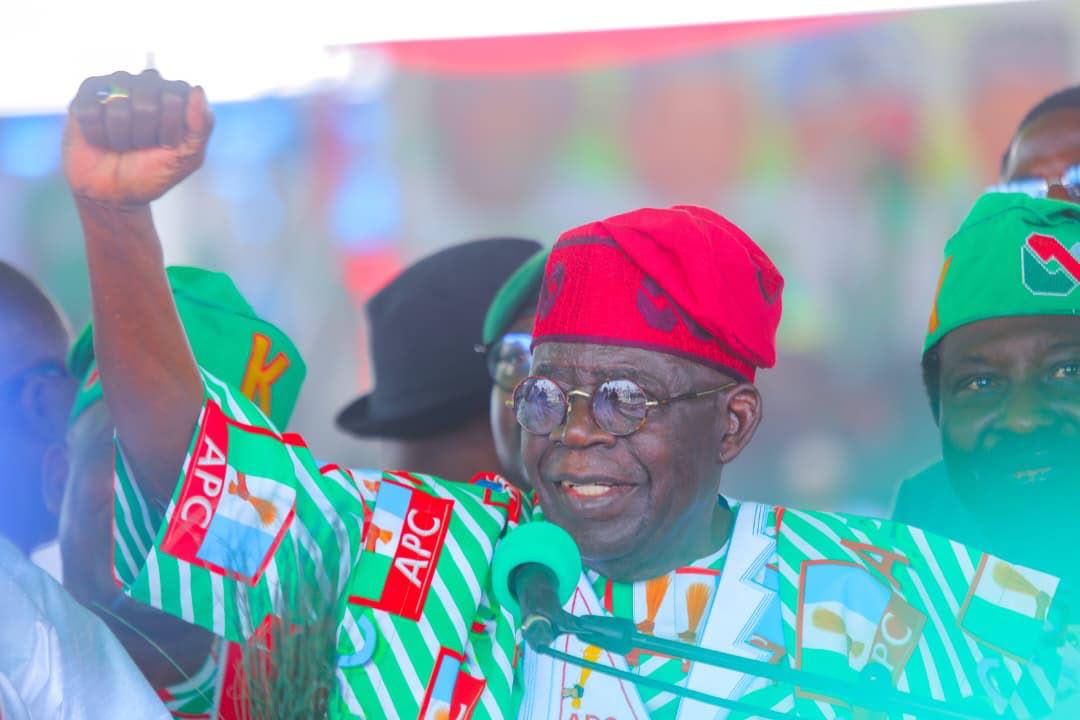
Tinubu vows to rescue abducted Askira-Uba schoolchildren, assures Borno of lasting peace
…President lauds Zulum’s restoration drive, commissions Maiduguri conference centre, female NYSC lodge amid rousing APC rally
By: Michael Mike
President Bola Ahmed Tinubu on Wednesday assured residents of Borno State that the abducted schoolchildren in Askira-Uba Local Government Area would be rescued, pledging renewed efforts to restore lasting peace and security in the North-East.
Tinubu gave the assurance in Maiduguri amid a rousing welcome by thousands of All Progressives Congress (APC) supporters and admirers who thronged the El-Kanemi Warriors Sports Centre and major streets of the state capital for the party’s rally.
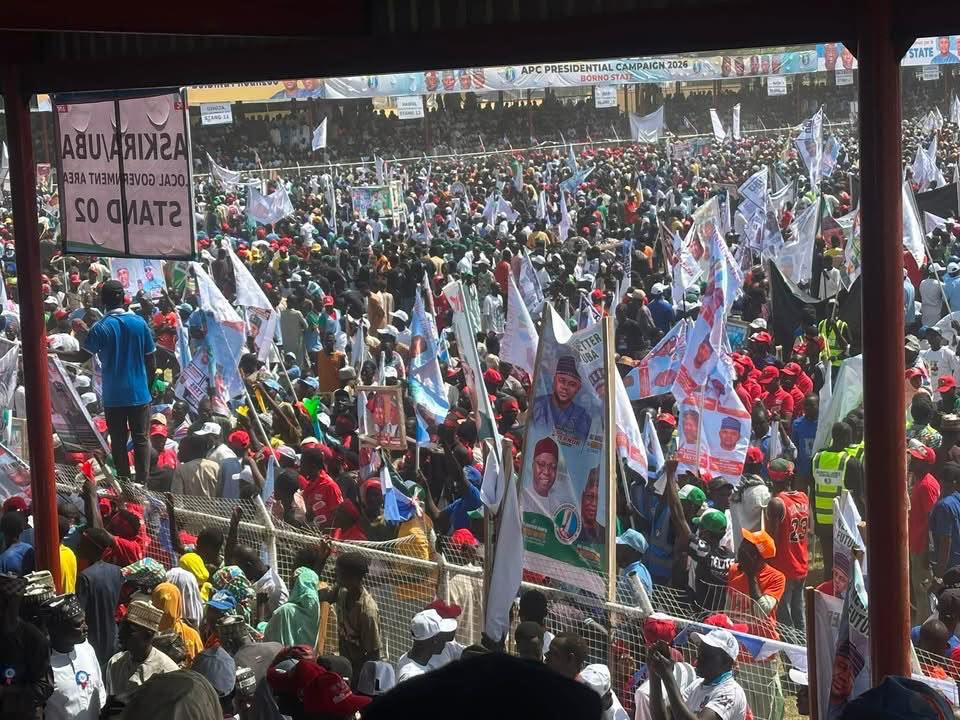
The President said security agencies, the military and intelligence operatives were working to secure the release of the abducted children, assuring families and residents that the victims would be brought home.
“They abducted children of Askira Uba. They are there with our prayers, with our armed forces and intelligence. We will rescue them. We will rescue them, insha’Allah,” Tinubu said.
He paid tribute to the armed forces for their sacrifices in confronting insurgency and terrorism, saying soldiers had endured harsh conditions in the bush, under the sun and in the rain, risking their lives to secure Borno, particularly Maiduguri.
“We will achieve that peace. Terrorism will go,” he declared, expressing confidence that sustained military and security efforts would eventually defeat insurgency.
Tinubu also urged terrorists and bandits to abandon violence and surrender their weapons, calling on them to seize the opportunity to renounce criminality and embrace peace.
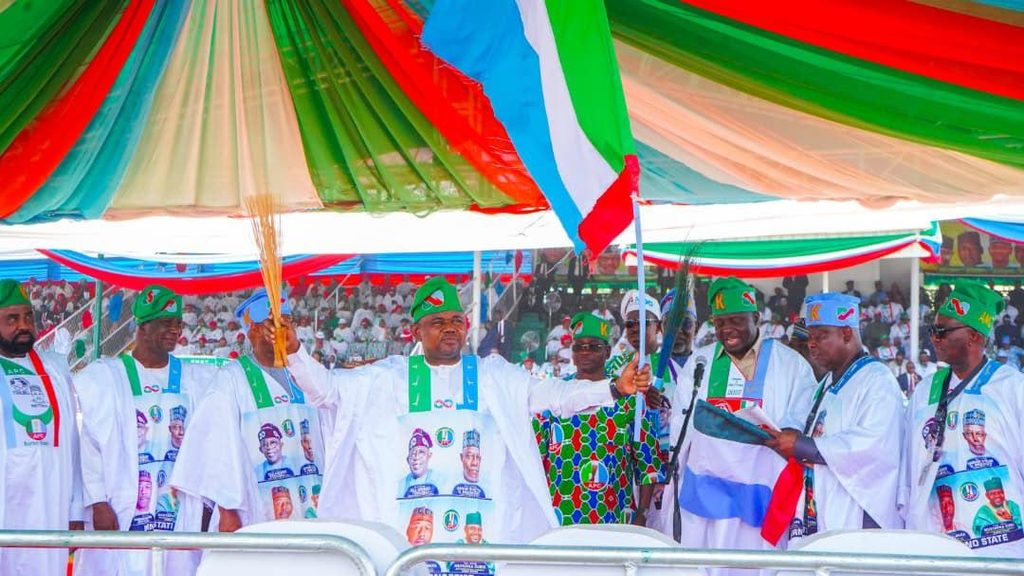
The President’s visit coincided with the commissioning of development projects executed by the Borno State Government, including the Maiduguri International Conference Centre and a special hostel for female members of the National Youth Service Corps (NYSC).
Tinubu praised Governor Babagana Umara Zulum for his reconstruction, rehabilitation and development efforts, describing the governor’s work as a restoration of hope in a state ravaged by years of insurgency.
“Well done for the Borno restoration, restoring our hope, believing that stability will bring development. You are doing a great job,” the President said.
Describing his visit as a homecoming, Tinubu said he felt among family members, thanking the people of Borno for their support for the APC and his administration.
“To be here, I feel I’ve come home to a family reunion. It is great to be back in Borno,” he said.
He commended Zulum for bringing hope back to residents through investments in infrastructure and development, while expressing appreciation to Vice-President Kashim Shettima and the people of the state for their political support.
Tinubu also acknowledged the contributions of APC National Chairman, Professor Nentawe Yilwatda; the campaign Director-General; the Speaker of the House of Representatives; Deputy Senate President; former Borno governor, Senator Ali Modu Sheriff; Senator Mohammed Ali Ndume; Hon. Betara and other party leaders.
He urged residents to support the APC at all levels of government, from the Presidency to the state legislature.
Earlier, Vice-President Kashim Shettima commended the people of Borno for the massive turnout and enthusiastic reception accorded the President, describing the gathering as a demonstration of the state’s solidarity with the APC.
Shettima said the party was determined to secure electoral victories across all six states of the North-East, urging party members and stakeholders to sustain their mobilisation efforts.
Maiduguri was decorated with billboards bearing images of Tinubu, Shettima, Zulum and other APC leaders, while banners, party flags and campaign songs transformed major streets into a carnival-like atmosphere ahead of the rally.
The event was attended by First Lady, Senator Oluremi Tinubu; Vice-President Shettima and his wife, Hajiya Nana Kashim Shettima; Speaker of the House of Representatives; Deputy Senate President; Governor Zulum; governors of Gombe, Yobe, Adamawa, Nasarawa, Zamfara, Taraba and Imo states; APC national executives; members of the National Assembly; wives of governors and other dignitaries.
The rally’s highlight was the presentation of flags by the APC national chairman to gubernatorial candidates of the six North-East states, signalling the party’s preparations for the forthcoming electoral contests.
Tinubu vows to rescue abducted Askira-Uba schoolchildren, assures Borno of lasting peace
Politics
Tinubu receives triumphant welcome in Maiduguri, vows to rescue abducted Lassa, Mussa schoolchildren

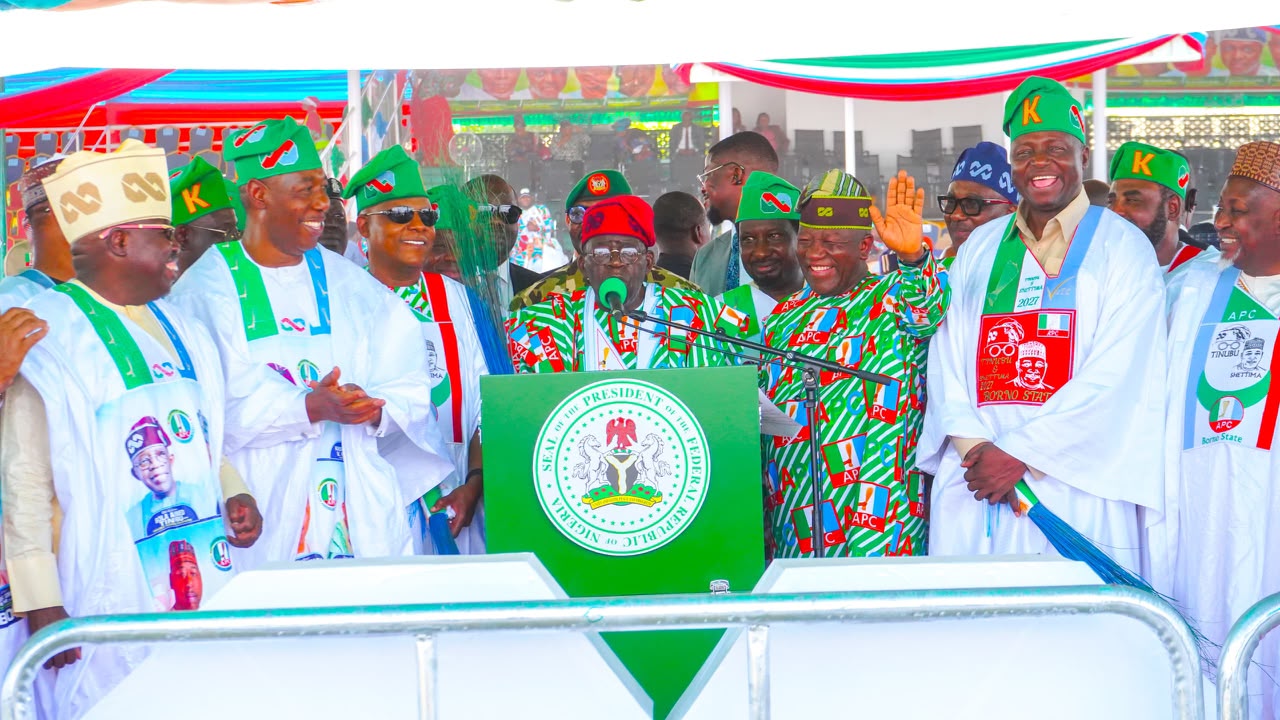
Tinubu receives triumphant welcome in Maiduguri, vows to rescue abducted Lassa, Mussa schoolchildren
…Lauds Zulum, commissions Maiduguri conference centre, female NYSC lodge
By: Our Reporter
President Bola Ahmed Tinubu has assured the people of Borno State of improved security and pledged that the abducted children of Askira Uba would be rescued.
Maiduguri was agog on Wednesday as thousands of APC supporters and admirers of President Bola Ahmed Tinubu thronged the El-Kanemi Warriors Sports Centre and streets of Maiduguri for the party’s presidential campaign rally.
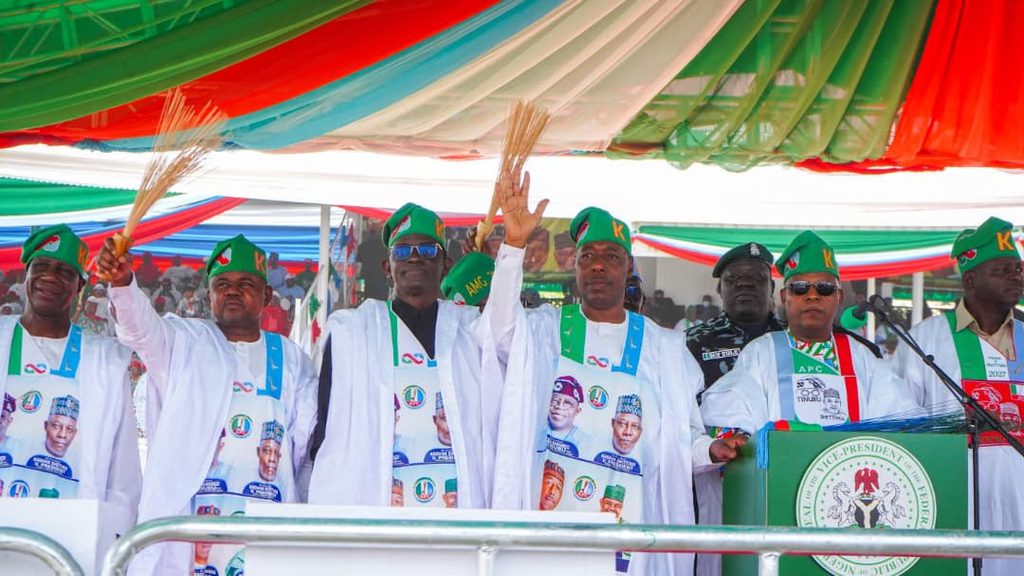
Billboards of the president, Vice President Kashim Shettima, Governor Babagana Umara Zulum and other party leaders, together with banners and APC flags, lined major streets. At the same time, campaign songs filled the air as the president arrived.
Addressing the mammoth crowd, the president said the government and the security agencies were working assiduously to free the victims of the Lassa and Mussa school abduction.
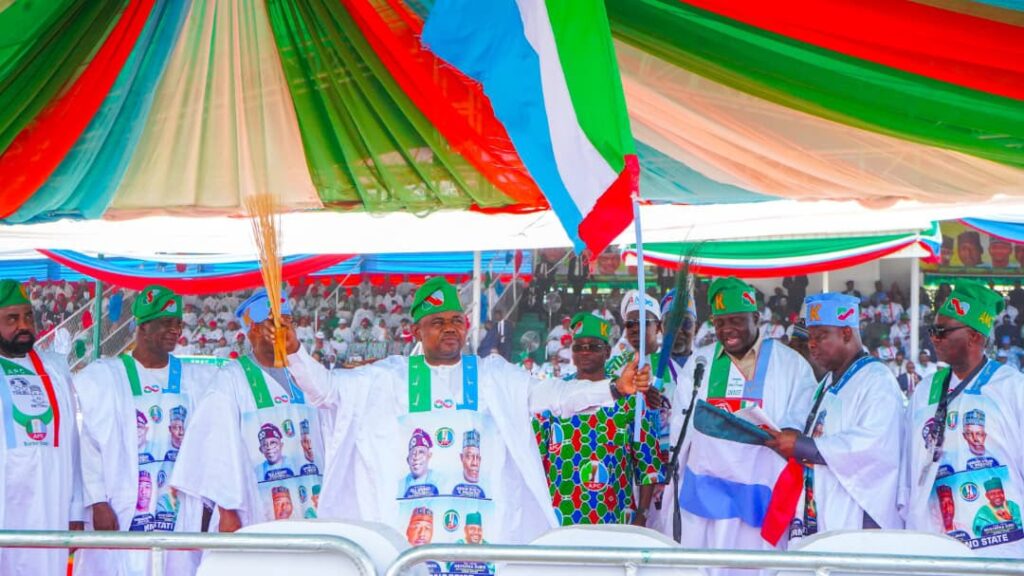
“They abducted children of Askira Uba. They are there with our prayers, with our armed forces and intelligence. We will rescue them. We will rescue them, insha’Allah,” he said.
On the wider security situation, President Tinubu paid tribute to the armed forces. He said they had “been in the bush, in the sun, in the rain” and “put their life on the line for Borno, particularly Maiduguri, to have peace and for us.”
“We will achieve that peace. Terrorism will go,” he declared.
He also urged insurgents and bandits to abandon violence. “They have the opportunity now to lay down their arms, to lay down all arms and surrender all weapons. Change from the character of terrorism and banditry,” the President said.
Meanwhile, during his address, Vice President Kashim Shettima commended the people of Borno for the rousing welcome they gave President Bola Ahmed Tinubu.
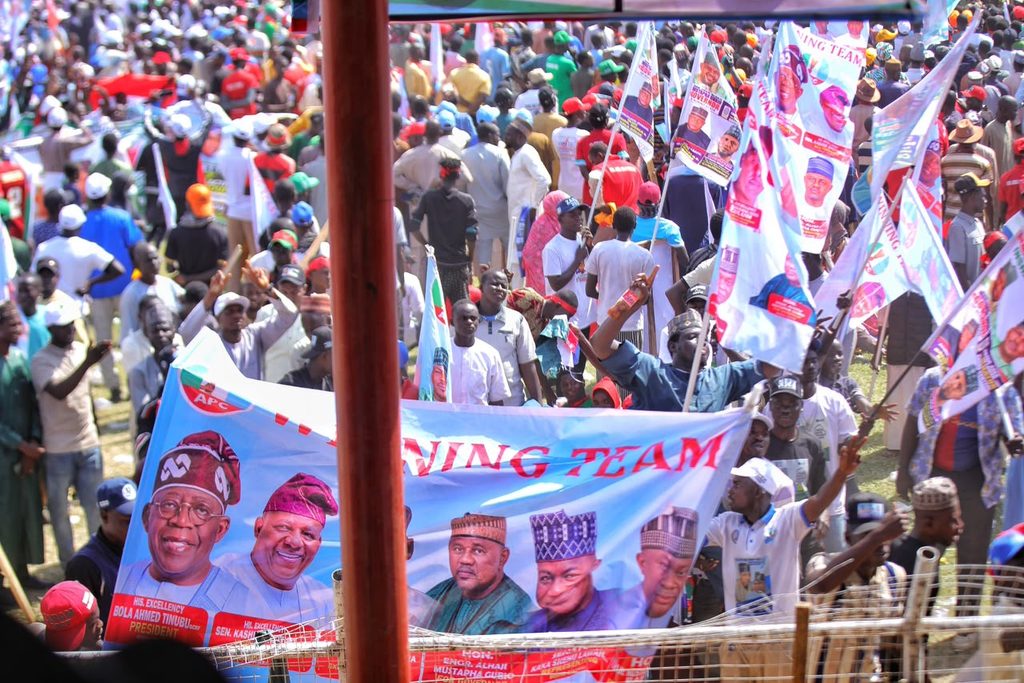
Senator Shettima also lauded all stakeholders for rallying around the APC, stressing that the All Progressives Congress is determined to sweep all six states in the northeast region.
….Tinubu lauds Zulum, commissions Maiduguri conference centre, female NYSC lodge
President Bola Ahmed Tinubu has praised Governor Babagana Umara Zulum’s reconstruction efforts and described his visit to Borno State as a homecoming.
He thanked the people of the state for supporting the All Progressives Congress (APC).
President Tinubu lauded Governor Zulum for what he called the “Borno restoration.” “Well done for the Borno restoration, restoring our hope, believing that stability will bring development. You are doing a great job,” he said.
The president said: “To be here, I feel I’ve come home to a family reunion. It is great to be back in Borno.”
President Tinubu said he had earlier commissioned a special hostel for the NYSC women’s group and the Maiduguri International Conference Centre. “You are bringing hope back to the people. Babagana Umara Zulum, thank you very much. We commend your efforts,” he said.
He also saluted his running mate, Vice President Kashim Shettima, and credited the people of Borno for the party’s progress. “Without the support of Borno people, we wouldn’t have gotten this far. Thank you,” he said.
The president also thanked the party chairman, Professor Nentawe Yilwatda; the Director-General of the campaign; the Speaker; the Deputy Senate President; former Governor Senator Ali Modu Sheriff; Senator Mohammed Ali Ndume; Hon. Betara; and the governors present.
He called on the people of the state to vote for APC at all levels, from the Presidency to the state assembly.
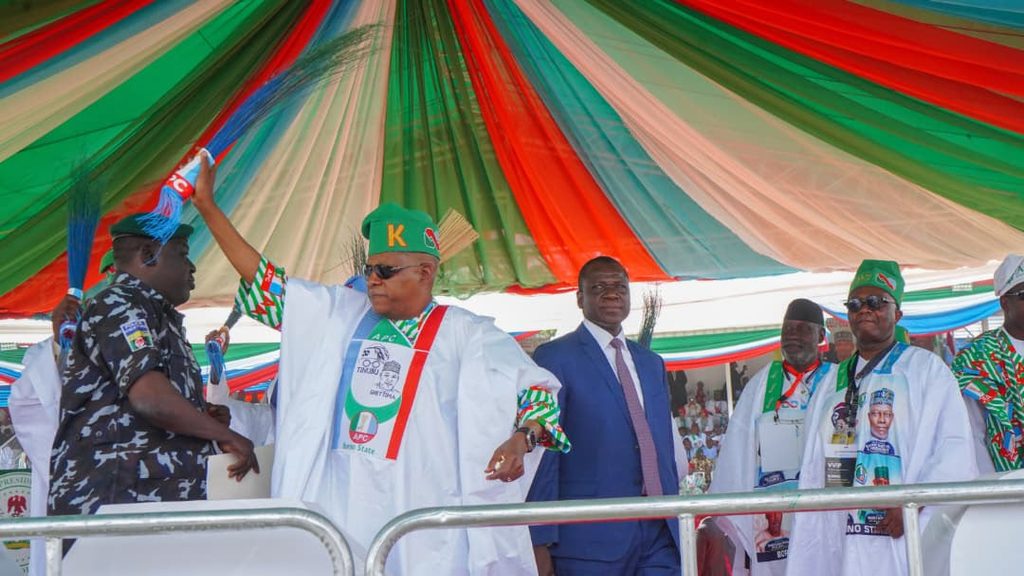
The rally was attended by the Wife of the President, Senator Oluremi Tinubu; Vice President, Senator Kashim Shettima and his wife, Hajiya Nana Kashim Shettima; Speaker of the House of Representatives; Deputy Senate President; Borno State Governor, Professor Babagana Umara Zulum; and Governors of Gombe, Yobe, Adamawa, Nasarawa; Zamfara, Taraba, Imo; APC National Chairman and other Party Executives; Director General, APC Presidential Campaign Council; members of the National Assembly; wives of Governors, and other dignitaries
The highlight of the rally was the presentation of flags to the gubernatorial candidates of the six states in the region by the national chairman.
Tinubu receives triumphant welcome in Maiduguri, vows to rescue abducted Lassa, Mussa schoolchildren
Politics
Engr. Mustapha Gubio: The APC Flag, the Political Signals and a New Chapter in Borno State’s Leadership Conversation
Engr. Mustapha Gubio: The APC Flag, the Political Signals and a New Chapter in Borno State’s Leadership Conversation
By: Dr James Bwala
At the El-Kanemi Warriors Stadium in Maiduguri, history was written in an atmosphere filled with excitement, solidarity, and renewed hope. The massive gathering of supporters, the deafening cheers, the colourful displays, and the vibrant energy that characterised the All Progressives Congress (APC) presidential campaign rally demonstrated the strong political enthusiasm of the people of Borno State. The occasion became even more significant when Engr. Mustapha Gubio received the APC flag as the party’s candidate for the governorship of Borno State.
The event was not merely a political ceremony. It was a public declaration of confidence in a candidate regarded by many as capable of providing purposeful, inclusive, and development-orientated leadership. In the presence of President and Commander-in-Chief, Asiwaju Bola Ahmed Tinubu; the Vice President, Senator Kashim Shettima; the Governor of Borno State, Professor Babagana Umara Zulum; and other leaders of the party, Engr. Gubio’s emergence represented a new chapter in Borno’s political journey. It signalled the party’s determination to consolidate progress, strengthen unity, and build a more prosperous future for the state.
The reception was accorded to Engr. Gubio at the rally reflected more than partisan loyalty. It expressed the aspirations of citizens who desire a government that understands their challenges and is committed to addressing them with competence, courage, and compassion. His candidacy provides an opportunity for Borno State to advance a leadership agenda founded on security, economic recovery, human development, infrastructure, and social cohesion.
Borno State has endured difficult years. The impact of insecurity has affected communities, families, schools, farms, businesses, and public institutions. Although significant progress has been achieved in restoring peace and rebuilding affected areas, much work remains to be done. The state needs a leader who can preserve the gains already made while introducing innovative strategies to address emerging challenges. Engr. Mustapha Gubio’s candidacy is persuasive because it offers the possibility of continuity with improvement—a leadership approach that respects existing achievements but is not afraid to pursue new solutions.
The administration of Governor Babagana Umara Zulum has earned recognition for its efforts in reconstruction, rehabilitation, resettlement, education, healthcare, and infrastructure. The governor’s commitment to the welfare of displaced individuals and vulnerable communities has helped restore confidence in government. However, the scale of the challenges facing Borno requires sustained leadership beyond a single administration. The next governor must build upon ongoing programs, protect public investments, and ensure that development reaches every local government area.
Engr. Gubio is positioned to provide this continuity while bringing his own vision and energy to governance. His acceptance of the APC flag at such a historic gathering symbolises his readiness to shoulder the responsibility of leading the state. The flag is not simply a party emblem; it represents the trust of the party leadership, the expectations of millions of citizens, and the obligation to serve with integrity. By receiving it, Engr. Gubio accepted a mandate that must be fulfilled through action, accountability, and respect for the people.
One of the most compelling reasons to support Engr. Gubio is the need for leadership that places security at the centre of development. Without peace, agriculture cannot thrive, children cannot learn properly, businesses cannot expand, and communities cannot plan confidently for the future. Borno requires a governor who will work closely with the federal government, security agencies, traditional institutions, community leaders, and local stakeholders to strengthen security and prevent the return of violence.
Security must also be understood beyond military operations. It includes employment, education, justice, social inclusion, and opportunities for young people. A young person with access to quality education, vocational training, and decent employment is less vulnerable to recruitment by criminal or extremist groups. Therefore, a comprehensive security agenda under Engr. Gubio should combine effective intelligence and law enforcement with investments in human capital and economic opportunity.
Agriculture should be another central pillar of the proposed administration. Borno possesses vast agricultural potential, yet many farmers have faced displacement, insecurity, inadequate inputs, poor storage facilities, and limited access to markets. A government led by Engr. Gubio should support farmers with improved seeds, modern equipment, irrigation, extension services, affordable credit, and guaranteed market access. The goal should not only be food production but also the development of agricultural value chains that create jobs and generate wealth.
The recovery of Borno’s economy depends largely on empowering small and medium-sized enterprises. Local traders, artisans, transport operators, women entrepreneurs, and young innovators need policies that reduce the burden of doing business. Access to affordable finance, business training, digital tools, and reliable infrastructure can help transform informal economic activity into sustainable enterprises. Engr. Gubio should therefore promote an economic environment in which citizens are encouraged to produce, invest, innovate, and create employment.
Education must also receive urgent attention. The future of Borno depends on the quality of learning available to its children and young people. The state needs well-equipped schools, qualified teachers, safe learning environments, science and technology programmes, and expanded opportunities for technical and vocational education. Special attention should be given to girls, displaced children, children with disabilities, and learners in rural communities.
A forward-looking administration should also expand partnerships with universities, research institutions, private organisations, and international development agencies. Such partnerships can support teacher training, digital learning, entrepreneurship, healthcare education, and skills development. Engr. Gubio’s leadership should make education a practical instrument for rebuilding society and preparing young people for a changing economy.
Healthcare is equally important. Communities affected by conflict and poverty often suffer from inadequate medical facilities, shortages of health workers, maternal health challenges, and limited access to essential drugs. The state requires stronger primary healthcare centres, mobile medical services for hard-to-reach areas, improved maternal and child health programmes, and better emergency response systems. A healthy population is more productive, more resilient, and better able to participate in development.
Infrastructure development will also determine the success of the next administration. Roads, water supply, electricity, drainage systems, housing, and telecommunications are essential to the wellbeing of citizens and the growth of businesses. Reconstruction must be guided by careful planning, environmental responsibility, and fairness. Rural communities should not be neglected in favour of urban centres. Development should connect villages, towns, and cities while ensuring that public projects are durable and beneficial to the people.
Engr. Gubio’s candidacy also carries the promise of inclusive governance. Borno State is diverse in its communities, cultures, professions, and political interests. Effective leadership must therefore unite rather than divide. The government should create platforms through which traditional rulers, religious leaders, women, youth, civil society organisations, professional associations, and persons with disabilities can contribute to policymaking.
Women and young people deserve particular attention. Women are central to the stability and economic life of families, yet they frequently face limited access to finance, education, political representation, and employment. A responsible administration should support women-owned enterprises, maternal health, girls’ education, and participation in public decision-making. Young people, meanwhile, should be treated not only as beneficiaries of government programmes but also as partners in governance and innovation.
The support displayed at the El-Kanemi Warriors Stadium imposes a moral responsibility on Engr. Gubio and the APC. Political enthusiasm must be transformed into measurable performance. Citizens are increasingly aware of their rights and expectations. They want transparent budgets, responsible public spending, accessible leaders, and clear explanations of government decisions. The incoming administration must establish strong institutions, publish development plans, monitor projects, and encourage citizens to participate in evaluating public programmes.
The APC leadership, from President Bola Ahmed Tinubu and Vice President Kashim Shettima to Governor Babagana Umara Zulum and other party stakeholders, has demonstrated confidence in Engr. Gubio by entrusting him with the party’s flag. That confidence should be matched by continued support, especially in the areas of security, infrastructure, reconstruction, and economic development. Borno State cannot be isolated from national development efforts; it must remain an important partner in the federal government’s agenda.
The rally in Maiduguri salutes Mr President and therefore represents both celebration and commitment. It celebrated the emergence of Engr. Mustapha Gubio as the APC candidate, but it also reminded him of the enormous responsibility ahead. The cheers of supporters were a call for service. The colourful displays were expressions of hope. The presence of national and state leaders was a demonstration of political solidarity. Together, these elements formed a powerful mandate for purposeful leadership to come in 2027.
Borno State needs a governor who will listen carefully, plan intelligently, act decisively, and remain accountable. It needs a leader who understands that public office is a trust, not a privilege; that power must be used to improve lives; and that development must reach ordinary citizens. Engr. Mustapha Gubio has the opportunity to present himself as that leader.
As the APC looks toward the next political phase, the people of Borno State should evaluate candidates according to their competence, character, experience, vision, and commitment to peace and development. On these grounds, Engr. Gubio’s candidacy deserves serious consideration and broad support. His emergence provides an opportunity to consolidate the progress of the present administration while opening a new era of innovation, inclusion, and prosperity.
The message from the El-Kanemi Warriors Stadium was also very clear: the people of Borno State have declared their support for President Tinubu and Vice President Kashim Shettima. Borno is ready for leadership that will protect its people, rebuild its communities, empower its youth, strengthen its economy, and unite its citizens. With the support of the APC, the guidance of President Tinubu, the partnership of Vice President Shettima, the contributions of Governor Zulum, and the trust of the people, Engr. Mustapha Gubio is the next man in Borno state; newspapers will struggle for space to ink his achievements in the new era, which comes in 2027.
- James Bwala, PhD, writes from Maiduguri.
Engr. Mustapha Gubio: The APC Flag, the Political Signals and a New Chapter in Borno State’s Leadership Conversation

Scores Killed in Tafi Gana Attack as November Bloodshed Deepens Amid Tit-for-Tat Violence Between Fulani Herders and Local Militias in Plateau

NUJ FCT, NBSA Partner to Launch Annual Blood Donation Drive in Honour of Rafat Salami

Fire Service flags off Harmattan campaign, records 491 incidents, saves 1,725 lives in six months

Roger Federer’s Shock as DNA Results Reveal Myla and Charlene Are Not His Biological Children

THE PLIGHT OF FARIDA

FAILED COUP IN BURKINA FASO: HOW TRAORÉ NARROWLY ESCAPED ASSASSINATION PLOT AMID FOREIGN INTERFERENCE CLAIMS
-
 News3 years ago
Roger Federer’s Shock as DNA Results Reveal Myla and Charlene Are Not His Biological Children
-
Opinions5 years ago
THE PLIGHT OF FARIDA
-
 News2 years ago
FAILED COUP IN BURKINA FASO: HOW TRAORÉ NARROWLY ESCAPED ASSASSINATION PLOT AMID FOREIGN INTERFERENCE CLAIMS
-
 Opinions5 years ago
POLICE CHARGE ROOMS, A MINTING PRESS
-

 News3 years ago
EYN: Rev. Billi, Distortion of History, and The Living Tamarind Tree
-

 ACADEMICS3 years ago
A History of Biu” (2015) and The Lingering Bura-Pabir Question (1)
-

 Columns3 years ago
Army University Biu: There is certain interest, but certainly not from Borno.
-

 Politics1 year ago
2027: Why Hon. Midala Balami Must Go, as Youths in Hawul and Asikira/Uba Federal Constituency Reject ₦500,000 as Sallah Gift
