
News
THE PROMISE WE MAKE TO TOMORROW

THE PROMISE WE MAKE TO TOMORROW
By: His Excellency, Vice President Kashim Shettima, GCON
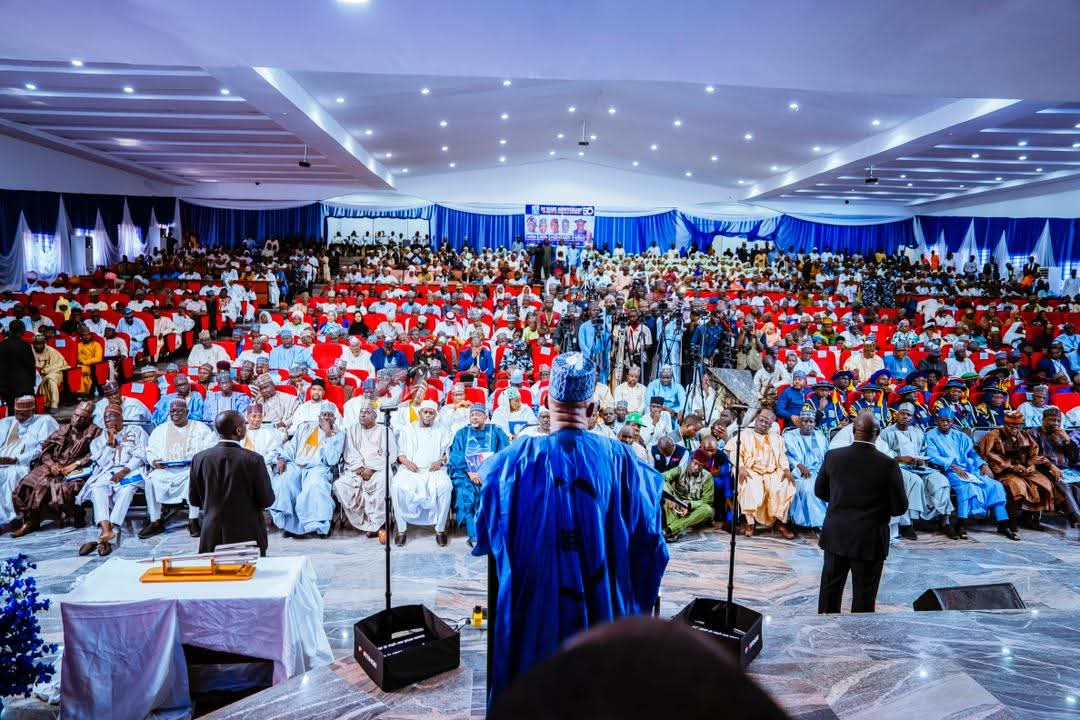
Being the speech of His Excellency, Senator Kashim Shettima, GCON, Vice President of the Federal Republic of Nigeria, on the Golden Jubilee Celebration of the University of Maiduguri, held at the Muhammadu Indimi International Conference Centre, University of Maiduguri, on Saturday, November 29, 2025.
No heritage is greater than the gift of education, for we are the children of a civilisation built by words, refined by books, and elevated by ideas. We are products of generations of scholars and thinkers who lit the path before us, men and women whose quiet labour laid the foundation for every aspiration to progress and development in our society. Their contributions would not have endured without institutions that inspired their thoughts, debated their convictions, and preserved their wisdom in libraries for generations yet unborn. This is what the University of Maiduguri has meant to us, a cradle of intellect, a place of inquiry, and a custodian of the ideals that shape our world. And so, it is with profound honour that I join you today to celebrate the history of its excellence and the legacy it continues to build across time.
Every institution is defined not only by the strength of its research outputs but by the quality of the students it moulds. On this front, we have been fortunate to count the University of Maiduguri as a place where minds are empowered to imagine better futures. This is the true meaning of education, the belief that we are what becomes of our children, for they carry the light that guides us into tomorrow. No society that neglects education survives the attrition of time, for knowledge remains the only inheritance that grows in value through use. And so, as we gather to celebrate half a century of this distinguished institution, we are affirming the immortality of an idea, the idea that human beings, regardless of birth or class, can rise to their fullest potential through the power of learning. We gather to honour an institution that took root in the Sahelian sands and blossomed into a home for all, nurturing generations who now serve as contributors to the engines of our nation’s development and as torchbearers beyond our borders.
As an alumnus of this great institution, I feel the weight of those humble beginnings and the soaring ambitions that followed. I arrived here as a young man convinced that education is the brick with which a purposeful life is built, and I learned that truth within these walls, beneath the fine Sahelian skies of Maiduguri. But this education was never a pastime of cramming for exams; it was a calling. It was an invitation to use knowledge as the most potent tool in the service of humanity. Today, I return home with a heart full of gratitude for every lecture hall that shaped our thinking, for every laboratory that refined our curiosity, for every library that awakened our intellectual appetites, and for every challenge that sharpened our character.
I was trained here to believe that the greatest heritage one can inherit is knowledge and the greatest duty one can undertake is to pass it on. And no matter the office I occupy, I remain first and forever a student of this institution. For you, I will always be the boy who walked into these classrooms with nothing but a dream, leaving with a mission to serve. It is one of the quiet prides of my life that I stand before you not in violation of any code of conduct, not as one summoned to defend a failure in character, but as one who has tried, earnestly and consistently, to deploy his education in the service of the society that nurtured him.
That this institution still stands despite the storms of violence we have witnessed is owed to our collective belief in what truly matters, the conviction that nothing must come between us and our education. Perhaps it is this stubborn refusal to surrender the classroom to the merchants of fear, this insistence on preaching and promoting learning in a land where those who oppose it have waged a war against enlightenment, that defines the magnitude of your sacrifice. You have kept faith with the sanctity of knowledge in a place where doing so demanded uncommon courage. And in choosing to keep these gates open, you have proclaimed loudly that education is sacred, that it is non negotiable, and that its message must continue to echo across our communities no matter the darkness that seeks to silence it.
As individuals, we also owe it to ourselves to become symbols of the possibilities that well tailored education offers. Unless we strive to become the reference points for why this institution exists and why our teachers labour to prepare us for the uncertainty of tomorrow, we risk leaving the stage to the anarchists. We will not let them drag us back into the darkness that our ancestors devoted their lives to end, because we know the road that leads to damnation and the one that leads to redemption. We choose education because it is the antidote to the fear that fuels extremism. We choose it because it is the light that exposes the fake glamour of violence. Education is the shield that protects communities from forces determined to roll back centuries of progress. That is why we must be the light of humanity, the hope of the downtrodden, and the rhetorical motivation of the sceptics who doubt whether this nation can rise to its promise.
Distinguished ladies and gentlemen, fifty years in the life of an institution is enough time to test the quality of its products. It is enough time to see whether knowledge handed down in classrooms has been translated into innovation, into responsible leadership, and into lives devoted to service. Whether as economists or biologists, as computer programmers or medical doctors, as lawyers or engineers, our obligation extends beyond excelling in our careers. Without purpose, education becomes a grand exercise in self stimulation, a trophy polished only for personal admiration. Yet this university has never lacked purpose. The University of Maiduguri has paid its dues. It has produced scholars and specialists who have injected knowledge, competence, and moral character into the labour market and into communities far and near. This Jubilee is therefore a celebration of impact.
And although fifty years is young compared to ancient institutions such as al Qarawiyyin, the University of Bologna, and even the University of Oxford whose origins stretch into the mists of the ninth and eleventh centuries, we are reminded that purpose matters far more than age. Since 1975, when this university was conceived under the Third National Development Plan and began its academic programmes the following year, it has stood shoulder to shoulder with institutions twice its age and has shone with distinction. The journey of every alumnus gathered here today is proof that relevance is not measured in centuries but in the depth of vision that guided its founding fathers and the quality of minds that have sustained this legacy across time.
It is on the strength of this legacy and on the confidence it inspires that we turn our thoughts to the theme of this celebration, Education, Leadership, and National Development. It is an invitation for us to reflect on the connection between what we learn and the nation we aspire to build. It calls us to rethink the boundary between the knowledge we acquire and the measure of progress we hope to achieve. In societies like ours, true development depends on our ability to understand the relationship between what we teach, how we lead, and the collective vision we pursue as a people.
Today, there is a shared national understanding that education is the most reliable vehicle to development. It is the immune system of the nation. It fuels economic mobility, lifts families out of poverty, strengthens social cohesion, deepens democratic culture, and fortifies national security. It sustains every modern endeavour, from the construction of strong institutions to the building of a strong economy. An educated citizenry is more prepared to participate in civic life, to champion democratic values, to hold leaders accountable, to demand competence and fairness, and to stand as pillars of national stability.
This is why we have made it clear that we do not come to pay lip service to education. We recognise that the soul of national development lies in what our citizens know, what they can imagine, and what they can create. Because we understand the transformative power of learning, our budgetary commitments have been deliberately aligned with the broader goals of national progress. In the 2025 Budget, education received a total of 3.5 trillion naira, amounting to 7.3 percent of the national budget, an increase from the previous year. For the first time in many years, our universities are being supported to develop mechanised farming programmes. Grants have been introduced to strengthen medical education, and entrepreneurial initiatives have been expanded to equip students for the realities of a modern economy.
There is no doubt that a vision for a competitive and globally relevant education sector is beginning to take shape. The world is changing at a pace that leaves no room for complacency. Nations no longer rise or fall on natural resources but on the quality of their human capital. Nigeria cannot aspire to compete on the global stage while its universities remain underfunded, its teachers underpaid, and its classrooms ill equipped. We cannot hope to thrive in a knowledge driven world while preparing our young people with the tools of a bygone age. The 2025 allocation is therefore a declaration of intent and a clear acknowledgement that the future belongs to those who invest in their people.
Indeed, we are not blind to the challenges that have persisted. For decades, underfunding has weakened the foundations of our education system. International benchmarks recommend that between fifteen and twenty percent of national budgets be devoted to education, yet we have often fallen short. We have fallen short because we are compelled to balance competing national priorities such as security, healthcare, and infrastructure. The consequences confront us daily in the form of inadequate infrastructure, outdated learning materials, poorly motivated teachers, opaque management of funds, frequent strikes, and academic calendars that struggle to hold their rhythm. And for us in the Northeast, the most painful challenge has been the violence inflicted by insurgency. Our classrooms became frontline casualties in a senseless war against civilisation.
Between 2009 and 2021 in Borno State alone, more than five hundred schools were attacked. Between two thousand two hundred and forty six and five thousand classrooms were destroyed. Two thousand two hundred and ninety five teachers were killed, and nineteen thousand others were displaced. Children lost years of learning. Libraries were burned. Laboratories were shattered. Aspirations were silenced. These attacks were ideological in nature. They were designed to extinguish the light of knowledge that generations before us had struggled to keep alive. The attackers understood that an educated population cannot be manipulated, cannot be enslaved, and cannot be compelled to bow to tyranny. They understood that education is liberation, and that is precisely why they targeted it. When terrorists attacked schools, they were attempting to kill the future.
Yet the story of Borno is not the story of defeat. It is the story of a people who refused to let darkness define them. By March 2025, public schools in Borno State had registered 877,777 learners. Education received 70 billion Naira out of a 585 billion Naira state budget, while basic education received 12 billion Naira. More than 10 billion Naira in counterpart funding unlocked an additional 17 billion Naira for the sector. The state paid 530 million Naira in West African Senior School Certificate Examination fees for over 26,000 public school students, ensuring that no child missed examinations for financial reasons. The daily investment in school feeding stands at approximately 122 million Naira. These are evidence that even in adversity, leadership can rebuild, restructure, and reimagine society. Yet challenges persist, particularly in the availability of qualified teachers, in infrastructure deficits, and in enrolment gaps. These challenges mirror patterns across many northern states and remind us that regional disparities in education require systemic, sustained, and equitable interventions.
We also understand that our tertiary institutions continue to grapple with inadequate funding, poor infrastructure, staff shortages, high student to teacher ratios, limited research opportunities, outdated curricula, and the painful haemorrhaging of talent through brain drain. We know that many of our finest academics have relocated in search of better opportunities, leaving behind overburdened departments and students deprived of the mentorship they deserve. The consequences have been unmistakable.
We recognise these constraints, and it is in response to them that we are pursuing reforms to modernise the sector. The National Education Repository and Database has strengthened coordination across institutions. The Nigerian Education Loan Fund, which provides interest free loans for tuition and upkeep, has already disbursed 110 billion naira to over three hundred and twenty eight thousand students. Digital transformation initiatives are expanding e learning and access to modern teaching tools. The Fourth Industrial Revolution programme is equipping students with competencies in artificial intelligence, robotics, and data analytics. Skills based learning reforms are shifting education away from rote memorisation toward critical thinking, emotional intelligence, problem solving, creativity, and enterprise. Curriculum reviews are embedding digital literacy, entrepreneurship, and citizenship education into the heart of learning.
Leadership is a responsibility to imagine, to inspire, and to build. More than ever, we are reminded that at the centre of every nation’s progress is the quality of investment it makes in its people. Education remains the womb of national transformation. Around the world, history affirms this truth. India under Jawaharlal Nehru built its scientific and technological identity on the foundation of education. Malaysia under Mahathir Mohammed rose to global relevance through deliberate investment in human capital. Botswana under Seretse Khama moved from poverty into stability through visionary governance. South Africa under Nelson Mandela reinvented itself by placing dignity, justice, and institutional strength at the heart of its national renewal. What these leaders understood is what we have equally embraced, that education shapes leadership and leadership in turn strengthens education. Our own history bears testimony to this. The Third National Development Plan from 1975 to 1980, which midwifed this very institution, was a distinguished example of forward thinking leadership. It gave birth not only to the University of Maiduguri but also to the Universities of Calabar, Ilorin, Jos, Port Harcourt, and Bayero University. It demonstrated that a nation can only rise to the height of the educational ambitions it sets for itself, and it is a vision that continues to guide our steps today.
For Nigeria to reach its full potential, we must build a genuine synergy across all stakeholders. Government cannot do it alone. The private sector, universities, alumni communities, civil society, international partners, and host communities must work together to create centres of excellence. The world has become a single interconnected labour market. Talent moves to where opportunities exist, and opportunities gravitate to where talent is nurtured. Our responsibility is to ensure that Nigeria is not merely a participant in this global contest but a competitive and confident player. This requires increased investment in education, the modernisation of infrastructure, the strengthening of research capacity, the continuous training of teachers, the adoption of new technologies, and a determined fight against corruption in educational administration. It requires systems that outlive individual tenures. Above all, it requires leaders with integrity and imagination, leaders who understand that nation building is an act of intergenerational responsibility.
Education is the foundation of human capital development. It is the engine that drives economic growth. It is the pathway to social mobility. It is the shield against inequality. It is the soil in which innovation grows. It is the thread that weaves national unity. It is the antidote to poverty. It is the armour of democracy. It is the womb in which the future is conceived. Yet for education to fulfil its mission, we must address persistent problems such as limited access in rural and conflict affected areas, poor teacher training, inadequate facilities, outdated curricula, and low investment in technology and research. We must accept the truth that the future belongs to nations that build schools, not prisons, that train teachers, not soldiers, that encourage inquiry, not conformity, and that see every child as a national asset, not a demographic burden.
His Excellency President Bola Ahmed Tinubu understands this charge. The Renewed Hope Agenda recognises that national development is impossible without highly skilled citizens and leaders of integrity. We are prioritising education funding, expanding infrastructure, improving teacher welfare, investing in digital skills, strengthening research capacity, and promoting institutional autonomy. We are reinforcing the synergy between education, leadership, and national development not as abstract ideals but as pillars upon which a new Nigeria must stand.
As we celebrate this Golden Jubilee, we are reminded of the immortal truth that the wealth of a nation lies not in gold or oil but in the minds of its people. Fifty years from now, may our children look back and say that we honoured the legacy of those who built this university in the heart of the desert. May they say that we did not waste the sacrifices of teachers who braved danger to keep education alive. May they say that we insisted on building a Nigeria where learning is stronger than violence, where hope is stronger than fear, and where education remains the greatest equaliser known to humanity.
Today, I invite all of us, students and teachers, policymakers and alumni, friends and custodians of this university, to renew our commitment to be ambassadors of the values this institution has instilled in us. Let us dedicate ourselves to building a nation where every child, regardless of class or tribe, gender or geography, faith or circumstance, has access to the transformative power of education. And may this great University of Maiduguri continue to stand as a lighthouse in the Sahel, an institution whose story is defined not by the storms it has endured but by the light it continues to shine.
Once again, I congratulate the entire University of Maiduguri community on this Golden Jubilee, and I thank you all for your kind attention. May God bless the Federal Republic of Nigeria.
THE PROMISE WE MAKE TO TOMORROW


Military
Establishment of Army Depot in South-East Reflects FG’s Commitment to National Unity, Security and inclusiveness– COAS
Establishment of Army Depot in South-East Reflects FG’s Commitment to National Unity, Security and inclusiveness– COAS
By Zagazola Makama
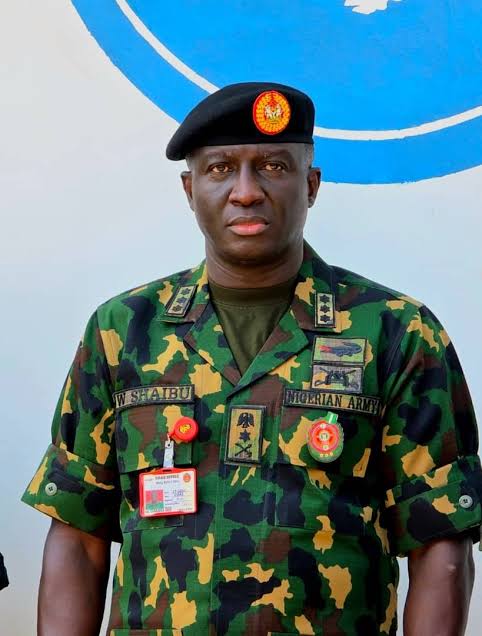
The Chief of Army Staff (COAS), Lt.-Gen. Waidi Shaibu, has said that the establishment of the Depot Nigerian Army in Amasiri-Edda, in Ebonyi State is a clear demonstration of the Federal Government’s commitment to national security, inclusiveness, national integration and balanced development across the country.
Shaibu made the remarks while addressing dignitaries during activities marking the inauguration of the newly established military training institution in Abakaliki, Ebonyi State.
According to the Army Chief, the depot, which is the first primary recruit training institution of the Nigerian Army in the South-East geopolitical zone, represents a strategic investment by President Bola Ahmed Tinubu’s administration in strengthening national security and promoting equitable distribution of critical national institutions.
“The establishment of this depot reflects the Federal Government’s commitment to national security, inclusiveness, national integration and balanced development,” Shaibu said.
He described the inauguration of the facility as a landmark achievement in the ongoing transformation of the Nigerian Army under President Tinubu, noting that it would significantly enhance the Army’s capacity to train professionally competent and combat-ready soldiers.
The COAS disclosed that the first set of recruits trained at the new depot would graduate the following day, describing the event as a historic milestone not only for the institution but also for the evolution of recruit training within the Nigerian Army.
“Their graduation will not only mark the successful completion of basic military training but will also usher in a new chapter in the evolution of recruit training in the Nigerian Army,” he said.
Shaibu explained that since its establishment, the depot had steadily developed into a modern recruit training institution designed to produce disciplined, professional and capable soldiers in line with the Nigerian Army’s transformation agenda and long-term strategic vision.
He said the facility forms part of the Federal Government’s broader efforts to modernise the Armed Forces and expand military capacity to address Nigeria’s dynamic security environment.
The Army Chief expressed profound appreciation to President Tinubu for approving the establishment of the institution and providing the necessary resources for its successful implementation.
He noted that the new depot would not only improve military training capacity but also strengthen the strategic importance of the South-East within Nigeria’s security architecture.
According to him, locating the institution in Ebonyi State underscores the government’s determination to ensure that all parts of the country benefit from national development initiatives while fostering greater national cohesion.
Shaibu also commended Ebonyi State Governor Francis Nwifuru for his unwavering support towards the establishment and successful take-off of the depot.
He said the state government provided accommodation, logistics and other essential support that contributed significantly to the successful training of the pioneer batch of recruits.
“From facilitating the historic groundbreaking ceremony to providing sustained support for this institution, the governor has demonstrated remarkable patriotism and an enduring commitment to national security,” he said.
The COAS further described the Government and people of Ebonyi State, as well as the entire South-East, as indispensable partners in the establishment and growth of the institution.
He also acknowledged the contributions of traditional rulers, political leaders, religious leaders, community leaders and residents of the state for creating a peaceful and conducive environment for the depot to thrive.
Shaibu reaffirmed the Nigerian Army’s commitment to deepening its partnership with host communities and stakeholders, stressing that sustained collaboration between the military and the people remains critical to enhancing national security and maintaining lasting peace.
According to him, the state’s sustained support demonstrates a strong commitment to national security, peace and development.
The Army Chief further commended traditional rulers, community leaders, members of the State Development Committee, political and religious leaders, and other stakeholders for fostering a peaceful environment that enabled the successful establishment of the Depot.
He reaffirmed that the Nigerian Army values its partnership with the state and pledged to continue strengthening collaboration in pursuit of improved security and national development.
The COAS also paid tribute to distinguished retired senior military officers from the region for their contributions to the growth and development of the Nigerian Army.
The establishment of the Depot Nigerian Army in Ebonyi is widely regarded as one of the landmark military infrastructure projects under the Tinubu administration, aimed at expanding recruit training capacity while promoting inclusiveness, national integration and balanced development across Nigeria’s six geopolitical zones.
Establishment of Army Depot in South-East Reflects FG’s Commitment to National Unity, Security and inclusiveness– COAS
Troops, CJTF Arrest Suspected ISWAP Informant Accused of Identifying Kidnap Targets in Borno
By Zagazola Makama
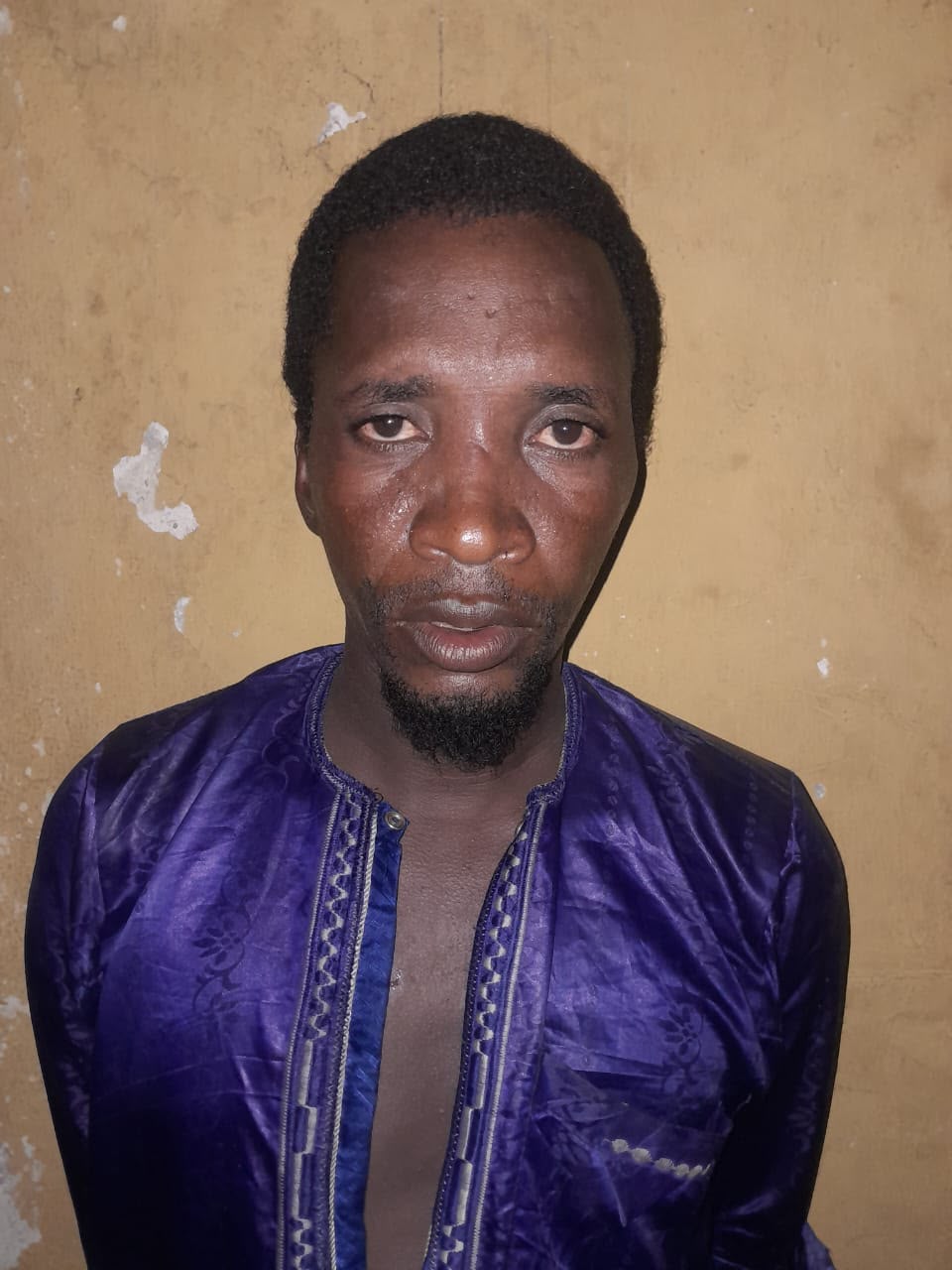
Operatives of the Military Intelligence Brigade (MIB) under Sector 3 of Operation HADIN KAI, working in collaboration with the Civilian Joint Task Force (CJTF), have arrested a suspected Islamic State West Africa Province (ISWAP) informant in Monguno Local Government Area of Borno State.
Intelligence sources told Zagazola Makama that the suspect, identified as Isa Janyu, 30, was tracked and apprehended at about 7:20 p.m. on July 4 during a targeted intelligence-led operation at Kasuwan Shanu in Monguno town.
According to the sources, items recovered from the suspect included a Tecno mobile phone, a knife, a comb, a mirror, and ₦10,000 in cash.
Preliminary investigation revealed that the suspect is a native of Arianna Mai Massallachi Village in Kukawa Local Government Area and allegedly specialised in identifying wealthy residents for ISWAP elements to facilitate kidnapping operations for ransom.
The suspect is currently in the custody of the Headquarters Sector 3 Military Intelligence Brigade for further investigation and other necessary actions.
Military sources said the arrest was part of ongoing intelligence-driven operations aimed at dismantling terrorist support networks and disrupting the activities of informants providing critical information to insurgent groups in the North-East.
They added that although the general security situation across the theatre remains relatively calm, it is still unpredictable, with troops maintaining a high level of operational readiness and sustained offensive pressure against terrorist elements.
Troops, CJTF Arrest Suspected ISWAP Informant Accused of Identifying Kidnap Targets in Borno
News
FG Moves to Stem Human Trafficking, Irregular Migration as Over 1,000 Nigerians Return from Crisis Routes
FG Moves to Stem Human Trafficking, Irregular Migration as Over 1,000 Nigerians Return from Crisis Routes
By: Michael Mike
The Federal Government on Tuesday unveiled a renewed strategy to curb irregular migration and dismantle human trafficking networks, warning that worsening economic hardship and the growing use of digital platforms by traffickers are exposing more Nigerians, particularly women and young people, to exploitation across Africa, the Middle East and Europe.
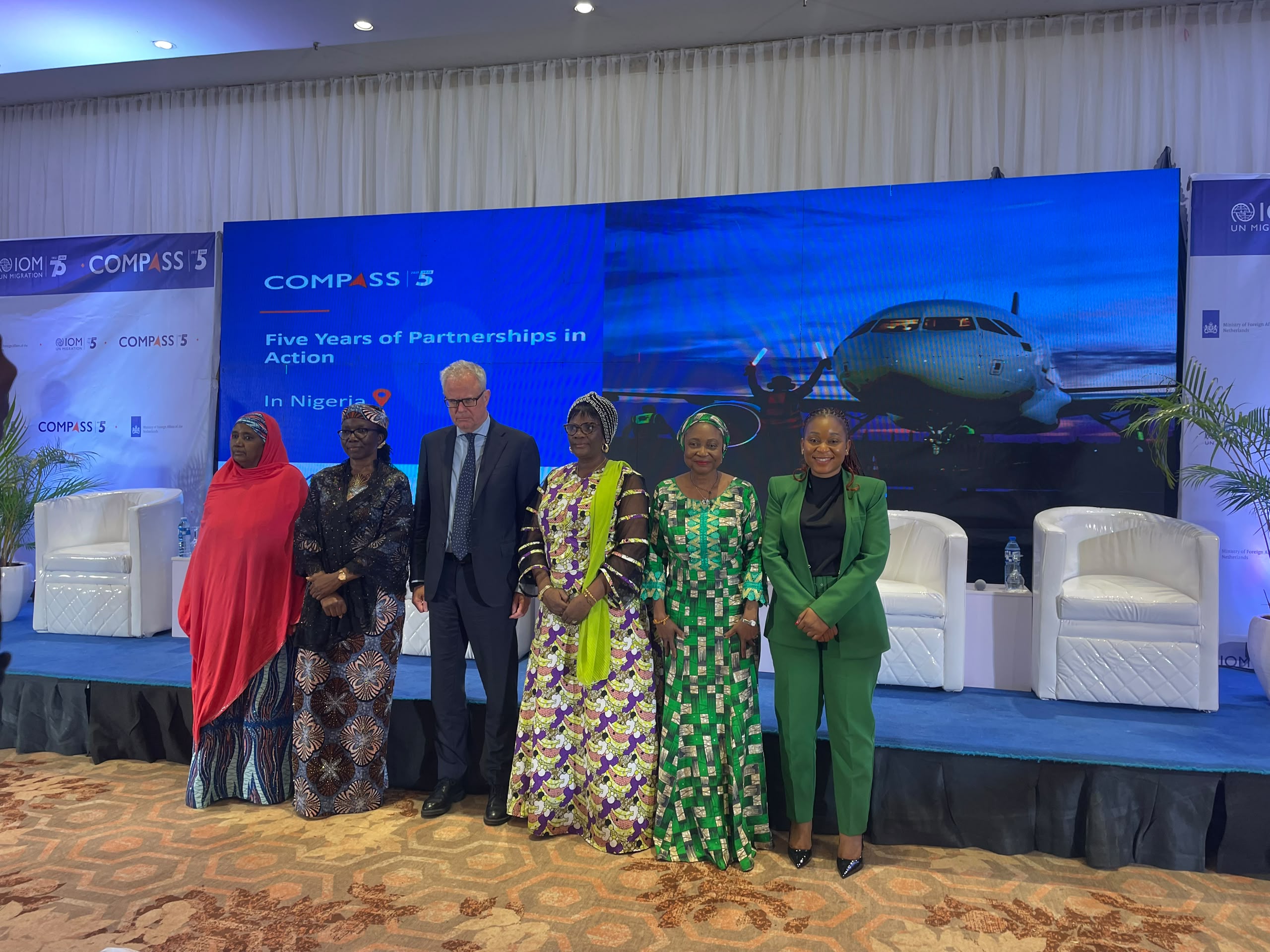
The renewed commitment came as the government and its international partners marked the fifth anniversary of the Comprehensive Protection, Reintegration and Assistance to Migrants and Communities (COMPASS) Programme, revealing that more than 1,000 stranded Nigerians have voluntarily returned from countries including Libya, Lebanon, Morocco, Mali, Egypt, India and the United Arab Emirates, while over 900 vulnerable returnees have received psychosocial care, healthcare and livelihood support to rebuild their lives.
Stakeholders warned that trafficking syndicates are becoming increasingly sophisticated, exploiting technology, poverty and unemployment to lure desperate Nigerians into dangerous migration routes where many end up trapped in forced labour, sexual exploitation and other forms of abuse.
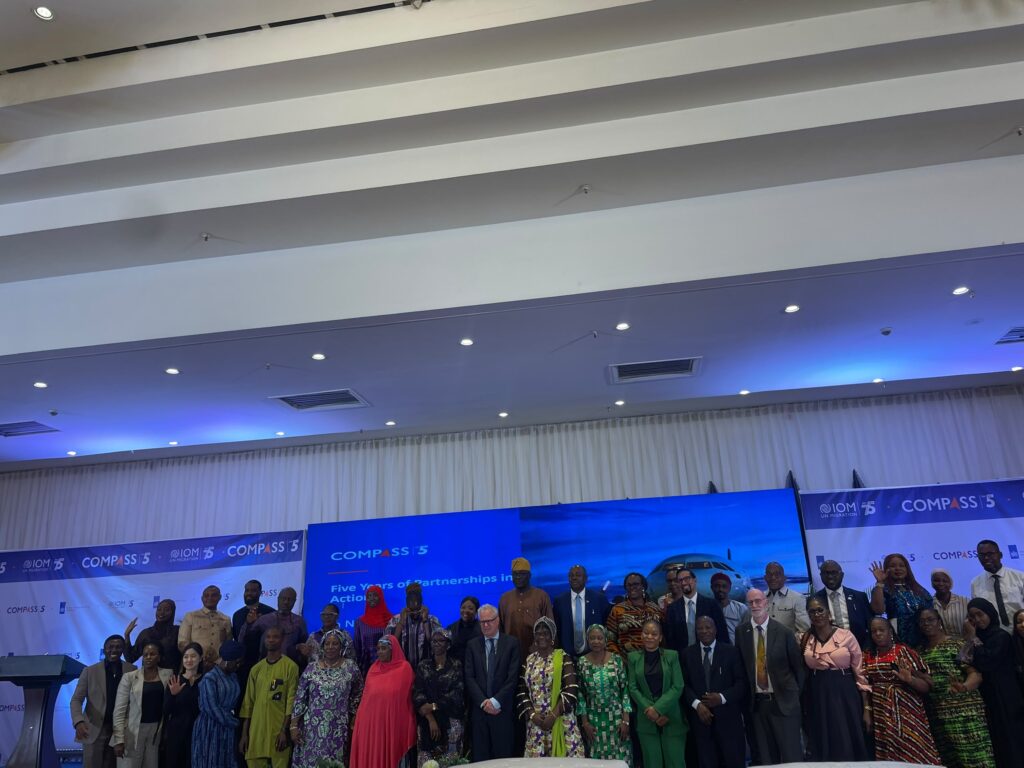
Speaking at the anniversary event, the Chief of Mission of the International Organisation for Migration (IOM) in Nigeria, Sharon Dimanche, said migration itself was not the problem but the absence of safe and legal pathways.
She said: “Migration is not the problem. The challenge is ensuring that migration is safe, orderly and regular, while protecting the dignity of every migrant.”
Dimanche said the COMPASS Programme had significantly strengthened Nigeria’s migration governance architecture by improving policies and institutional coordination while placing the protection of migrants at the centre of migration management.
Highlighting the programme’s impact, she recounted the story of “Joy”, a Nigerian woman trafficked abroad and subjected to severe exploitation before returning home traumatised.
According to her, through IOM’s psychosocial support and reintegration programme, Joy rebuilt her life, established a fashion business and now employs several young women.
“Joy is no longer defined by what happened to her. She is defined by what she has become,” Dimanche said, describing the story as evidence that effective reintegration can transform survivors into productive members of society.
The Minister of Humanitarian Affairs and Poverty Reduction, Dr. Bernard Doro. reaffirmed the Federal Government’s commitment to protecting returning migrants, refugees, internally displaced persons and vulnerable communities.
He said the government’s “One Humanitarian, One Poverty Reduction” framework under President Bola Ahmed Tinubu’s Renewed Hope Agenda was designed to integrate humanitarian assistance with long-term poverty reduction.
“Migration, when properly managed, presents opportunities for national development. We will continue to strengthen institutions, expand livelihood opportunities and ensure that returning migrants are empowered to rebuild their lives with dignity.”
The Minister of Women Affairs and Social Development, Imaan Sulaiman-Ibrahim, who was represented at the event, by the Director and Special Adviser Administration, Mrs. Erimfolami Ola, warned that women and children continue to bear the greatest burden of irregular migration and human trafficking.
According to her representative, the ministry has worked closely with partners under the COMPASS Programme to facilitate the voluntary return of over 1,000 stranded Nigerians while strengthening institutional responses to trafficking and forced displacement.
She stressed that interventions in Edo State had demonstrated that addressing poverty and unemployment significantly reduces the factors driving irregular migration.
Representing the Minister of Youth Development, Ayodele Olawande, represented by the the Head of Youth Migration and Climate Action Resilience, pecial Adviser (Administration), Adedoyin Oyekan, said creating sustainable opportunities for young Nigerians remains one of the most effective responses to irregular migration.
The ministry pledged to deepen collaboration with IOM and development partners in expanding entrepreneurship, skills acquisition, innovation and employment programmes aimed at discouraging dangerous migration.
Also speaking, the Ambassador of the Kingdom of the Netherlands to Nigeria, Bengt van Loosdrecht, announced plans for a football-based youth initiative that would equip young Nigerians with coaching and life skills while educating communities about the dangers of irregular migration.
He said the programme would empower participants to become community ambassadors for safe migration.
According to the ambassador, “Migration is fundamentally a human issue. Through COMPASS, we are investing not only in stronger institutions but also in protecting people, supporting survivors and preventing others from falling into the hands of traffickers.”
Van Loosdrecht explained that the Netherlands established the COMPASS Programme to consolidate migration support into a coordinated framework capable of providing survivor care, mental health services, institutional strengthening and protection for vulnerable migrants.
Also addressing the gathering, the Director-General of the National Agency for the Prohibition of Trafficking in Persons (NAPTIP), Binta Bello, described the COMPASS Programme as one of Nigeria’s most strategic partnerships in the fight against human trafficking.
She said the initiative had strengthened the agency’s capacity to investigate and prosecute trafficking cases through specialised training for investigators and prosecutors while improving support for victims.
Warning that trafficking networks continue to evolve, Bello said: “Traffickers are adapting to technology, exploiting economic hardship and taking advantage of the aspirations of vulnerable young Nigerians. We must therefore strengthen partnerships among government, international organisations, civil society and communities to stay ahead of these criminal networks.”
The renewed commitment comes amid persistent concerns over the thousands of Nigerians who, in recent years, have embarked on perilous journeys across the Sahara Desert and the Mediterranean Sea in search of better economic opportunities. Many have perished, while others have been rescued from detention camps, trafficking rings and exploitative labour conditions abroad.
Stakeholders at the event agreed that while stronger law enforcement remains essential, tackling poverty, unemployment and social vulnerability is critical to addressing the root causes of irregular migration and sustaining Nigeria’s fight against human trafficking.
FG Moves to Stem Human Trafficking, Irregular Migration as Over 1,000 Nigerians Return from Crisis Routes

Troops Arrest Suspected Boko Haram Logistics Supplier with Motorcycle Tyres in Yobe

Troops Arrest Wanted Suspect, Recover AK-47 Rifle in Adamawa

Army, NDLEA Arrest Three Suspected Drug Suppliers Linked to Terrorists in Katsina

Roger Federer’s Shock as DNA Results Reveal Myla and Charlene Are Not His Biological Children

THE PLIGHT OF FARIDA

FAILED COUP IN BURKINA FASO: HOW TRAORÉ NARROWLY ESCAPED ASSASSINATION PLOT AMID FOREIGN INTERFERENCE CLAIMS
-
 News2 years ago
Roger Federer’s Shock as DNA Results Reveal Myla and Charlene Are Not His Biological Children
-
Opinions4 years ago
THE PLIGHT OF FARIDA
-
 News1 year ago
FAILED COUP IN BURKINA FASO: HOW TRAORÉ NARROWLY ESCAPED ASSASSINATION PLOT AMID FOREIGN INTERFERENCE CLAIMS
-

 News2 years ago
EYN: Rev. Billi, Distortion of History, and The Living Tamarind Tree
-
 Opinions5 years ago
POLICE CHARGE ROOMS, A MINTING PRESS
-

 ACADEMICS2 years ago
A History of Biu” (2015) and The Lingering Bura-Pabir Question (1)
-

 Columns2 years ago
Army University Biu: There is certain interest, but certainly not from Borno.
-

 Politics1 year ago
2027: Why Hon. Midala Balami Must Go, as Youths in Hawul and Asikira/Uba Federal Constituency Reject ₦500,000 as Sallah Gift
