
News
WAHO Receives Keys to Temporary Headquarters in Côte d’Ivoire

WAHO Receives Keys to Temporary Headquarters in Côte d’Ivoire
…Move to Grand-Bassam marks new chapter for West African health cooperation
By: Michael Mike
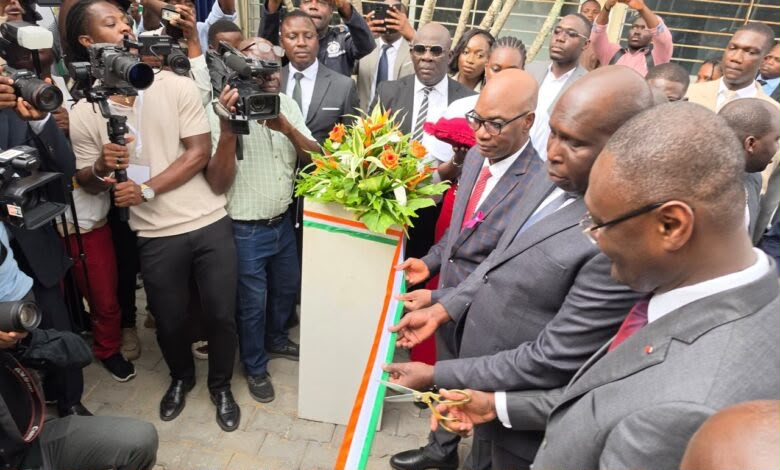
The West African Health Organisation (WAHO), the health institution of the Economic Community of West African States (ECOWAS), has received the keys to its temporary headquarters in Grand-Bassam, Côte d’Ivoire, marking a major step in its relocation to the country.
The handover ceremony, held at the Village of Information Technology and Biotechnology (VITIB), followed the decision by ECOWAS Heads of State and Government on December 14, 2025, in Abuja, to establish the organisation in Côte d’Ivoire.
The relocation opens a new chapter for the regional health institution as it seeks to strengthen cooperation among West African countries in tackling epidemics, improving access to quality healthcare and medicines, and developing coordinated responses to public health emergencies.
The ceremony brought together senior Ivorian government officials, representatives of ECOWAS and its institutions, WAHO leadership, VITIB officials and partner organisations.
Speaking at the event, Minister Delegate Adama Dosso said the handover demonstrated the Ivorian government’s commitment to providing the necessary conditions for WAHO’s establishment.
He said the decision to host the organisation reflected the confidence reposed in Côte d’Ivoire by ECOWAS leaders and the country’s commitment to regional integration.
Dosso commended the national institutions involved in preparing the facilities within a short period, particularly the National State Property Management Company (SONAPIE) and VITIB.
Also speaking, Minister Delegate in charge of Technical Education and Mayor of Grand-Bassam, Jean Louis Moulot, described WAHO’s arrival as an important development for the city and its growing profile as a centre for technology and healthcare.
He highlighted investments in health infrastructure, the development of VITIB and the construction of the National Oncology and Radiotherapy Centre, noting that WAHO’s presence would create further opportunities for cooperation and innovation.
Moulot said the establishment of the organisation also demonstrated West African countries’ determination to pool expertise and develop common solutions to shared health challenges.
The Director-General of WAHO, Professor Palokinam T. Pitche, expressed appreciation to the government and people of Côte d’Ivoire for their hospitality and the measures taken to facilitate the relocation.
He also paid tribute to Burkina Faso and the people of Bobo-Dioulasso for hosting and supporting the organisation for several decades, while acknowledging the ECOWAS Commission and other stakeholders involved in the transition.
Describing the handover as a significant institutional milestone, Pitche said: “It marks a decisive step in WAHO’s effective establishment in the Republic of Côte d’Ivoire and opens a new chapter in the institutional life of our Organisation.”
He said WAHO’s location within VITIB offered an opportunity to link public health expertise with technological innovation, digital solutions and biotechnology.
“Our presence at VITIB should be an invitation to build bridges between health, innovation, digital technologies and biotechnology, for the benefit of West African populations,” he said.
The WAHO chief identified access to quality healthcare, epidemic prevention and response, preparedness for other health emergencies, access to quality medicines and vaccines, and stronger regional health initiatives as priority areas for cooperation with Ivorian health authorities.
He expressed the hope that the new headquarters would become a centre for consultation, coordination and innovation, enabling member states to develop common responses to health challenges across the region.
In his remarks, the Director-General of VITIB, Mebeti Dosso, welcomed WAHO to the technology park, saying its presence would strengthen the facility’s scientific, technological and regional significance.
He identified digital health, training and innovation as areas offering opportunities for collaboration and reaffirmed VITIB’s readiness to support WAHO’s operations and develop joint initiatives.
WAHO’s establishment in Grand-Bassam is expected to deepen its cooperation with Côte d’Ivoire while providing a platform for connecting national expertise with regional health priorities.
The organisation will continue to pursue its mandate of harmonising health policies and strategies, strengthening regional cooperation and promoting solidarity among ECOWAS member states to improve the health and well-being of West African populations.
WAHO Receives Keys to Temporary Headquarters in Côte d’Ivoire


“I Can Throw Stones At Atiku, But Obi, Kwankwaso, Makinde Are My Friends” — Shettima
By: Our Reporter
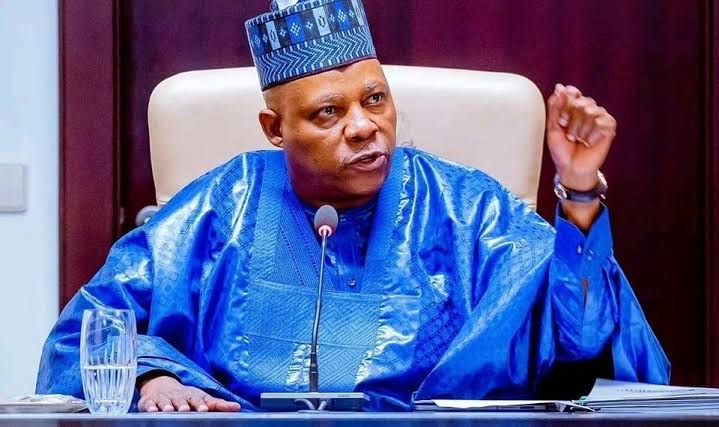
Vice President Kashim Shettima drew a clear line on Tuesday, November 24, 2026, between friends he will not insult, and one man he says he has every right to attack.
Speaking at a stakeholders’ meeting in Maiduguri, Borno State held alongside the launch of multi-sectoral development interventions by the North-East Development Commission, Shettima’s comments went viral.
His message was simple: Politics does not have to be bitter. But if you attack his boss, expect a response.
He named them one by one: “Peter Obi, Governor Seyi Makinde, Rabiu Kwankwaso, and Rotimi Amaechi are my friends. Have you ever heard me insult them?”
Shettima said he and Obi were governors at the same time, Obi in Anambra, himself in Borno. Makinde is a personal friend. Kwankwaso is a friend too.
He even recalled how his support for Amaechi in the Nigerian Governors’ Forum chairmanship contest once caused friction with former President Goodluck Jonathan, a sign, he suggested, of how far his loyalty to friends goes.
Then he turned to Atiku Abubakar, the ADC presidential candidate.
For Atiku, the rules are different. “Atiku Abubakar is an elder statesman, but as a Fulani man, I have the right to throw stones at him, and he has to endure stoically whatever stones I throw at him,” Shettima said.
He dismissed those criticizing the banter as people who lack a sense of history. In his framing, this is Fulani-to-Fulani sparring and Atiku, having repeatedly attacked President Bola Tinubu, should take it.
That, Shettima said, is the condition for his restraint:
“So long as they do not attack my boss, we will practice politics of maturity, politics without bitterness, and politics of tolerance because what binds us together surpasses whatever divides us.”
The timing matters. Nigeria is heading into the 2027 general elections. Tinubu and Shettima are seeking re-election on the APC ticket. Obi is running on the Nigeria Democratic Congress (NDC) ticket, with Kwankwaso as his running mate. Atiku is leading the ADC. Makinde has been part of broader opposition discussions.
Shettima and Obi have clashed on policy before. In October 2026, Shettima called Obi a “master of bogus statistics and incoherent economic prescriptions” over his economic arguments and Kwankwaso publicly defended Obi’s data.
But Shettima insists there is a difference between policy criticism and personal insult.
For his friends, he says, he will keep it mature. For Atiku who he accuses of attacking Tinubu, the stones will keep flying.
“I Can Throw Stones At Atiku, But Obi, Kwankwaso, Makinde Are My Friends” — Shettima
News
Shettima Unveils 10,000 Electric Vehicles in North-East, NEDC Plans 100,000 Fleet, Airline, Pharmaceutical Firm
Shettima Unveils 10,000 Electric Vehicles in North-East, NEDC Plans 100,000 Fleet, Airline, Pharmaceutical Firm
…As FG steps up post-insurgen your phone reconstruction, targets 50MW solar power, infrastructure renewal
By: Michael Mike
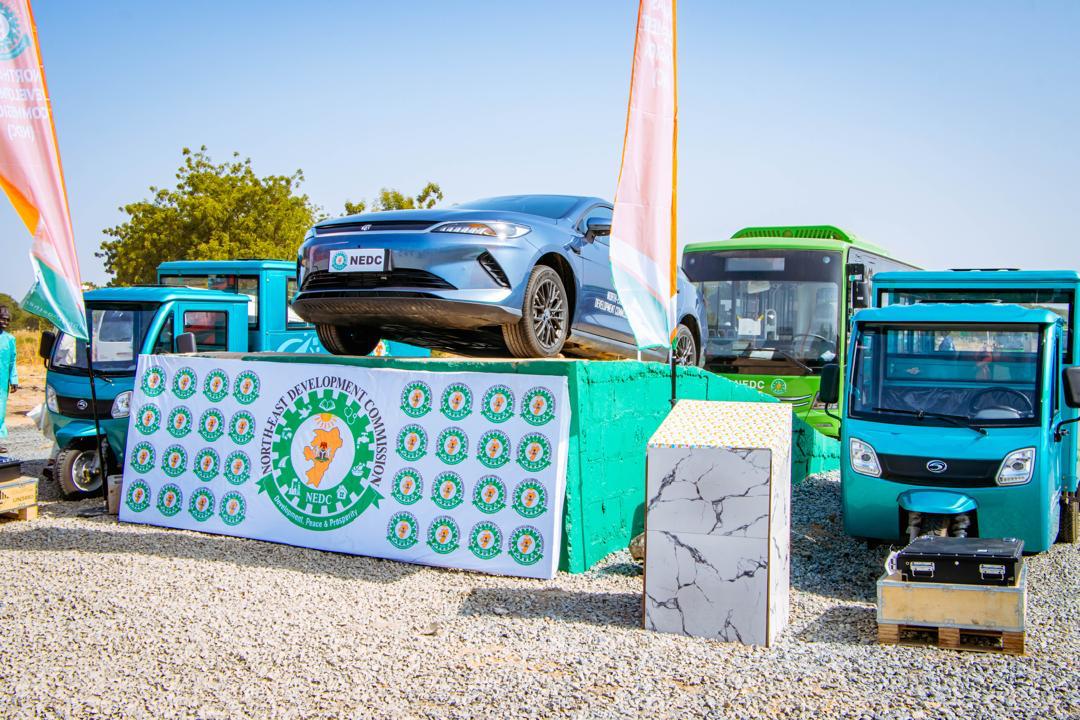
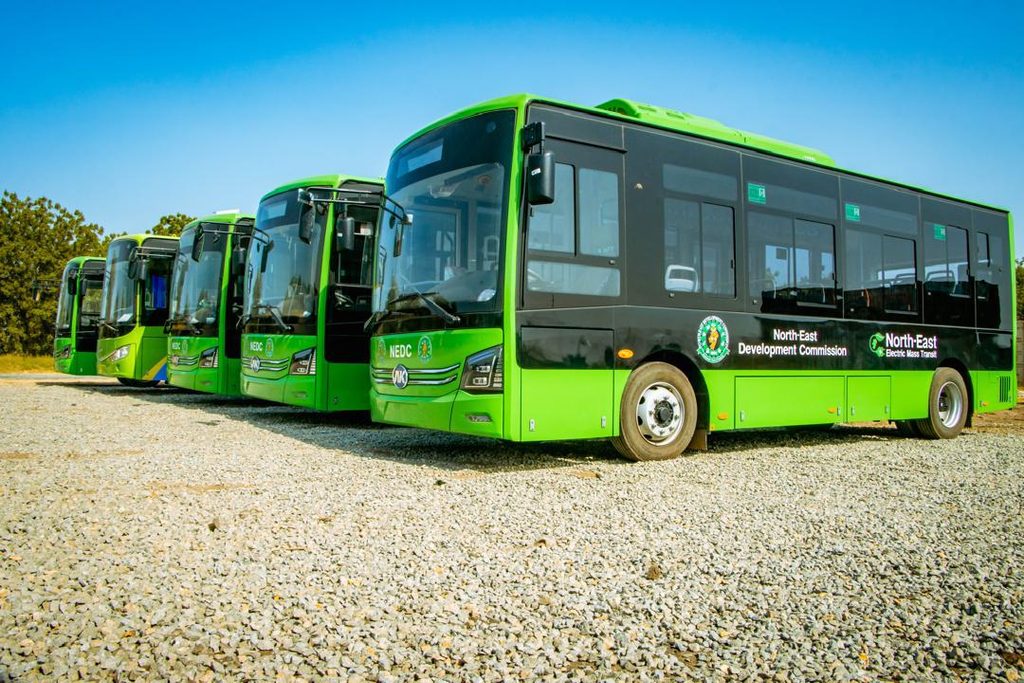
Vice-President Kashim Shettima on Tuesday unveiled 10,000 electric vehicles in Maiduguri, Borno State, as the Federal Government intensified efforts to rebuild the North-East, with the North-East Development Commission (NEDC) announcing plans to expand the fleet to more than 100,000 vehicles across the region.
The ambitious electric mobility programme, alongside plans to establish a regional airline and pharmaceutical company, signals a fresh push to transform the North-East from a region devastated by years of insurgency into an emerging centre of economic activity, industrial development and renewable energy investment.
The initiatives formed part of a series of development projects commissioned by Shettima in Maiduguri, covering transportation, roads, education, healthcare, agriculture, energy and humanitarian support, in what officials described as a significant milestone in the region’s reconstruction efforts.
The proposed expansion of the electric vehicle scheme, coupled with a planned 50-megawatt solar mini-grid project, also places renewable energy at the centre of the NEDC’s development strategy, particularly as the region seeks alternatives to expensive petrol-powered transportation and unreliable electricity supply.
Speaking at the commissioning ceremony, Shettima challenged governments and communities in the North-East to take advantage of the region’s abundant sunshine to develop solar energy and other alternative power sources.
He described electric mobility as essential to the region’s development, noting that the initiative would reduce dependence on petrol, ease transportation difficulties and support the transition to cleaner energy.
The Vice-President commended the NEDC and governors of the six North-East states for their contributions to the region’s recovery but stressed that the battle against Boko Haram insurgency, banditry and other security threats required sustained cooperation.
He called for greater unity among political leaders and stakeholders, insisting that the region’s development aspirations could only be achieved in an atmosphere of peace and stability.
The Minister of Regional Development, Abubakar Momoh, said the electric vehicle initiative was consistent with President Bola Tinubu’s Renewed Hope Agenda and would provide affordable transportation for women, youths, traders and farmers.
He said the intervention was designed not merely to improve mobility but also to stimulate commercial activities, support livelihoods and create opportunities for economic growth.
Momoh also highlighted the Jere Bowl road project, which is expected to improve access to agrarian communities and facilitate the transportation of agricultural produce, alongside the proposed 50-megawatt solar mini-grid initiative.
In a further indication of the commission’s long-term economic ambitions, the Minister of State for Regional Development, Uba Maigari Ahmadu, disclosed plans to establish an airline and a pharmaceutical company for the North-East.
The proposed investments are expected to broaden the region’s economic base, strengthen connectivity and create opportunities in the aviation and pharmaceutical sectors.
Borno State Governor and Chairman of the North-East Governors Forum, Babagana Zulum, said the region was gradually recovering from years of insecurity through rehabilitation, resettlement, innovation and infrastructure development.
Zulum, who commended the NEDC for its interventions, said the commission had made remarkable contributions to rebuilding communities and restoring hope among residents affected by the insurgency.
“No other government agency did what you have done,” the governor declared.
He expressed appreciation to Tinubu and Shettima for their support for the region, urging the Federal Government to sustain its commitment to security, reconstruction and economic recovery.
Gombe State Governor, Inuwa Yahaya, also praised the Federal Government for establishing regional development commissions, describing them as important institutions for addressing the peculiar development challenges confronting different parts of the country.
He commended the NEDC’s electric mobility programme and reaffirmed the commitment of governors in the region to collective action in advancing development.
Earlier, NEDC Managing Director, Mohammed Ali Alkali, said Shettima’s visit was not merely to console the people over the devastation caused by insurgency but also to witness the achievements and resilience of a region determined to rebuild itself.
Alkali said the 10,000 electric vehicles would help reduce dependence on petrol and ease transportation difficulties, while the commission was also investing in human capital development through skills acquisition programmes and scholarships.
He listed the commission’s interventions to include the construction and rehabilitation of roads and bridges, schools, hospitals, provision of medical equipment, boreholes, agricultural support, humanitarian assistance and livelihood programmes for vulnerable communities.
The managing director commended Tinubu for providing the funding and institutional support required to execute the commission’s development programmes.
The North-East, comprising Borno, Adamawa, Yobe, Bauchi, Gombe and Taraba states, has endured more than a decade of insurgency, particularly from Boko Haram and its splinter factions, resulting in widespread destruction of infrastructure, displacement of millions of people, disruption of agriculture and the collapse of economic activities in several communities.
The crisis has made reconstruction, rehabilitation and resettlement major priorities for governments and development partners, with Borno bearing a particularly heavy burden of the conflict.
Established to coordinate and accelerate the recovery of the region, the NEDC has been implementing interventions aimed at rebuilding critical infrastructure, restoring livelihoods, improving access to education and healthcare and addressing the development deficits that have compounded insecurity.
The latest projects underscore the growing emphasis on moving beyond emergency humanitarian interventions towards long-term economic recovery.
However, the success of the ambitious electric mobility programme and proposed investments in aviation, pharmaceuticals and solar energy will ultimately depend on effective implementation, sustainable financing, adequate infrastructure and the restoration of lasting security across the region.
Shettima Unveils 10,000 Electric Vehicles in North-East, NEDC Plans 100,000 Fleet, Airline, Pharmaceutical Firm
Yobe APC flag-off 2027 campaign in Damaturu
By: Yahaya Wakili
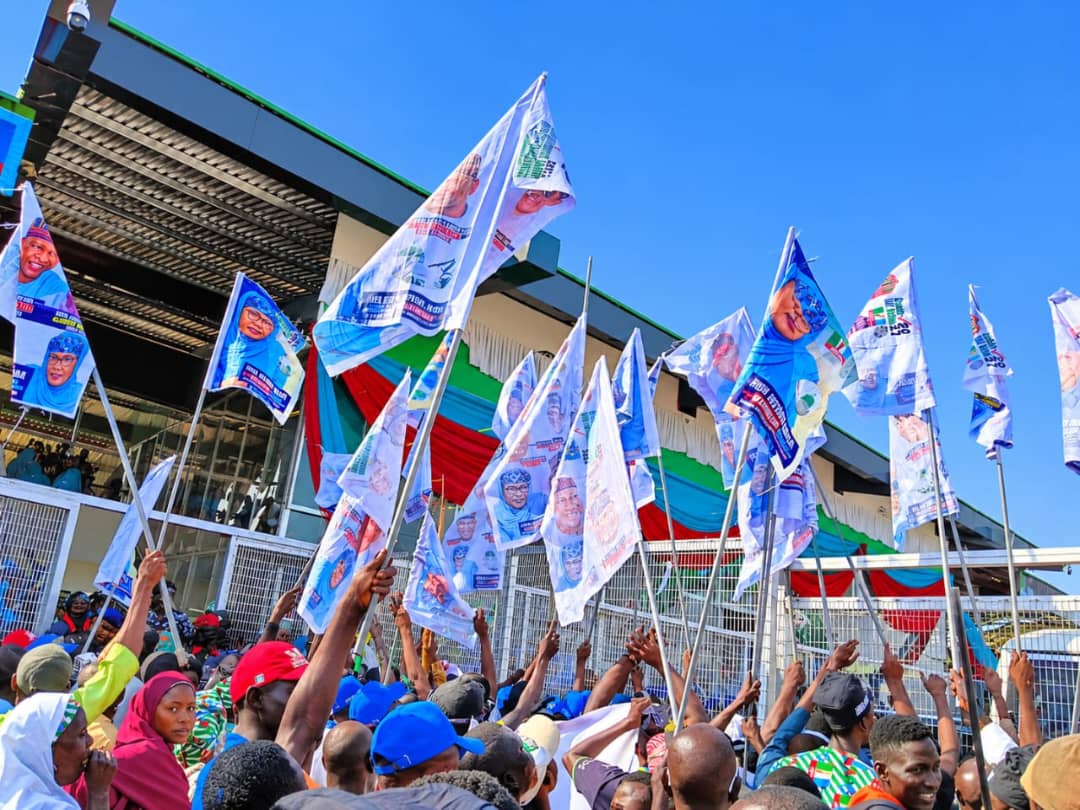
The All Progressives Congress (APC) Yobe state chapter has today officially flagged off its statewide campaign ahead of the 2027 general elections at the August 27 stadium in Damaturu, the state capital.
Addressing a massive crowd of APC supporters, the Minister of Police Affairs and Chairman of critical stakeholders in Yobe state, Senator Ibrahim Geidam, has cautioned members of the party against anti-party activities in the forthcoming general elections in the state and the country as a whole.
According to Senator Geidam, the party leadership has concrete evidence regarding those who worked tirelessly against the interest of the APC during the previous general elections in the state.
‘I have the record at my hand of those who participated in the non-success of the party in the past general elections, and I will disclose them now if possible,’ the Minister of Police Affairs added.
The highlight of the ceremony was the receiving of the large number of decampees from the PDP to APC. The defectors led by the former minister of science and technology, Dr. Abdu Bulama, and the former national chairman of the People’s Democratic Party (PDP), Ambassador Umaru Iliya Damagum.
In his remarks, Governor Mai Mala Buni CON, COMN of Yobe State, welcomed the defectors and presented them the party flags and commended them for what he described as a welcome development and solidarity to the party.
Governor Buni assured the defectors that the leadership of the All Progressives Congress (APC) in the state promised equal opportunities for the new members and called on all party supporters in the state to come out and en masse to vote for President Bola Ahmed Tinubu GCFR and all APC candidates from top to bottom.
Also speaking of the detector-general of the campaign council, Hon. Kaigama Umar Yunusari said the 2027 election is a competition between zone C and two other zones because this time around the governorship candidate is from zone C; the zone has never produced the governor or the deputy since the restoration of democracy in 1999.
Yobe APC flag-off 2027 campaign in Damaturu

“I Can Throw Stones At Atiku, But Obi, Kwankwaso, Makinde Are My Friends” — Shettima

Shettima Unveils 10,000 Electric Vehicles in North-East, NEDC Plans 100,000 Fleet, Airline, Pharmaceutical Firm

Yobe APC flag-off 2027 campaign in Damaturu

Roger Federer’s Shock as DNA Results Reveal Myla and Charlene Are Not His Biological Children

THE PLIGHT OF FARIDA

FAILED COUP IN BURKINA FASO: HOW TRAORÉ NARROWLY ESCAPED ASSASSINATION PLOT AMID FOREIGN INTERFERENCE CLAIMS
-
 News3 years ago
Roger Federer’s Shock as DNA Results Reveal Myla and Charlene Are Not His Biological Children
-
Opinions5 years ago
THE PLIGHT OF FARIDA
-
 News2 years ago
FAILED COUP IN BURKINA FASO: HOW TRAORÉ NARROWLY ESCAPED ASSASSINATION PLOT AMID FOREIGN INTERFERENCE CLAIMS
-
 Opinions5 years ago
POLICE CHARGE ROOMS, A MINTING PRESS
-

 News3 years ago
EYN: Rev. Billi, Distortion of History, and The Living Tamarind Tree
-

 ACADEMICS3 years ago
A History of Biu” (2015) and The Lingering Bura-Pabir Question (1)
-

 Columns3 years ago
Army University Biu: There is certain interest, but certainly not from Borno.
-

 Politics1 year ago
2027: Why Hon. Midala Balami Must Go, as Youths in Hawul and Asikira/Uba Federal Constituency Reject ₦500,000 as Sallah Gift
