
News
WAHO: “Until I get there, I won’t give up” — Pitche vows to transform West Africa’s health system


WAHO: “Until I get there, I won’t give up” — Pitche vows to transform West Africa’s health system
By: Michael Mike
Incoming Director-General of the West African Health Organisation (WAHO), Prof. Vincent Palokinam Pitche, has declared that he is determined to bring his experience, energy and reform agenda to bear on the region’s health sector, insisting that he would not relent until he delivers on the mandate entrusted to him.
Pitche, who is expected to assume office as head of the regional health institution, gave the assurance in an interaction ahead of his formal assumption of duty, outlining a vision anchored on stronger health systems, sustainable financing, regional solidarity and improved access to quality healthcare across West Africa.
His message — “Tant que je ne suis pas arrivé, je ne lâche rien”, loosely translated as “Until I get there, I won’t give up” — captures what he described as his determination to confront the complex health challenges facing the Economic Community of West African States (ECOWAS) region.
The incoming WAHO chief brings extensive experience in public health and disease-control programmes, particularly from Togo, where he played a prominent role in the country’s response to HIV/AIDS for nearly two decades.
That experience, according to observers, could prove crucial as West Africa confronts a health landscape increasingly defined by interconnected challenges — infectious diseases, emerging epidemics, maternal and child mortality, weak health infrastructure, shortages of health workers, inadequate domestic financing and growing pressure on already stretched public-health systems.
For Pitche, however, the region’s challenges cannot be addressed through isolated national interventions.
He believes West African countries must strengthen collective action and build health systems capable of responding not only to existing diseases but also to future health emergencies.
A major plank of his emerging agenda is the question of sustainable health financing.
Across much of West Africa, governments continue to rely heavily on external assistance to fund critical health programmes. While international support has played an important role in combating HIV/AIDS, malaria, tuberculosis and other diseases, the sustainability of such programmes remains vulnerable whenever donor priorities or funding levels change.
Pitche is therefore expected to place greater emphasis on mobilising domestic resources and encouraging governments to treat health expenditure as an investment in economic and human development rather than merely as a recurrent cost.
The issue is particularly significant for a region that continues to face substantial gaps in healthcare access and infrastructure.
A stronger regional approach, he argues, could allow member states to share expertise, coordinate responses to cross-border health threats, improve disease surveillance and make better use of scarce resources.
WAHO, headquartered in Bobo-Dioulasso, Burkina Faso, serves as the specialised health institution of ECOWAS and plays a central role in coordinating health interventions among member states.
Its mandate has become increasingly important as diseases and health emergencies pay little attention to national borders.
The COVID-19 pandemic, for instance, exposed the vulnerabilities of health systems across the continent while simultaneously demonstrating the importance of regional coordination, timely information sharing and joint procurement and response mechanisms.
West Africa has also experienced repeated outbreaks of infectious diseases, including Ebola and Lassa fever, reinforcing the need for stronger regional surveillance and preparedness.
Pitche’s arrival therefore comes at a critical moment for the organisation.
Beyond emergency response, the incoming Director-General faces the broader challenge of helping member states strengthen routine healthcare delivery — from primary healthcare and maternal services to disease prevention, health workforce development and access to essential medicines.
His professional background in HIV/AIDS programming is particularly relevant to the continuing effort to sustain gains made against the epidemic while integrating HIV services into stronger national health systems.
But the new WAHO leadership will also have to navigate the realities of the region’s diverse political and economic environment.
West African countries differ significantly in their health financing capacity, infrastructure, workforce availability and institutional strength. Political instability and insecurity in parts of the region have further complicated the delivery of healthcare, particularly in communities affected by conflict and displacement.
For Pitche, regional integration must therefore move beyond declarations and translate into practical cooperation that improves the lives of ordinary citizens.
His emphasis on results could become one of the defining features of his tenure.
Rather than measuring success solely through programmes launched or meetings held, the expectation is that WAHO under his leadership will increasingly focus on tangible outcomes — stronger health facilities, better disease surveillance, improved access to essential services, more resilient health workers and greater capacity of countries to finance their own health priorities.
The task will not be easy.
West Africa remains one of the regions with some of the world’s most significant health challenges, while governments must simultaneously contend with economic pressures, insecurity, demographic growth and competing development priorities.
Yet Pitche appears to be approaching the assignment with the conviction that progress is possible if countries work together and take greater ownership of their health systems.
His pre-assumption message is consequently more than a personal declaration of determination. It signals an ambition to make regional health cooperation more practical, sustainable and responsive to the realities confronting West African populations.
As he prepares to take the helm of WAHO, expectations will be high.
For millions of West Africans whose access to healthcare remains constrained by poverty, distance, inadequate infrastructure and shortages of medical personnel, the real test of the new leadership will not be the strength of its rhetoric but whether its policies translate into better health outcomes.
Pitche’s declaration that he will “not give up” until he arrives could therefore serve as an early statement of intent for what may become a consequential chapter in West Africa’s regional health cooperation.
WAHO: “Until I get there, I won’t give up” — Pitche vows to transform West Africa’s health system



N101m defamation judgment debt: A/Court begins hearing SERAP’s appeal Friday
The Court of Appeal in Abuja has scheduled hearing for Friday in the appeal filed by the Incorporated Trustees of the Socio-economic Rights and Accountability Project (SERAP) in relation to the May 5 judgment given against the group by a High Court of the Federal Capital Territory (FCT).
Information about the planned hearing date is contained in a notice sent on Wednesday by the appellate court’s Registry to parties in the appeal marked: CA/ABJ/CV/1114/2026.
Justice Halilu Yusuf of the High Court of the FCT had, in the May 5 judgment, awarded N101million in damages and cost against SERAP and its Deputy Director, Kolawole Oluwadare upon holding that they defamed two officials of the Department of State Services (DSS) through a false publication it made on September 10, 2024.
The judgment was on the suit marked: CV/4547/2024 filed by the DSS officials – Sarah John and Gabriel Ogundele – who accused SERAP and Oluwadare of making false claims in publications on the group’s website and social media platforms that the claimants invaded their Abuja office on September 9, 2024 and subjected them to harassment.
Justice Halilu Yusuf held among others that claimants led sufficient evidence that effectively established all the ingredients of defamation.
Justice Yusuf rejected that defence of justification raised by SERAP and Oluwadare on the grounds that they failed to provide evidence that their publications were not based on falsehood.
The judge noted that the words like invasion, forceful entry and harassment were used inaccurately, the defendants having admitted at trial that the DSS officials did not forcefully enter into SERAP’s premises and did not brandish any weapon
He held that the publications made by the defendants injured the reputation of the claimants in their professional capacity and standing in the society.
Justice Yusuf said: “Having been unable to establish invasion and harassment, the defence of justification fails. There is no doubt that the publication affected the claimants mentally and psychologically.”
The judge said, going forward, it was necessary for care and due diligence on the part of SERAP and its officials before releasing information to the public.
He added that in the exercise of their right to tweet and send information out, the defendants should be aware of the rights of others, particularly as it relates to government agencies and their officials.
The judge dismissed the objection raised by the defendants against the competence of the suit and held that the claimants possessed the requisite locus standi to file the suit over which the court has the jurisdiction to entertain.
He held that as against the defendants’ argument, the claimants must not be named in the publication complained about for defamation to be established.
Justice Yusuf noted that from when the claimants complained about the inaccuracy of the publications, the defendants failed to take any steps to pull down the injurious publication.
He proceeded to adjudge the publications as defamatory and awarded damages of N100million against the defendants in addition to N1m as cost of prosecuting the suit.
The judge also ordered the defendants to publish a public apology on SERAP’s website, X handle, two national daily newspapers and two television stations.
He held that the judgment sum shall attract 10 percent interest per annum from the date of the judgment until the sum is fully paid by the defendants.
N101m defamation judgment debt: A/Court begins hearing SERAP’s appeal Friday

NCYP Backs Tinubu’s 2027 Bid, Says Economic Reforms Must Translate Into Jobs
By: Michael Mike
The Northern Christian Youth Professionals (NCYP) has thrown its weight behind President Bola Ahmed Tinubu’s re-election bid in 2027, arguing that continuity in economic policy is necessary to consolidate ongoing reforms and translate Nigeria’s improving macroeconomic performance into jobs, investment and higher living standards.
The group’s position came as the World Bank reported that economic growth in sub-Saharan Africa is gaining momentum, with Nigeria among the countries whose growth forecasts have been upgraded, while warning that the next challenge is to convert growth into more jobs and better opportunities.
In a statement signed by its National Chairman, Isaac Abrak, on Tuesday, NCYP said Nigeria had reached a critical stage in its economic reform journey where the emphasis should shift from stabilisation to inclusive prosperity.
The group was reacting to President Tinubu’s Independence Day address on October 1, in which the President declared: “The emergency treatment is over. The foundation has been repaired,” and said the government’s economic priority had moved from correcting the country’s economic course to achieving “shared and widespread prosperity.”
According to NCYP, the latest World Bank assessment reinforces the argument that Nigeria must sustain the reforms rather than reverse course.
The World Bank said on October 6 that growth in sub-Saharan Africa was being supported by improved macroeconomic resilience, stronger domestic demand and investment, while noting that years of reforms and improved economic management had contributed to improved forecasts for countries including Nigeria. It nevertheless warned that growth remained insufficient to substantially reduce extreme poverty or create enough jobs for the region’s rapidly expanding labour force.
The World Bank’s latest country assessment similarly said Nigeria’s macroeconomic performance had improved further in 2026, with real GDP growth of 4.2 per cent in the first half of the year, compared with 3.9 per cent a year earlier.
It, however, cautioned that growth was still insufficient to generate enough productive jobs and materially reduce poverty, stressing the need for greater private investment, productivity, human capital development and job creation.
NCYP said this was precisely the challenge facing the Tinubu administration in the next phase of its economic programme.
“Nigeria must now move from reform to prosperity, from growth to jobs, and from jobs to poverty reduction,” the group said.
It noted that the country’s real GDP grew by 4.43 per cent in the second quarter of 2026, compared with 3.89 per cent in the first quarter, citing the National Bureau of Statistics’ latest GDP report. The NBS has published its Q2 2026 GDP report dated August 31, 2026.
While describing the improving growth trajectory as encouraging, NCYP maintained that headline economic figures would only become meaningful when ordinary Nigerians experienced improvements in employment, income and living conditions.
The group said youth development should therefore remain central to the next phase of the economic programme, particularly given Nigeria’s large young population.
It cited the Nigeria Education Loan Fund (NELFUND), saying more than 1.1 million students had gained access to tertiary education financing.
NELFUND’s current data shows that more than 1.08 million students have been supported across 37 states, with over ₦191 billion in loans disbursed, while its broader student-loan platform records more than 1.4 million registered students.
NCYP also backed proposed reforms to the National Youth Service Corps, saying a more productive national service scheme could equip graduates with specialised skills in agriculture, medicine, education, technology, digital innovation, infrastructure, the green economy, enterprise and the creative sector.
The organisation argued that Nigeria’s youthful population should be treated as an economic asset rather than merely a demographic challenge.
“With education, skills, financing and the right economic environment, our young people can become entrepreneurs, skilled professionals, job creators and drivers of industrialisation,” it said.
The group outlined what it described as the economic pathway to prosperity: reforms should create stability; stability should encourage investment; education and skills should create opportunities; enterprise should create businesses and jobs; while industrialisation should deliver sustainable prosperity.
It said the agenda was particularly important for Northern Nigeria, where it called for an economy capable of converting skills into enterprise, enterprise into jobs and jobs into sustainable livelihoods.
The World Bank has similarly identified the creation of more and better private-sector jobs as central to Nigeria’s long-term prosperity, with its 2026–2032 Country Partnership Framework focusing on competitiveness, private capital, human capital and resilience.
The Bank has also acknowledged that Nigeria’s recent reforms have strengthened macroeconomic stability, but warned that household incomes have not fully recovered and poverty remains high. It has called for the stabilisation gains to be consolidated while accelerating inclusive growth.
Against this backdrop, NCYP said it had decided to support President Tinubu’s re-election in 2027, framing the decision around continuity of economic policy.
“It is against this background that NCYP supports the re-election of President Bola Ahmed Tinubu in 2027, with our position anchored on policy continuity and the need to consolidate the economic reforms while moving decisively into the next phase of job creation, human-capital development and industrialisation,” Abrak said.
NCYP Backs Tinubu’s 2027 Bid, Says Economic Reforms Must Translate Into Jobs
37 Minna Deaths: Panel Flags Institutional Breakdown, Overzealousness in NSCDC Operation
…Committee seeks two-week extension, awaits forensic, pathology reports
By: Michael Mike
The Federal Government’s investigative committee probing the reported deaths of 37 persons in the custody of the Nigeria Security and Civil Defence Corps (NSCDC) in Minna, Niger State, has uncovered indications of possible institutional breakdown, overzealousness and inadequate training among personnel involved in the incident.
The committee, however, said it would not rush to a final conclusion, announcing that it had sought a two-week extension to complete its investigation and submit a “thorough and credible” report.
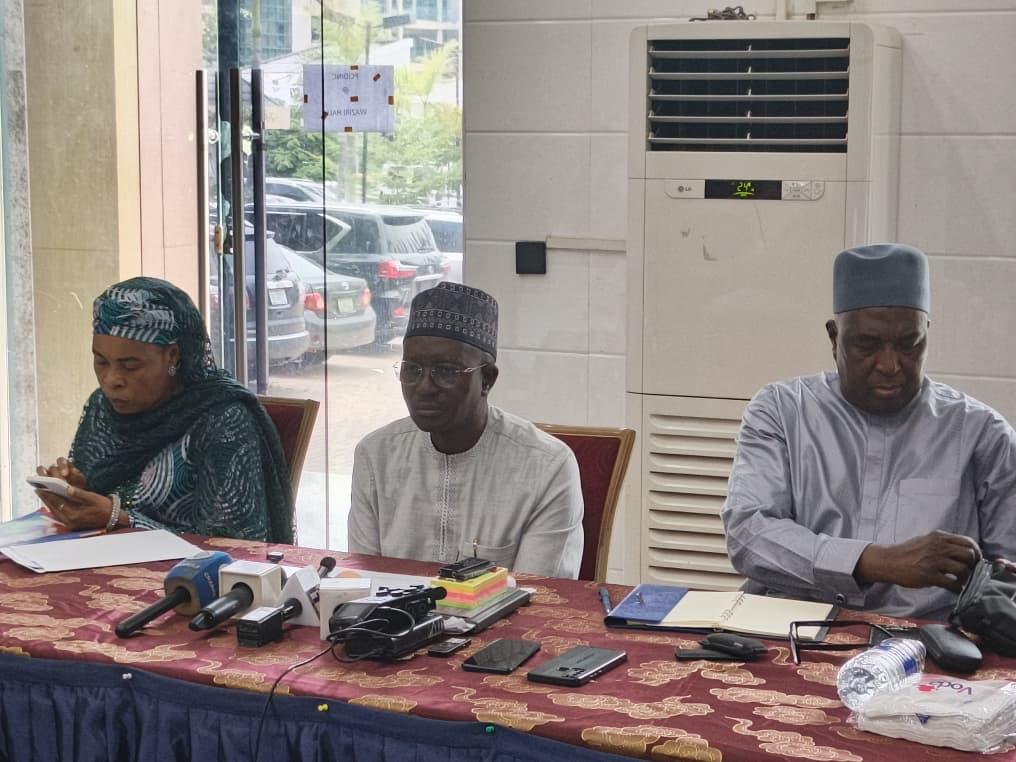
Chairman of the Independent Investigative Committee, Jonathan Kure (retd.), disclosed this on Tuesday during a press briefing in Abuja, saying the committee was yet to conclude its assignment because of the volume of evidence gathered and the need to obtain forensic and pathology reports.
The committee was originally expected to submit its report on October 7, but has requested an extension until October 21, 2026.
Kure said the committee had made appreciable progress since its inauguration, including inspection of the custody facility, conduct of autopsies, interviews with survivors and bereaved families, and the taking of statements from NSCDC personnel and other witnesses.
He said the panel had also visited the mining site and the Niger State Command headquarters of the NSCDC, where members examined the scene connected with the incident.
According to him, the committee had interacted with officers and men of the Civil Defence Corps who were involved either directly or indirectly, but was still engaging some of them as part of the investigation.
“Because of the peculiar nature of this investigation, it involves a large volume of testimonies and evidence which require our meticulous review and collation,” Kure said.
He added that the committee was still awaiting forensic and pathology reports considered critical to determining the causes of death.
The chairman stressed that the panel was determined to ensure that its eventual findings would withstand scrutiny and command public confidence.
He said persons implicated in the incident, including officers who had already been suspended, must be given an opportunity to respond before the committee reaches its final conclusions.
Beyond the immediate circumstances surrounding the deaths, Kure said the investigation had begun to point to broader institutional issues that would require attention.
“There are elements of institutional breakdown. There are elements of overzealousness. Some elements that will require more training for personnel,” he said.
The disclosure potentially broadens the scope of the investigation from establishing how the 37 persons died to examining whether weaknesses within the security and civil defence system contributed to the incident.
The reported deaths had triggered public concern and prompted the Federal Government to constitute the independent committee to investigate the circumstances surrounding the incident.
Kure said the committee had visited the affected communities, met the families of all the deceased and interacted with survivors in an effort to reconstruct what happened.
He said the panel was conscious of the grief suffered by the affected families and would ensure that its findings were based on evidence rather than speculation.
“We promised Nigerians a thorough job,” he said, adding that members of the committee would work throughout the additional two-week period to ensure that the final report did justice to the matter.
Kure said the extension would enable the committee to complete the review of documentary and forensic evidence, receive outstanding medical reports and hear from all persons whose conduct or actions might be relevant to the investigation.
He assured Nigerians that the panel would return with its report at the end of the extended period.
The committee’s request for additional time comes amid heightened scrutiny of security agencies and growing demands for accountability whenever deaths occur in official custody.
The final report is expected to determine the circumstances surrounding the deaths, establish responsibility where applicable and make recommendations aimed at preventing a recurrence.
37 Minna Deaths: Panel Flags Institutional Breakdown, Overzealousness in NSCDC Operation

N101m defamation judgment debt: A/Court begins hearing SERAP’s appeal Friday

Suspected cattle rustlers injure youth in isolated attack in Plateau

Troops arrest three suspected kidnappers in Kaduna

Roger Federer’s Shock as DNA Results Reveal Myla and Charlene Are Not His Biological Children

THE PLIGHT OF FARIDA

FAILED COUP IN BURKINA FASO: HOW TRAORÉ NARROWLY ESCAPED ASSASSINATION PLOT AMID FOREIGN INTERFERENCE CLAIMS
-
 News3 years ago
Roger Federer’s Shock as DNA Results Reveal Myla and Charlene Are Not His Biological Children
-
Opinions5 years ago
THE PLIGHT OF FARIDA
-
 News1 year ago
FAILED COUP IN BURKINA FASO: HOW TRAORÉ NARROWLY ESCAPED ASSASSINATION PLOT AMID FOREIGN INTERFERENCE CLAIMS
-

 News3 years ago
EYN: Rev. Billi, Distortion of History, and The Living Tamarind Tree
-
 Opinions5 years ago
POLICE CHARGE ROOMS, A MINTING PRESS
-

 ACADEMICS3 years ago
A History of Biu” (2015) and The Lingering Bura-Pabir Question (1)
-

 Columns3 years ago
Army University Biu: There is certain interest, but certainly not from Borno.
-

 Politics1 year ago
2027: Why Hon. Midala Balami Must Go, as Youths in Hawul and Asikira/Uba Federal Constituency Reject ₦500,000 as Sallah Gift
