
News
Youth O’clock engages stakeholders on peace-building in Gombe

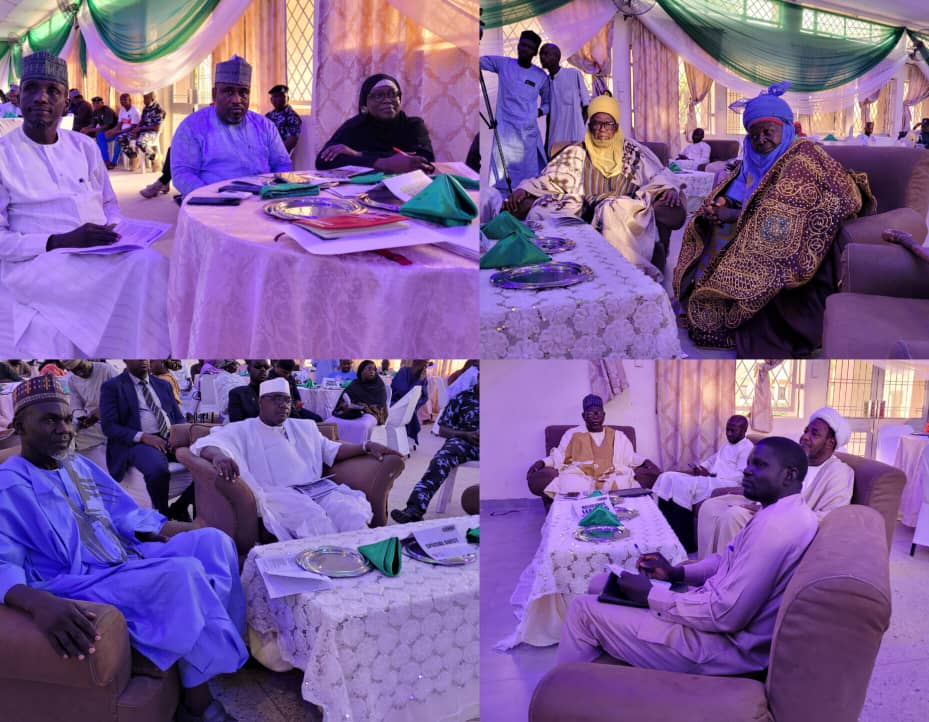
Youth O’clock engages stakeholders on peace-building in Gombe
Youth O’Clock Advancement Association, Gombe State chapter has organised a one-day dialogue to strengthen efforts at improving peaceful coexistence amongst citizens of Gombe State.
The dialogue which had Federal, State and local government officials, security agencies, traditional rulers, religious leaders, Civil Society Organisations, women groups and the media was themed: “Building Bridge, Promoting Peace, Fostering Harmony in Gombe State.”
The event, which was the Association’s first Peace dialogue, was hosted in Gombe on Saturday.
The Gombe State Commissioner for Internal Security and Home Affairs, Col. Abdullahi Bello (rtd.) restated the commitment of the state government to peace and security of lives and property in the state.
Bello said that the state government had taken measures and was regularly re-strategising ways of improving security in the state.
He urged residents to support the state government’s effort at maintaining the prevailing peace in the state for citizens to enjoy development and good governance.
For his part, the National Convener and Coordinator of Youth O’Clock Nigeria, Engr Seth Francis emphasised the need for all stakeholders to engage more towards smoothening relations and ensuring peace.
Francis said that there was need for citizens and stakeholders to support efforts towards building peace in the country.
“We realise that for the society to be at peace, there must be understanding and religious tolerance, and that’s why we brought the stakeholders together for a dialogue.
“We can’t really find solutions to our problems if we don’t understand one another.
“Our aim is to ensure that there is peace at the end of the dialogue; so we are urging the stakeholders to step down the message to their people towards strengthening the peace in Gombe State.”
Also speaking, Comrade Abdulazeez Sani Labaran, the Gombe State Coordinator of Youth O’Clock reiterated that the event was aimed at bringing out the young people to interact with religious leaders, traditional rulers, service chiefs and the media.
Labaran said the task of peace-building remained a collective one, hence the reason his association engaged all stakeholders towards strengthening peace in the state.
“We came to discuss on ways we can promote peaceful coexistence that will lead to further development.
“As we know, peace is everybody’s business and that’s why we needed to bring on board all the stakeholders to ensure that we contribute toward the enhancement of our peaceful coexistence in Gombe.”
He assured that more engagements would be carried out towards ensuring youths participation in peace building, governance and positive decision-making that would bring about a better country for all Nigerians.
He commended the participants for coming to dialogue and also to observe Iftar with them, noting that the outcome of the dialogue would encourage youths and other stakeholders to put all hands on deck towards sustaining Gombe State as a reference point for peace.
For her part, the Gombe State Director of National Orientation Agency (NOA), Mrs Adaline Patari commended Youth O’Clock for hosting its maiden peace dialogue, describing it as a worthy initiative that would contribute to peace-building efforts of the government.
Patari urged youths to support government at all levels towards building a better future for them and all citizens of the state and country
.Youth O’clock engages stakeholders on peace-building in Gombe



2027: Nigeria Needs Issue-Based Political Discourse and Genuine Leadership
By: Dr James Bwala
Going through the pages of newspapers, the drama that is taking over Nigeria’s approaches to the 2027 presidential elections is disconcerting. The pattern that dominates the political landscape speaks less of the personalities falling over themselves as the days unfolded. Politicians are fixated more on personal attacks and partisan squabbles than on substantive discussions about national challenges and solutions. This trend is not only counterproductive but also detrimental to Nigeria’s democratic progress and socio-economic development. For a country grappling with profound insecurity, widespread poverty, and pervasive corruption, the electorate deserves leaders who prioritise meaningful dialogue about policies and governance rather than engage in divisive rhetoric and political mudslinging.
The current state of political discourse reveals a troubling shift away from issue-based debates towards an obsession with personalities and irrelevant vendettas. A glaring example is the recent exchange between supporters of President Bola Tinubu and former Vice President Atiku Abubakar. When an Atiku supporter lambasted President Tinubu by questioning the public’s knowledge of his father, it exposed not only the pettiness of political arguments but also their irrelevance to the electorate’s pressing concerns. Ironically, the same critic forgets that Atiku himself has little public discourse about his own paternal background, underscoring how such personal attacks add no value to the presidential contest. More importantly, the lineage or parentage of these candidates bears absolutely no relevance to their ability to govern Nigeria effectively or address the nation’s myriad problems. Yet, this shallow focus distracts from urgent national issues that demand serious attention.
Similarly, Tinubu’s supporters have largely resorted to celebratory chants like “On your mandate we shall stand” instead of articulating and showcasing the tangible achievements or policy successes under the Tinubu-Shettima administration. Such displays may cultivate loyalty among core supporters but do little to persuade undecided voters or sceptics who seek evidence of competent governance. What Nigerians require are detailed outlines of policy frameworks and measurable progress reports on security, economic reforms, healthcare, education, and anti-corruption efforts—outcomes that directly impact daily lives. The absence of these critical conversations speaks volumes about the superficiality permeating political campaigns.
The disturbing episode involving Bishop Onayinkon and the Sultan of Sokoto further exemplifies the politics of distraction. While these revered figures occasionally become embroiled in political controversies, the essential “table” where politicians should lay down concrete plans remains conspicuously empty. Whether in the ruling party or the opposition, there is scant evidence of genuine engagement with the core issues undermining Nigeria’s stability and prosperity. Instead, time and resources are expended on symbolic gestures or media-driven theatrics rather than strategic policymaking and governance innovation.
As the opposition coalition attempts to regroup, with Atiku and Peter Obi supporters exploring alliances like the new G-100 coalition, numerous questions arise. For the new G-100 coalition, numerous questions loom large. Can these groups, historically divided by ideology and political ambition, genuinely reconcile and formulate a cohesive governance blueprint? Or will their efforts devolve into another round of factionalism and power struggles that fail to address Nigeria’s fundamental needs? The success or failure of such coalitions will significantly influence Nigeria’s political trajectory, underscoring the imperative for unity premised on substantive policy alignment rather than mere electoral arithmetic.
Giving this background, the broader socio-political context cannot be ignored. Nigeria’s challenges are deeply entrenched and multifaceted. Insecurity remains pervasive, with insurgency, banditry, kidnappings, and communal conflicts destabilising communities and eroding citizens’ confidence in government protection. Simultaneously, poverty continues to ravage millions, with economic inequality starkly visible in urban slums and rural hinterlands alike. Corruption, the perennial cancer afflicting governance structures, persists despite institutional anti-corruption agencies’ existence, largely due to weak enforcement, political interference, and lack of transparency.
Regrettably, government bodies tasked with combating these challenges have yet to deliver tangible results that speak at the grassroots level. Public trust in institutions is waning, and this vacuum often fuels apathy or cynicism during elections. Adding to the complexity, grassroots conversations across Nigerian towns and villages reveal a palpable anxiety about the future. Voters whisper tentative plans, alliances, and expectations ahead of 2027, signifying both hope and uncertainty. These silent discourses often escape mainstream political narratives but are crucial indicators of public sentiment and priorities.
From all indications, a critical juncture lies ahead. The political actors have a clear choice: continue with self-serving battles and distractions that risk further destabilising Nigeria’s fragile democracy, or rise above partisan bickering to offer authentic leadership grounded in ideas, solutions, and national interest. Nigerians deserve a “full table” of ideas—a comprehensive agenda addressing insecurity, poverty alleviation, systemic corruption, economic diversification, infrastructure development, education reform, and social cohesion. Without this, the elections risk becoming a mere spectacle of personalities rather than a genuine exercise in democratic renewal.
The fact remains that the 2027 Nigerian presidential elections must transcend the current culture of personal attacks and symbolic posturing. For Nigeria to progress, politicians must shift focus from criticising each other’s lineage or engaging in hollow celebrations to presenting substantive plans that respond to the nation’s critical challenges. The electorate deserves leaders who speak boldly about what they can contribute to Nigeria’s development and who demonstrate commitment to transparent governance and inclusive growth. Only through such a transformation in political discourse can Nigeria hope to build a more secure, prosperous, and united future. The days ahead will reveal whether Nigerian politicians choose to build bridges or deepen divisions—but the stakes could not be higher for the country and its people.
- James Bwala, PhD, writes from Abuja.
- 2027: Nigeria Needs Issue-Based Political Discourse and Genuine Leadership

Troops Arrest Suspected Terrorist Logistics Vendor in Adamawa
By Zagazola Makama
Troops of the Nigerian Army have arrested two suspected associates of terrorists, including an alleged logistics vendor, during an intelligence-led operation in Mubi, Adamawa State.
The operation was conducted at about 9:50 p.m. on Aug. 6 by troops of 247 Reconnaissance Battalion, in conjunction with a local hunters’ group, following intelligence that a suspected terrorist associate was operating in Mubi under the guise of a businessman and Bureau de Change operator.
The main suspect, identified as Alhaji Adamu Abba, 39, was arrested alongside his associate, Abdulhamid Shamsudeen, 31, at Wurobululde in Mubi South Local Government Area.
Abba, a Kanuri from Banki, is reportedly resident in Tasha-Gella, Mubi South. During preliminary interrogation, he allegedly disclosed that he had worked with terrorists for about 10 years at a terrorist camp in Ndawori, Borno State, before leaving the camp for Cameroon and later relocating to Mubi.
Items recovered from Abba included one Infinix Android phone, one Tecno button phone, one Itel power bank, one Salti motorcycle and ₦65,000 cash.
Items recovered from Shamsudeen included one Tecno Spark 8P phone, one Itel power bank, ₦162,700 cash and 262,500 CFA francs.
The suspects remain in military custody and are undergoing further investigation.
Troops Arrest Suspected Terrorist Logistics Vendor in Adamawa
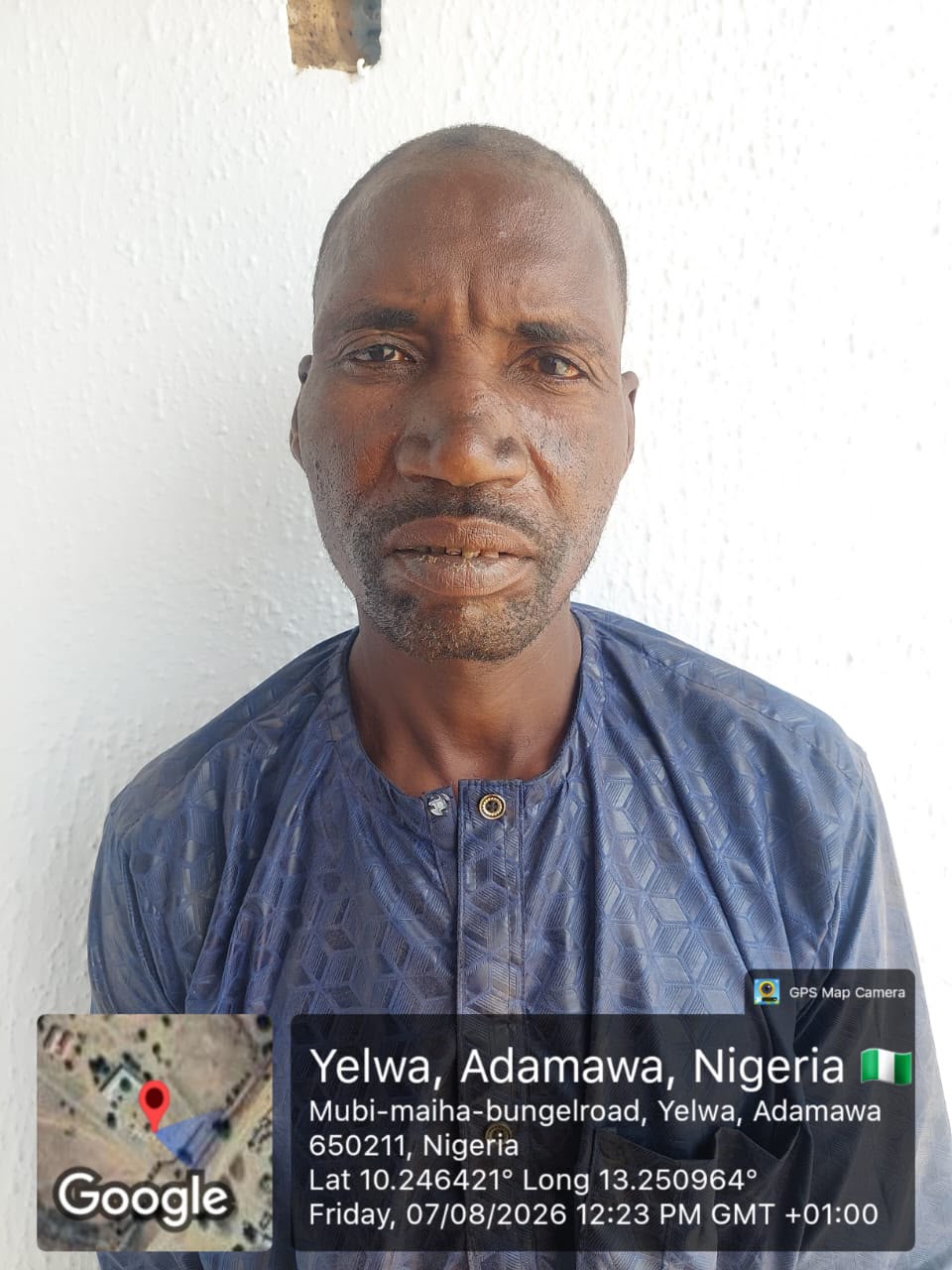
Troops Arrest Suspected Terrorist Logistics Supplier in Adamawa
By Zagazola Makama
Troops of the Nigerian Army have arrested a suspected Boko Haram terrorist logistics supplier during a joint operation with local hunters in Hong Local Government Area of Adamawa State.
The suspect, identified as Mallam Badamasi Maikudi, 40, was arrested at about 6:30 p.m. on Aug. 6 in Garaha town, following suspicious movements within the community.
According to military sources, troops of 232 Battalion (Tactical), working with a hunters’ group, apprehended the suspect after observing his activities in the area.
Preliminary information indicated that Maikudi was allegedly a regular supplier of energy soft drinks and foodstuffs to a suspected terrorist location.
The suspect is currently in military custody and is undergoing investigation to establish the extent of his links with the terrorist network.
Troops Arrest Suspected Terrorist Logistics Supplier in Adamawa

2027: Nigeria Needs Issue-Based Political Discourse and Genuine Leadership

Troops Arrest Suspected Terrorist Logistics Vendor in Adamawa

Troops Arrest Suspected Terrorist Logistics Supplier in Adamawa

Roger Federer’s Shock as DNA Results Reveal Myla and Charlene Are Not His Biological Children

THE PLIGHT OF FARIDA

FAILED COUP IN BURKINA FASO: HOW TRAORÉ NARROWLY ESCAPED ASSASSINATION PLOT AMID FOREIGN INTERFERENCE CLAIMS
-
 News2 years ago
Roger Federer’s Shock as DNA Results Reveal Myla and Charlene Are Not His Biological Children
-
Opinions4 years ago
THE PLIGHT OF FARIDA
-
 News1 year ago
FAILED COUP IN BURKINA FASO: HOW TRAORÉ NARROWLY ESCAPED ASSASSINATION PLOT AMID FOREIGN INTERFERENCE CLAIMS
-

 News2 years ago
EYN: Rev. Billi, Distortion of History, and The Living Tamarind Tree
-
 Opinions5 years ago
POLICE CHARGE ROOMS, A MINTING PRESS
-

 ACADEMICS2 years ago
A History of Biu” (2015) and The Lingering Bura-Pabir Question (1)
-

 Columns2 years ago
Army University Biu: There is certain interest, but certainly not from Borno.
-

 Politics1 year ago
2027: Why Hon. Midala Balami Must Go, as Youths in Hawul and Asikira/Uba Federal Constituency Reject ₦500,000 as Sallah Gift
