
News
Gov. Buni’s Long Stretch of Generosity

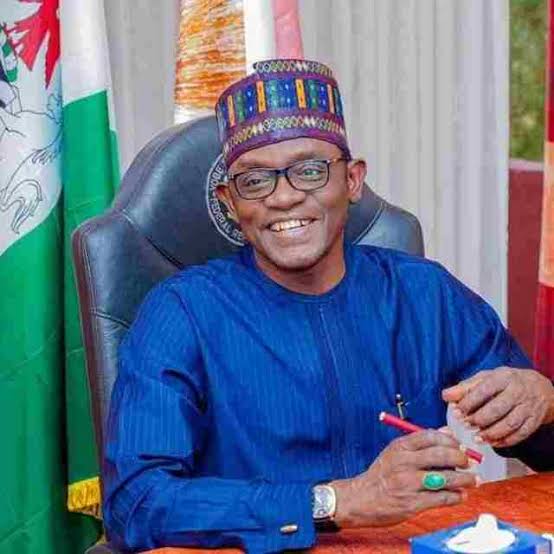
Gov. Buni’s Long Stretch of Generosity
By Umar Ali Kime
“The nourishment of the body is food, while the nourishment of the soul is feeding others” – Imam Ali Rahimullah.
The Executive Governor of Yobe state, Hon. Mai Mala Buni CON, has repeatedly said “there is no joy in wealth until and unless, someone benefits from it”. This corroborates the maxim which says “life is good when you are happy, but much better when others are happy because of you.”
There is no doubt that Gov. Buni has a special passion for making others happy, loved and dignified as clearly exemplified in his personal interactions, goodwills and gifts in cash, kind or both such that those meeting him for the first time are never in a haste to leave, while the familiar faces are already addicted to him.
Let me share my long cherished experience as a beneficiary of his generosity at a very youthful age. As classmates in our secondary school days, after the long vacation, my father was yet to return from his trip to Lagos and we were billed to return to school. It became naturally obvious for me that l will not join my mates to go back to school. The news of my predicament went viral and filtered into the ears of young Buni. He visited me at home and surrendered his transport and pocket money given to him by his father to return to school. The gesture was both unbelievable and scary. I could not take the money from this amateur philanthropist but he insisted and dropped the money only to go back home to tell his father what he did and requested for another transport and pocket money. This is a story l will live with for my entire life.
Today, it is an indisputable fact that His Excellency Governor Mai Mala Buni CON, has become a leading symbol of care, concern and support to orphans, indigent families, vulnerable groups, and People Living with Disabilities. It is therefore not surprising that his generosity has tremendously expanded to reach more people to satisfy his desire of assisting the less privileged persons in the society.
Just recently, at this crucial moment of economic hardship, Gov. Buni supported 1,000 orphans across the state with N50,000 each to enjoy the Ramadan season and also get new clothes for the Sallah festival for them to have a sense of belonging, love, and dignity.
He said the spirit of giving should be encouraged to go beyond the month of Ramadan. “The importance of such a kind gesture is that it promotes mutual respect and love, and in the same vein, eliminates hatred and envy. Above all, it earns us Allah’s Pleasure” .
Many orphans are today beneficiaries of government programmes with a special care given to them to pursue education at all levels.
“A very good percentage of orphans have been enrolled and sponsored by the State government to pursue education from primary schools up to tertiary level. Furthermore, many of them were enrolled in the Tsangaya Education System in the State” the Governor said.
When he assumed office as the governor of Yobe state in 2019, Governor Buni, visited YETIM orphanage care centre in Damaturu and increased its monthly running cost from N500,000 to N1 million.
He said that became necessary because, children orphaned by Boko Haram insurgency need the collective support by government, Non-Governmental Organizations and individuals, adding “the orphans are children to all of us, and we must give them a sense of belonging by catering for their needs, and that cannot be done by government alone, it’s a collective responsibility.”
It is gratifying that efforts are being made to provide widows and orphans in the state with empowerment packages for self-reliance, empowerment and employment generation. In 2023, the Yobe state government supported 400 widows and 200 orphans from across the 17 Local Government areas with start-up capital to promote self-reliance.
The effective performance by the Yobe State Emergency Management Agency in delivery of consumable and non consumable items to the targeted beneficiaries had been very impressive.
In Yobe state, the distribution of rice, Millet, Maize, Sorghum, Beans, beddings, soaps, and detergents among others has become a common sight. The free education and expanded free Healthcare Scheme has provided the orphans, the poor and vulnerable persons with opportunities to access education, and effective healthcare services in the state.
Governor Buni is personally sponsoring orphans, PLWD and other vulnerable persons in the Yobe State Contributory Healthcare system to access free medical services.
The construction of over 2,000 housing units has no doubt checked the housing deficit in Damaturu, the state capital, the 17 local government headquarters, and other major towns. The good news about this project is that widows and orphans, the vulnerable and People Living with Disabilities are all beneficiaries of the housing intervention. What is more? Governor Buni gave out the houses with a fifty percent (50%) subsidy. Meaning, the beneficiaries are ro pay only fifty percent of the houses. In recognition and appreciation of this incredible performance, the Africa Housing Award, conferred on the benevolent governor, the ‘Best Housing Friendly Governor’s award’ on Buni.
Under his watch, the state government through the Ministry of Wealth Creation, Empowerment and Employment Generation has empowered 68,000 widows, orphans, the indigent and People Living Disabilities with equipment and start-up capital worth over N1.3bn.
The provision of 100 Avensis cars worth over N461 million to professional drivers under the empowerment programme has definitely changed the status of the beneficiaries from drivers to proud car owners.
Governor Buni’s long stretch of goodwill has no doubt reached so many people from far and near, and impacted positively on their lives, with more opportunities to live a life with dignity.
Umar can be reached on kime1920@gmail.com
Gov. Buni’s Long Stretch of Generosity


NIMC Pushes Digital Identity Reforms to Boost Service Delivery, Security
By: Michael Mike
The National Identity Management Commission (NIMC) has reaffirmed its commitment to strengthening Nigeria’s Digital Public Infrastructure (DPI) through the deployment of secure digital identity systems aimed at improving governance, enhancing national security, and expanding access to public services.
Speaking at a digital conference in Abuja themed “Building Africa’s Digital Foundations Together,” the Director-General and Chief Executive Officer of NIMC, Abisoye Coker-Odusote, represented by the Head of Infrastructure Technology and Identity Databases, Mr. Sulaiman Falade, said the commission is driving reforms and institutional partnerships to build an inclusive and interoperable digital identity ecosystem.
According to her, the National Identification Number (NIN) has become central to Nigeria’s digital transformation agenda, serving as a key tool for identity verification, biometric authentication, and access to both government and private sector services.
She noted that following the Presidential Directive issued on April 5, 2024, Ministries, Departments and Agencies (MDAs) were mandated to integrate the NIN into digital services, particularly in areas involving data capture, identity verification, and authentication processes.
Coker-Odusote stated that NIMC has already established implementation structures to ensure compliance with the directive and to deepen the adoption of digital identity solutions across the country.
She further stressed that the Federal Government’s vision is to establish a unified, secure, and transparent digital identity framework capable of supporting efficient service delivery and accountability in governance.
The NIMC boss added that the commission is also advancing Nigeria’s broader digital governance goals through the deployment of the National Public Key Infrastructure (nPKI), a system designed to strengthen trust in digital transactions, safeguard citizens’ data, and promote secure online interactions.
She called on stakeholders in both the public and private sectors to continue supporting the implementation of Nigeria’s digital identity ecosystem, noting that the initiative is critical to national development and economic growth.
According to her, NIMC remains committed to leveraging technology and innovation to build a more connected, efficient, and resilient nation.
NIMC Pushes Digital Identity Reforms to Boost Service Delivery, Security
Tinubu Sweeps Zulum’s Ward with 100% Votes in APC Presidential Primary
By: Michael Mike
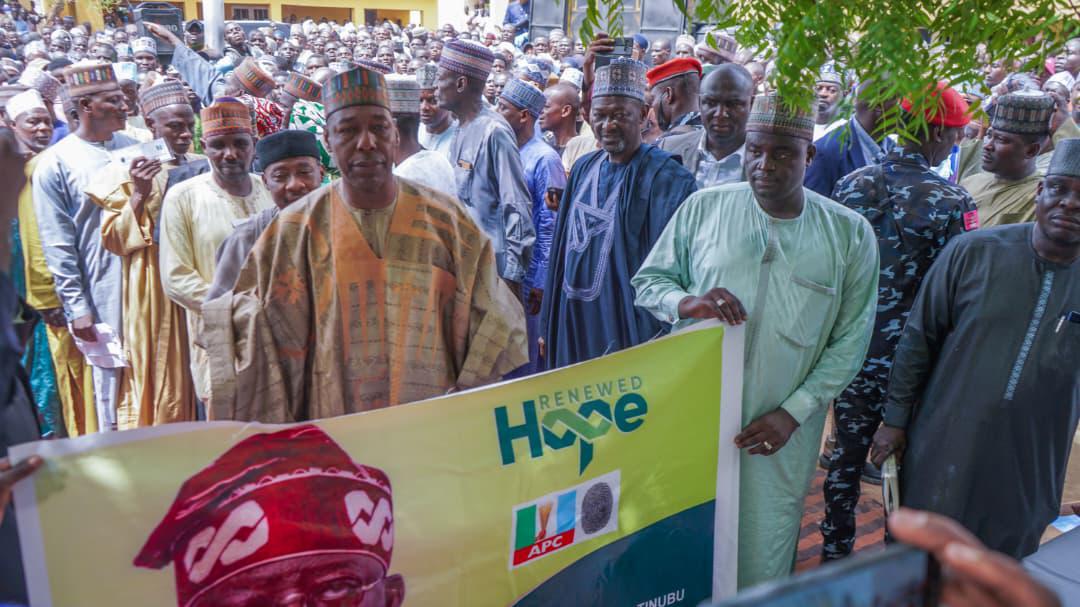
President Bola Ahmed Tinubu recorded a landslide victory in the All Progressives Congress (APC) presidential primary election in Mafa Ward of Borno State, securing all valid votes cast in the exercise held in the home ward of Governor Babagana Umara Zulum.
The direct primary election took place at Mafa Central Primary School under the supervision of the Chairperson of the Presidential Primary Election Committee, Hajiya Inna Alkali Imam.
According to the results announced at the ward level, Tinubu polled 2,175 votes, representing 100 per cent of the valid votes cast during the exercise. Out of the 2,277 registered APC members in the ward, 2,175 were accredited and participated in the voting process.
Tinubu’s challenger, Stanley Osifo, an APC chieftain and businessman from Edo State, failed to secure any vote in the ward.
Governor Zulum, who served as the Coordinator and Collation Officer for the presidential primary in the state, said he participated in the exercise as an indigene of Mafa Ward.
“I am from Mafa Ward, and that is why I am here to witness and participate in the exercise. We have two candidates, President Bola Ahmed Tinubu and Mr Stanley Osifo,” Zulum stated.
The governor also commended the peaceful conduct of the exercise and the turnout of party members.
“So far so good, we have conducted the presidential primary election for Mafa Ward, and I am very impressed with the turnout. We have a total of about 2,277 registered party members in Mafa Ward, out of which 2,175 were accredited for the voting, and all of them voted for President Bola Ahmed Tinubu, while the other candidate scored zero,” he said.
The APC presidential primary is ongoing in several states across the country, with the party expected to collate and announce final nationwide results at a later date.
Tinubu Sweeps Zulum’s Ward with 100% Votes in APC Presidential Primary
News
I Remember At Age Of 8,General Gowon Would Send Hand Written Letter To Yusuf Signed Uncle Joe-Sanusi

I Remember At Age Of 8,General Gowon Would Send Hand Written Letter To Yusuf Signed Uncle Joe-Sanusi
By: Our Reporter
The 16th Emir of Kano, Muhammadu Sanusi II, has recounted a touching childhood memory about former Nigerian Head of State Yakubu Gowon, portraying him as a compassionate leader who extended personal support to the family of a military officer killed during the 1966 coup.
Speaking during an interview on Signature TV, Sanusi reflected on his early years at St Anne’s Secondary School in Kaduna, where he attended school alongside Yusuf Pam, the son of the late Colonel Joseph Pam, one of the victims of the January 1966 Nigerian coup.
The former governor of the Central Bank of Nigeria recalled that despite the demands of national leadership, Gowon took a personal interest in the wellbeing of Yusuf following the loss of his father. According to Sanusi, the former Head of State frequently sent handwritten letters to the young boy, signing them “Uncle Joe.”
“What I remember at the age of eight was that General Gowon, as Head of State, would send a handwritten letter to Yusuf signed ‘Uncle Joe.’ That is a window into the person you are dealing with,” Sanusi said.
The Emir noted that the gesture has remained vivid in his memory over the years because it revealed a caring and humane side of leadership during one of the most turbulent periods in Nigeria’s history. He suggested that Gowon’s actions reflected empathy and a sense of responsibility toward families affected by the political upheaval of the time.
Colonel Pam was among several prominent figures who lost their lives during the 1966 coup, a pivotal event that reshaped Nigeria’s political landscape and contributed to years of instability and conflict that followed.
I Remember At Age Of 8,General Gowon Would Send Hand Written Letter To Yusuf Signed Uncle Joe-Sanusi

APC Primary peaceful, as Tinubu clears vote in Adamawa South -Abbati

NIMC Pushes Digital Identity Reforms to Boost Service Delivery, Security

Tinubu Sweeps Zulum’s Ward with 100% Votes in APC Presidential Primary

Roger Federer’s Shock as DNA Results Reveal Myla and Charlene Are Not His Biological Children

THE PLIGHT OF FARIDA

FAILED COUP IN BURKINA FASO: HOW TRAORÉ NARROWLY ESCAPED ASSASSINATION PLOT AMID FOREIGN INTERFERENCE CLAIMS
-
 News2 years ago
Roger Federer’s Shock as DNA Results Reveal Myla and Charlene Are Not His Biological Children
-
Opinions4 years ago
THE PLIGHT OF FARIDA
-
 News1 year ago
FAILED COUP IN BURKINA FASO: HOW TRAORÉ NARROWLY ESCAPED ASSASSINATION PLOT AMID FOREIGN INTERFERENCE CLAIMS
-

 News2 years ago
EYN: Rev. Billi, Distortion of History, and The Living Tamarind Tree
-
 Opinions4 years ago
POLICE CHARGE ROOMS, A MINTING PRESS
-

 ACADEMICS2 years ago
A History of Biu” (2015) and The Lingering Bura-Pabir Question (1)
-

 Columns2 years ago
Army University Biu: There is certain interest, but certainly not from Borno.
-

 Politics12 months ago
2027: Why Hon. Midala Balami Must Go, as Youths in Hawul and Asikira/Uba Federal Constituency Reject ₦500,000 as Sallah Gift
