
News
Group Demands Transparency, EIAs Over JBS’ $2.5bn Nigeria Investment

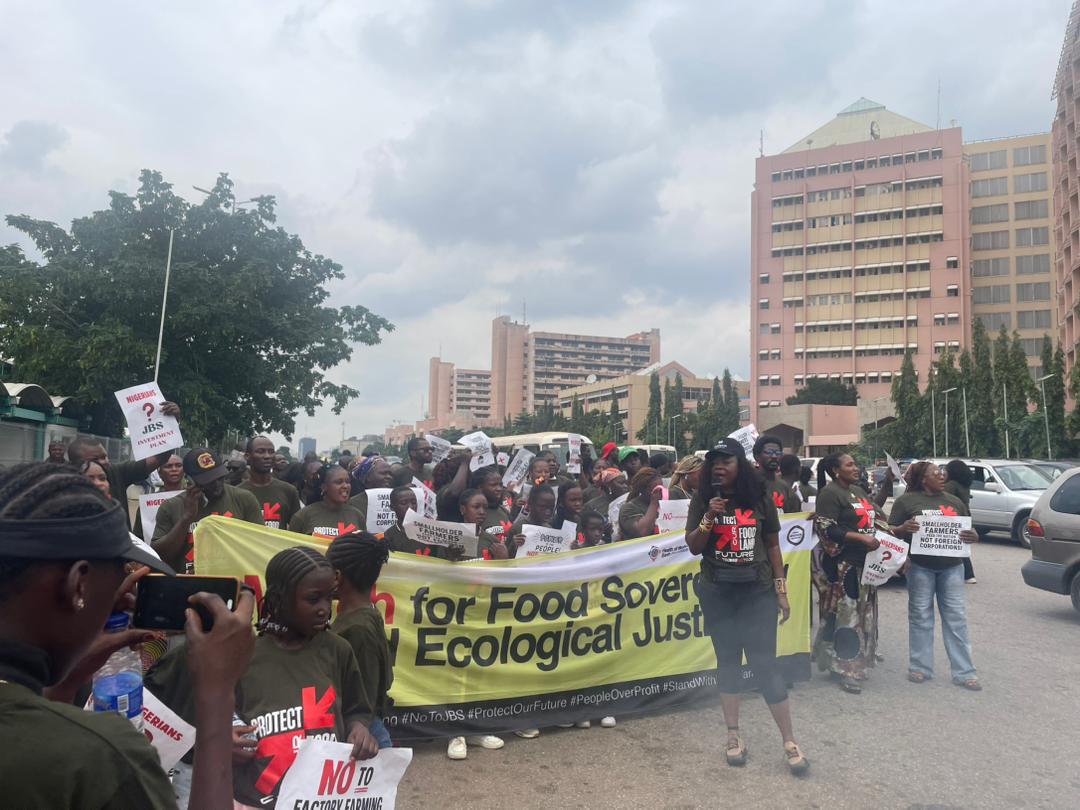
Group Demands Transparency, EIAs Over JBS’ $2.5bn Nigeria Investment
By: Michael Mike
The Environmental Rights Action/Friends of the Earth Nigeria (ERA/FoEN) has demanded full disclosure of the agreement between the Federal Government and global meat-processing giant JBS over its proposed $2.5 billion investment in Nigeria, warning that the project must not proceed without rigorous environmental and multi-sectoral scrutiny.
The environmental rights organisation said it was not opposed to foreign investment, job creation or industrial development, but insisted that the proposed JBS project must be subjected to transparent negotiations, independent environmental assessments and effective regulatory oversight to ensure that Nigerians and host communities do not bear the cost of the investment.
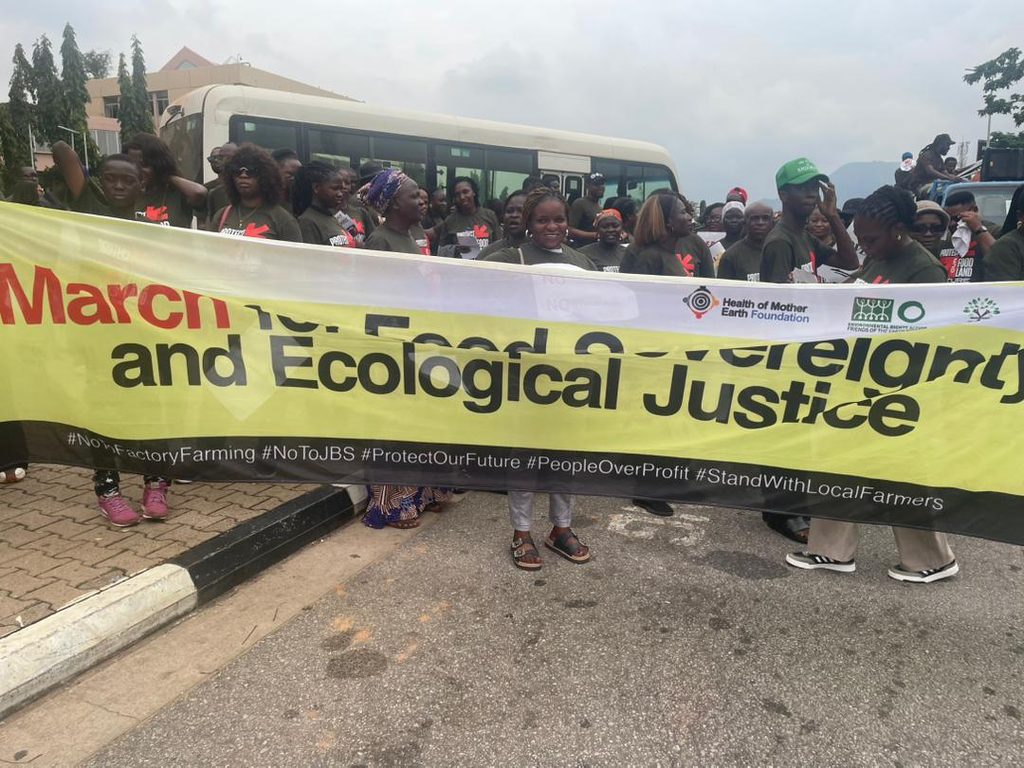
Deputy Executive Director of ERA/FoEN, Mariam Bassey-Olson, said the controversy surrounding the proposed investment should not be framed as a choice between development and opposition to foreign capital.
She said the critical issue was the nature of the investment, its terms, the resources it would require and its potential consequences for Nigeria’s farmers, communities, environment and food system.
“When people hear a company is coming to Nigeria and is bringing $2.5 billion, our first reaction is fantastic jobs, investment, infrastructure and development. But before we celebrate the numbers, we need to pause and ask a fundamental question: what exactly is this investment?” she said.
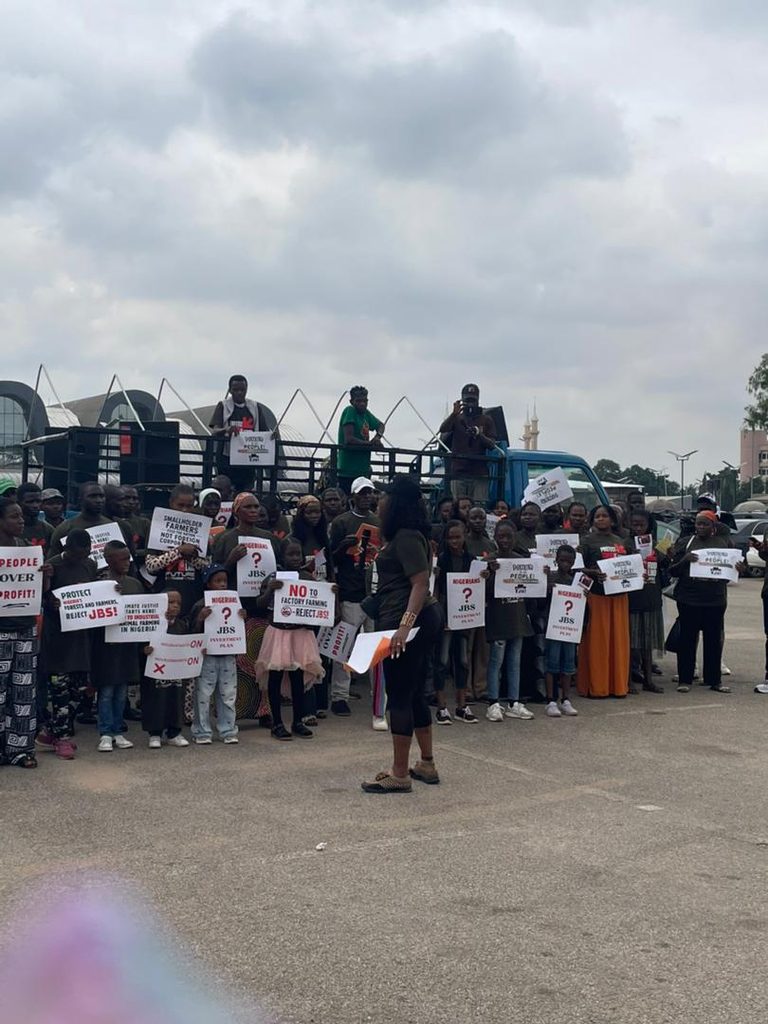
The proposed project reportedly involves the establishment of six facilities — three poultry, two beef and one pork processing plants — a scale ERA/FoEN said demands comprehensive scrutiny because of its potential implications for land ownership, livestock production, water resources, biodiversity, agriculture, local markets and food security.
Bassey-Olson said the debate was fundamentally about Nigeria’s control over its food system and whether local farmers and communities would retain meaningful economic opportunities as large-scale industrial production expands.
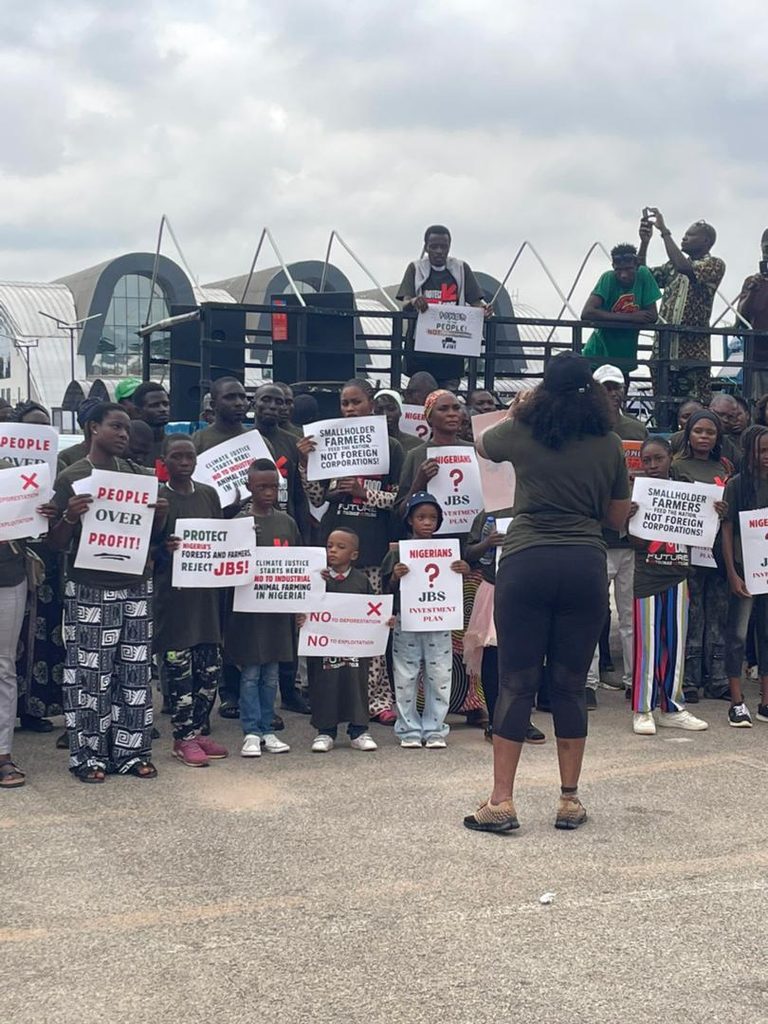
“This is about our land, our livestock, our people, our communities, our biodiversity, our farmers, our feed, our water, our markets, our food security and our food sovereignty,” she said.
She stressed that ERA/FoEN was not opposed to investment, arguing that foreign capital could support development when governed by policies that prioritise public interest.
“We are not against investment. We are not anti-investment. We are saying investment must have a people’s face. Investment must protect public interests,” she said.
The organisation consequently demanded the immediate publication of the agreement or Memorandum of Understanding between JBS and the Nigerian government, saying the public should be able to examine the conditions attached to a project of such magnitude.
Bassey-Olson said ERA/FoEN had sought details of the proposed investment since 2024 but that the agreement had remained outside the public domain.
“We want to know the terms of this investment. What does it mean for our people? What lands have been allocated? Have Environmental Impact Assessments (EIAs) been done? What will happen to our water? What will happen to the economy? Where will the land be sourced from?” she asked.
She argued that making the agreement public would not undermine the investment but would instead strengthen confidence in the government’s handling of the project.
“If you have something and you are coming to help the people as you claim, you should be very open in sharing whatever you have with the people,” she said.
The organisation also raised concerns over the possible regional consequences of a large-scale industrial meat operation in Nigeria, arguing that pollution, emissions, wastewater management and other environmental impacts could affect communities and ecosystems beyond the immediate project locations.
Bassey-Olson urged the African Union and other regional institutions to pay attention to major investments of this nature, warning that decisions taken by Nigeria could influence investment and environmental standards across Africa.
“If something is normalised in Nigeria, other countries will pick up and say, since Nigeria is our big brother, we should do it,” she said.
She further questioned the implications of JBS’ reported changes to previous climate commitments, insisting that Nigeria should assess the company’s environmental record and commitments before approving operations on such a large scale.
“If a company can backtrack, what does that mean for Nigeria?” she asked, stressing that enforceable environmental safeguards should take precedence over corporate assurances.
Also speaking, Joyce Brown, Director of Programmes at the Health and Modern Health Foundation, said concerns over the investment were informed partly by reports and controversies surrounding JBS’ environmental and socioeconomic record in some countries where it operates.
Brown said Nigeria should learn from experiences elsewhere and establish strong regulatory mechanisms capable of ensuring that the proposed investment generates broad-based economic benefits without imposing disproportionate costs on local communities, farmers or the environment.
“We want a situation where there are policies in place, there are structures in place that ensure that these sorts of investments are beneficial to the people,” she said.
She expressed particular concern over the absence, to the organisation’s knowledge, of evidence that Environmental Impact Assessments had already been conducted for the proposed facilities.
“So far, there is no evidence of any EIA conducted already,” Brown said.
She acknowledged reports that land had already been allocated in Niger State, but insisted that comprehensive environmental assessments should precede construction and large-scale operations.
According to her, EIAs would enable regulators and affected communities to identify potential impacts on land, water, ecosystems and livelihoods and establish appropriate mitigation measures before irreversible damage occurs.
Brown also demanded publication of the government-JBS agreement, saying experts in agriculture, environment, health and other relevant fields should be given access to the document for independent assessment.
“The agreement that JBS has signed with the Nigerian government is not in the public domain. This is something that should be available for experts across the various sectors to review, to ensure that we are not at the receiving end of any negative implications such a large-scale investment can have,” she said.
She maintained that the campaign was a demand for due diligence rather than a rejection of foreign capital, urging the government to examine JBS’ international track record and incorporate lessons from other jurisdictions into Nigeria’s regulatory framework.
Brown further called for a coordinated review involving all ministries, departments and agencies whose mandates could be affected by the project.
She questioned whether the approval process had adequately involved the ministries responsible for agriculture, environment, health and other relevant sectors, given that the project would extend beyond livestock production.
“This is something that different ministries and departments of Nigeria should come together to review before it is endorsed,” she said.
Brown also expressed concern that the process appeared to be driven largely by the Ministry of Livestock Development, arguing that the scale of the proposed investment warranted broader government participation.
“We do not know if the Ministry of Agriculture, the Ministry of Environment, the Ministry of Health and other relevant agencies are involved in the approval for JBS to start operations in Nigeria,” she said.
ERA/FoEN and its partners, while leading a parade on the National Assembly, called on the legislative house to exercise legislative oversight over the investment, insisting that the project should be examined against its implications for land, water resources, public health, agriculture, food security and the livelihoods of host communities.
“This is an investment that will take large expanses of land, that will affect water resources, that will affect the local communities and the people who live and depend on these environments, and it must be taken very seriously,” Brown said.
Group Demands Transparency, EIAs Over JBS’ $2.5bn Nigeria Investment


Faces Behind the Figures: Nigerians Lost in Russia’s War
By Oumarou Sanou
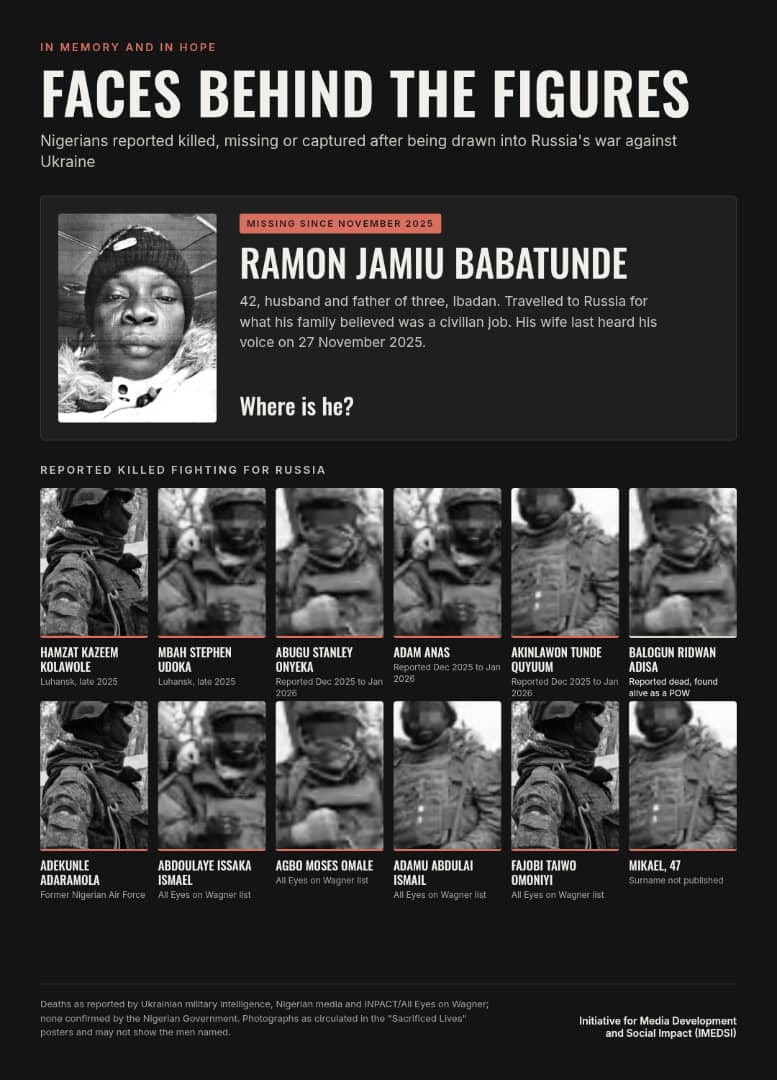
“Forgive your son.” Those were the words Balogun Ridwan Adisa chose for President Bola Tinubu when the Ukrainian outlet UNITED24 Media interviewed him while he was in captivity earlier this year. He is 32. He says he left Nigeria to feed his family and find work as a mechanic or engineer. He ended up in a Russian uniform near Lyman, in Ukraine’s Donetsk region, and surrendered to Ukrainian troops on 13 January 2026.
By then, Nigeria had already counted him among the dead. On 4 February, his name appeared in the press among four Nigerians said to have died fighting for Russia. The source was neither a Russian notification nor a Nigerian consular report, but a WhatsApp group run by African fighters. Adisa was alive. Nobody in authority had checked.
That single error captures how Nigeria is handling one of the quietest tragedies of our time. Our citizens are being lured into a war that is not theirs, and when they die, or are reported dead, the news reaches their families through messaging groups and foreign intelligence briefings rather than through their own government.
Moscow has denied wrongdoing at every turn. Yet on 10 September, Amnesty International concluded that Russia’s recruitment of foreigners in many cases amounts to human trafficking, documenting false job offers, contracts recruits could not read and deployment to the front after as little as two weeks of training.
The numbers are stark. The investigative collective INPACT/All Eyes on Wagner has documented 1,417 Africans from 35 countries recruited between 2023 and mid-2025, at least 316 of them killed. Ukrainian military intelligence, itself a party to the conflict, says at least 215 Nigerians had signed Russian contracts by May, with 25 dead or missing. Yet the greater danger is that, as the figures rise, the people behind them vanish from view. It is time to put faces to the names.
In his interview, Adisa says he arrived at a military base expecting work in his trade. Asked to sign a contract in Russian, he was refused a phone to translate it. “I did not know they were going to use me,” he says. Sixteen days of training later, he was at the front. A prisoner’s account to a Ukrainian-affiliated outlet deserves scrutiny, but his appearance alive settles one thing: the report of his death was wrong.
That matters for others on the same list. According to a Daily Nigerian investigation, Abugu Stanley Onyeka and Akinlawon Tunde Quyuum left Nigeria in November 2025 with Adam Anas and others, recruited for security jobs paying 200,000 roubles a month. The group reportedly travelled on tourist visas, signed papers in Russian without translation and were sent to the front after three weeks of training. Within three months, their names were on the same WhatsApp death list that wrongly carried Adisa’s. We do not even know with certainty whether they are dead. That uncertainty is itself an indictment.
Then there is Ramon Jamiu Babatunde, a 42-year-old father of three from Ibadan who, his family says, went to Russia for civilian work. Documents seen by the Initiative for Media Development and Social Impact (IMEDSI) show he entered on a tourist visa and that, within two weeks, a form bearing his name recorded his “voluntary” enlistment in a Russian assault unit. The same form warns that anyone who refuses will be detained, deported, banned from Russia, and made to repay the airfare. His wife, Mrs Adewunmi Suliat Ramon, last heard his voice on 27 November 2025 and petitioned the Ministry of Foreign Affairs in May. His one-year contract expired last month. He has not come home, and three children still do not know whether their father is alive.
Others have been named: Hamzat Kazeem Kolawole and Mbah Stephen Udoka, whose bodies Ukrainian intelligence said it recovered in Luhansk; Ayebusiwa Olabode Victor of Ondo State, reported killed near Kharkiv in May; Fajobi Taiwo Omoniyi, Agbo Moses Omale and others listed by All Eyes on Wagner. Memorial posters bearing some of these names now circulate online. Adisa’s case is a warning that such images cannot by themselves establish who has died. Families deserve certainty, not assumptions presented as fact.
This is why the silence of last month’s Russia-Africa Summit in Moscow is so disappointing. Ahead of the 28 to 29 October gathering, Amnesty International’s directors across Africa urged leaders to raise the trafficking of their citizens directly with the Kremlin. Kenya’s President William Ruto asked Moscow for help repatriating Kenyan recruits; Vladimir Putin offered no public answer. The summit drew 22 African heads of state, roughly half the number in 2019. For the Africans dying in Ukraine, there was no public commitment. Moscow did, however, find room for a Russia-Africa Media Forum that drew more than 200 participants from 46 African countries.
Other governments have shown what is possible. Kenya secured an undertaking from Moscow in March to stop enlisting its citizens and has brought more than 50 home. Ghana’s foreign minister confronted Sergei Lavrov in August over 62 Ghanaian deaths. Nigeria’s Ministry of Foreign Affairs issued a warning in February, and it has largely stopped.
Nigeria must do more. It should demand from Moscow a full list of Nigerians under contract, captured, missing or dead, and inform every family before social media does. It should work with Kyiv and the International Committee of the Red Cross to identify Nigerians held as prisoners of war, Adisa among them, and bring them home. NAPTIP and the police must pursue the agents behind these schemes and treat those deceived as victims of trafficking, not mercenaries who chose their fate. And Abuja, with the African Union and ECOWAS, should seek for every African state the no-recruitment undertaking Kenya obtained.
None of this is about choosing between Moscow and Kyiv. Strategic autonomy must never be used as an excuse to ignore the exploitation of our citizens, and public diplomacy is no substitute for consular access and accountability.
Ridwan Adisa asked his president for forgiveness. He is not the one who should be apologising. For Mrs Ramon and her children, the question remains painfully simple: where is their husband and father? Until it is answered, Africa’s diplomatic silence will be hard to justify, and African lives will remain cheap currency in other people’s wars.
Oumarou Sanou is a social critic, Pan-African observer and researcher focusing on governance, security and political transitions in the Sahel. He writes on geopolitics, regional stability and African leadership. Contact: sanououmarou386@gmail.com
Faces Behind the Figures: Nigerians Lost in Russia’s War
EFCC PETITIONED OVER N2.5M GTBANK FRAUD, UNAUTHORISED N138,000 LOAN
By: Michael Mike
A customer of Guaranty Trust Bank (GTBank), Mrs Stella Adepegba, has petitioned the Economic and Financial Crimes Commission (EFCC) over alleged fraudulent withdrawals of N2.587 million from two bank accounts belonging to her family, as well as an unauthorised N138,000 loan allegedly taken in her name.
The petitioner, Mr Adelani Adepegba, who filed the complaint on behalf of his wife and daughter, called on the anti-graft agency to investigate suspected insider collusion, alleged compromise of the bank’s security infrastructure and possible breaches of customers’ confidential banking information.
In the petition addressed to the EFCC Chairman at the commission’s headquarters in Jabi, Abuja, Adepegba alleged that the two accounts, both domiciled with GTBank, were compromised within 24 days through similar transaction channels.
According to him, his daughter’s Child Saver’s Account was allegedly accessed by fraudsters on October 8, 2026, at about 8 p.m., resulting in the unauthorised transfer of funds totalling N2.5 million through the bank’s Nigeria Inter-Bank Settlement System instant payment (NIP) channel.
He said three transfers of N399,000, N398,000 and N220,000 were made to a Moniepoint account belonging to one Abdulmalik Idris, while another N1.49 million was transferred to a Gomoney account operated by one Zainab Ibrahim.
The petitioner alleged that his wife, who operates the child’s account, received no transaction alerts and only became aware of the withdrawals after a GTBank staff member, identified as Boluwatife Akinwunmi, alerted her and offered to block the account.
By the time the intervention was initiated, however, the account had allegedly been emptied, leaving a balance of less than N2,000.
Adepegba said the incident was reported at a GTBank branch in Kubwa, Abuja, on October 9, where his wife was asked to document the complaint.
He, however, alleged that the bank subsequently responded by email, attributing the transactions to the use of his wife’s login credentials.
The petitioner said the incident was followed by another suspected breach on November 1, when N80,000 was allegedly transferred from his wife’s personal account to a FairMoney account belonging to one Jamilu Ahmad.
He put the combined withdrawals from the two accounts at N2.587 million.
Raising concerns over the circumstances surrounding the transactions, Adepegba insisted that his wife had physical possession of her mobile phone, SIM card and ATM card at their residence in Kubwa, Abuja, when the alleged fraud occurred.
He further maintained that she neither received any One-Time Password (OTP) prompt nor disclosed her PIN, password or USSD credentials to anyone. He also denied that she clicked on phishing links or authorised a SIM swap.
According to him, the circumstances raised serious questions about the bank’s security controls and the possibility of unauthorised access to customers’ banking information.
The complaint also alleged that the financial losses may have been compounded by further unauthorised deductions from his wife’s account.
Adepegba said N24,000 was deducted by the bank two days before the petition, and that when his wife visited the bank for clarification, she was informed that the money represented repayment for a N138,000 loan allegedly obtained by the fraudsters through her account.
He added that a further N19,000 allegedly stolen from the account had also been discovered, bringing additional concerns about the extent of the suspected compromise.
The petitioner faulted GTBank’s handling of the incidents, questioning how two accounts linked through family relationships, BVN details and telephone contacts could have been targeted within 24 days without effective security intervention.
He identified the repeated targeting of related accounts, alleged circumvention of two-factor authentication, transfers to the same beneficiary channels and the reported breach of the account despite a PIN reset after the first incident as grounds for suspecting possible insider involvement.
He urged the EFCC to investigate the incidents, trace and recover the allegedly stolen funds and conduct a forensic examination of GTBank’s staff and systems to establish whether customer information was leaked or security protocols were compromised.
Specifically, he asked the commission to compel GTBank to provide complete transaction logs, internet protocol (IP) addresses, device identification records and NIP transaction trace records relating to the disputed transfers.
He also called on the EFCC to direct Moniepoint, Gomoney and FairMoney Microfinance Bank to provide the full Know Your Customer (KYC) details of the beneficiaries and place the identified accounts under appropriate restrictions pending the outcome of investigations.
The petitioner maintained that the investigation should establish how the transactions were initiated, the devices and channels used, the identities of those behind them and whether any bank employee or external actor facilitated the alleged fraud.
As of the time of filing this report, the petitioner’s allegations had not been independently established, and there was no response from GTBank or the other financial institutions named in the complaint.
EFCC PETITIONED OVER N2.5M GTBANK FRAUD, UNAUTHORISED N138,000 LOAN
Why Borno Will Vote For APC At All Levels Of The Pending General Election……Ayuba
By: Bodunrin Kayode
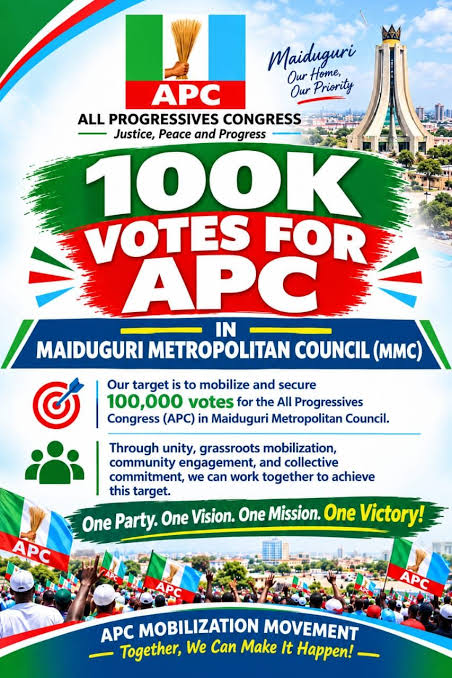
The Chairman of the All Progressives Congress (APC) in Borno State, Bello Ayuba, has said that Borno will surely vote for his party at all levels because of the massive investment by the central government in the state.
Ayuba who addressed newsmen in Maiduguri during the week stated that the Federal Government has implemented several major projects in the state, particularly in the areas of road reconstruction, anti flood infrastructure and rehabilitation of critical facilities to assist the state return to normalcy.
Ayuba, while highlighting the Federal Government’s interventions in Borno, listed the Gombe-Biu dual carriageway, Bama-Banki road and Maiduguri-Ngala-Gamboru road among major federal projects either awarded or currently under construction.
He stated that the contractor handling the Gombe-Biu dual carriageway had already mobilised to site, describing the project as a major intervention that would improve connectivity between Borno, Gombe and other neighbouring states.
The APC boss further said that the Federal Government had also awarded the Bama-Banki as well as the Maiduguri-Ngala-Gamboru federal roads respectively for complete reconstruction due to their insurgency battered, abandoned an dilapidated states.
He stressed that these glaring road projects were evidences that the Tinubu/Shettima administration was paying attention to Borno’s dire infrastructure needs.
Chairman Ayuba also cited the rehabilitation of the Alau Dam following the devastating flooding in the state, pointing out that the Federal Government has committed a substantial amount of money towards repairing the facility.
On the Maiduguri-Ngala-Gamboru road which leads into the Central African Republic, Ayuba said the difficult terrain and nature of the soil has made the project technically challenging and costly.
He explained that the Federal Government had taken the nature of the terrain into consideration in the design and reconstruction of the road to ensure greater durability beyond the post insurgency years.
“When you look at the terrain and the loamy soil and even how it shrinks during the dry season, If the work is poorly done, eventually the road will not last long.
” But I can tell you that this project was expected to be constructed to a very high standard, with concrete pavements and walkways designed to significantly extend its lifespan.
“When the project is completed, it is our intention to have a very solid concrete road, with a lifespan of up to 100 years,” said the APC boss.
Surrounded by party stalwarts in his office the APC chairman expressed optimism that if Borno votes for the Tinubu/Shettima ticket, at the fullnest of time, more federal projects would be attracted to Borno State,
He maintained that the ongoing road interventions would contribute massively to the state’s economic development and improve transportation links with other parts of the country.
Why Borno Will Vote For APC At All Levels Of The Pending General Election……Ayuba

Faces Behind the Figures: Nigerians Lost in Russia’s War

EFCC PETITIONED OVER N2.5M GTBANK FRAUD, UNAUTHORISED N138,000 LOAN

Why Borno Will Vote For APC At All Levels Of The Pending General Election……Ayuba

Roger Federer’s Shock as DNA Results Reveal Myla and Charlene Are Not His Biological Children

THE PLIGHT OF FARIDA

FAILED COUP IN BURKINA FASO: HOW TRAORÉ NARROWLY ESCAPED ASSASSINATION PLOT AMID FOREIGN INTERFERENCE CLAIMS
-
 News3 years ago
Roger Federer’s Shock as DNA Results Reveal Myla and Charlene Are Not His Biological Children
-
Opinions5 years ago
THE PLIGHT OF FARIDA
-
 News2 years ago
FAILED COUP IN BURKINA FASO: HOW TRAORÉ NARROWLY ESCAPED ASSASSINATION PLOT AMID FOREIGN INTERFERENCE CLAIMS
-
 Opinions5 years ago
POLICE CHARGE ROOMS, A MINTING PRESS
-

 News3 years ago
EYN: Rev. Billi, Distortion of History, and The Living Tamarind Tree
-

 ACADEMICS3 years ago
A History of Biu” (2015) and The Lingering Bura-Pabir Question (1)
-

 Columns3 years ago
Army University Biu: There is certain interest, but certainly not from Borno.
-

 Politics1 year ago
2027: Why Hon. Midala Balami Must Go, as Youths in Hawul and Asikira/Uba Federal Constituency Reject ₦500,000 as Sallah Gift
