
Uncategorized
Hamza Suleiman NAN: How ‘Christian genocide’ label distorts Nigeria’s conflict reality

Hamza Suleiman NAN: How ‘Christian genocide’ label distorts Nigeria’s conflict reality
By: Zagazola Makama
The claim that Nigeria is witnessing a state sanctioned “Christian genocide” has been trending in international discourse, amplifying domestic anxieties and sharpening an already fragile ethno-religious divide in the country.
Such narratives, when detached from the country’s complex security ecosystem, risk oversimplifying multi-layered conflicts into a single religious frame. Nigeria is constitutionally secular, and violence across its regions is driven less by faith alone than by a combustible mix of local grievances, criminal economies, identity politics, and transnational extremist agendas. When attacks occur, communities understandably interpret them through the lens of their beliefs; however, to cast the entire crisis as a binary religious war obscures root causes and hands strategic advantage to extremist groups seeking polarisation.
At the psychological level, Nigerians are highly sensitive to any perceived assault on their faith. This makes the information space a contested battlefield. Episodes in Jos, Southern Kaduna, Benue and parts of Taraba illustrate how disputes over land, grazing routes, political representation and local power can quickly acquire religious colouration once violence erupts between communities with different identities.
In the Middle Belt, Nigeria’s demographic and geographic crossroads ethnicity and religion overlap in ways that allow political entrepreneurs and armed actors to weaponise narratives. What begins as a farmer–herder clash or a dispute over local authority can be reframed as a civilisational struggle, accelerating reprisals and widening the conflict footprint.
Extremist organisations operating across Africa exploit this dynamic. Al-Qaeda and Islamic State affiliates pursue parallel-state projects by stoking fear, delegitimising national institutions and provoking sectarian backlash. From the Sahel to the Horn of Africa, insurgents attack civilians, displace populations and profit from the illicit flow of small arms.
Nigeria sits at the nexus of these corridors. In the northwest and north-central zones, Boko Haram offshoots and allied cells have adapted tactics—including IED use—while cultivating relationships with bandit networks. Their objective is not only territorial control but narrative dominance: to convince populations that the state cannot protect them and that coexistence is impossible.
This is why the “genocide” label, when applied wholesale to Nigeria, is analytically flawed and strategically dangerous. It compresses diverse theatres North-East insurgency, North-West banditry, Middle Belt communal violence into a single story that misreads motive and method. It also creates perverse incentives. Extremist groups thrive on publicity and polarisation; a global narrative that frames local conflicts as a religious extermination campaign can validate their propaganda and encourage copy-cat violence. Domestically, it hardens attitudes, weakens trust in institutions, and pressures political actors into zero-sum postures rather than pragmatic problem-solving.
Psychologically and historically, Nigeria’s past from the Uthman Dan Fodio jihad of 1805 to the 1966 crisis and civil war is often misunderstood and misused. These events are sometimes portrayed as purely religious campaigns, rather than complex political and social upheavals.
Against this backdrop, the U.S.-led narrative of a “Christian genocide” is not merely an analytical error; it becomes a negative description of Nigeria as a state. It suggests official neglect or complicity and projects Nigeria as a country defined by religious war rather than governance and security challenges.
More troubling are claims that the U.S. allegedly targeted Sokoto the historical seat of the Caliphate while neglecting ISWAP/ Boko Haram in the Lake Chad and JNIM offshoots near Kainji National Park. In optics and perception, this fuels suspicion that foreign powers are pursuing broader geostrategic or economic interests rather than purely humanitarian ones.
In a country that is one of the world’s highest consumers of social media content, such narratives spread rapidly. Once the idea of “Christian genocide” takes root in the national psyche, it becomes harder to reverse and easier for extremists and political actors to exploit.
The danger is not only external pressure, but internal fragmentation. Nigeria has long faced separatist and extremist ambitions from IPOB in the South-East, to Oduduwa groups in the South-West, to ISWAP/JAS in the North-East, and identity-based movements in the Middle Belt.
When international narratives suggest Nigeria is failing as a state, they unintentionally embolden these forces. The old CIA-era projection that Nigeria would break up by 2015 did not happen but the conditions for fragmentation remain visible in elite rhetoric, online mobilisation and communal distrust.
International engagement matters, but it must be calibrated to Nigeria’s realities. Security cooperation can deliver tangible benefits counter-IED capabilities, ISR assets, air mobility and training, if anchored in Nigerian ownership and intelligence-led operations. Precision, legality and accountability are essential to avoid civilian harm and the backlash that follows.
At the same time, an exclusive focus on kinetic tools misses the wider contest. Extremist ecosystems depend on recruitment pipelines, financing, social media amplification and local grievances. Disrupting these requires governance reforms, justice for victims, and economic recovery in affected communities so that civilians have reasons to resist insurgent narratives.
The information domain is just as critical. Media must be objective at all time and not to take side. From the government side, strategic communications should be proactive, not reactive: explaining the nature of threats, acknowledging failures honestly, and demonstrating progress in protecting all citizens regardless of faith. A recent failure of Stratcom was the case of the Kaduna state government for denying abduction of 171 Christians in Kajuru and later admitted that it actually took place.
When citizens see investigations, sincerity, arrests, and prosecutions alongside relief for victims and reconstruction of communities, the space for disinformation narrows. Religious and traditional also leaders have a unique role in de-escalation, offering moral authority that counters the language of collective blame.
Finally, Nigeria’s political class must treat local crises with urgency and coherence. State governments, security agencies and community structures should align around early-warning systems, mediation mechanisms and rapid response to prevent isolated incidents from spiralling into wider conflagrations.
Federal-state coordination, coupled with border management and regional diplomacy, can limit the spillover from Sahelian conflicts. None of this denies the suffering of Christian, Muslim and traditional communities alike; rather, it insists that justice and security are indivisible.
In sum, Nigeria’s security challenge is real and severe but it is not a single-story war of religion. It is a complex struggle against transnational extremism, organised crime and politicised identity. Reducing it to “genocide” rhetoric distorts policy choices and empowers those who benefit from division. A credible path forward blends precise security operations with governance, justice and narrative resilience so that Nigerians are protected not only from bullets and bombs, but also from the ideas that seek to turn neighbours into enemies.
Zagazola Makama is a Counter Insurgency Expert and Security Analyst in the Lake Chad region
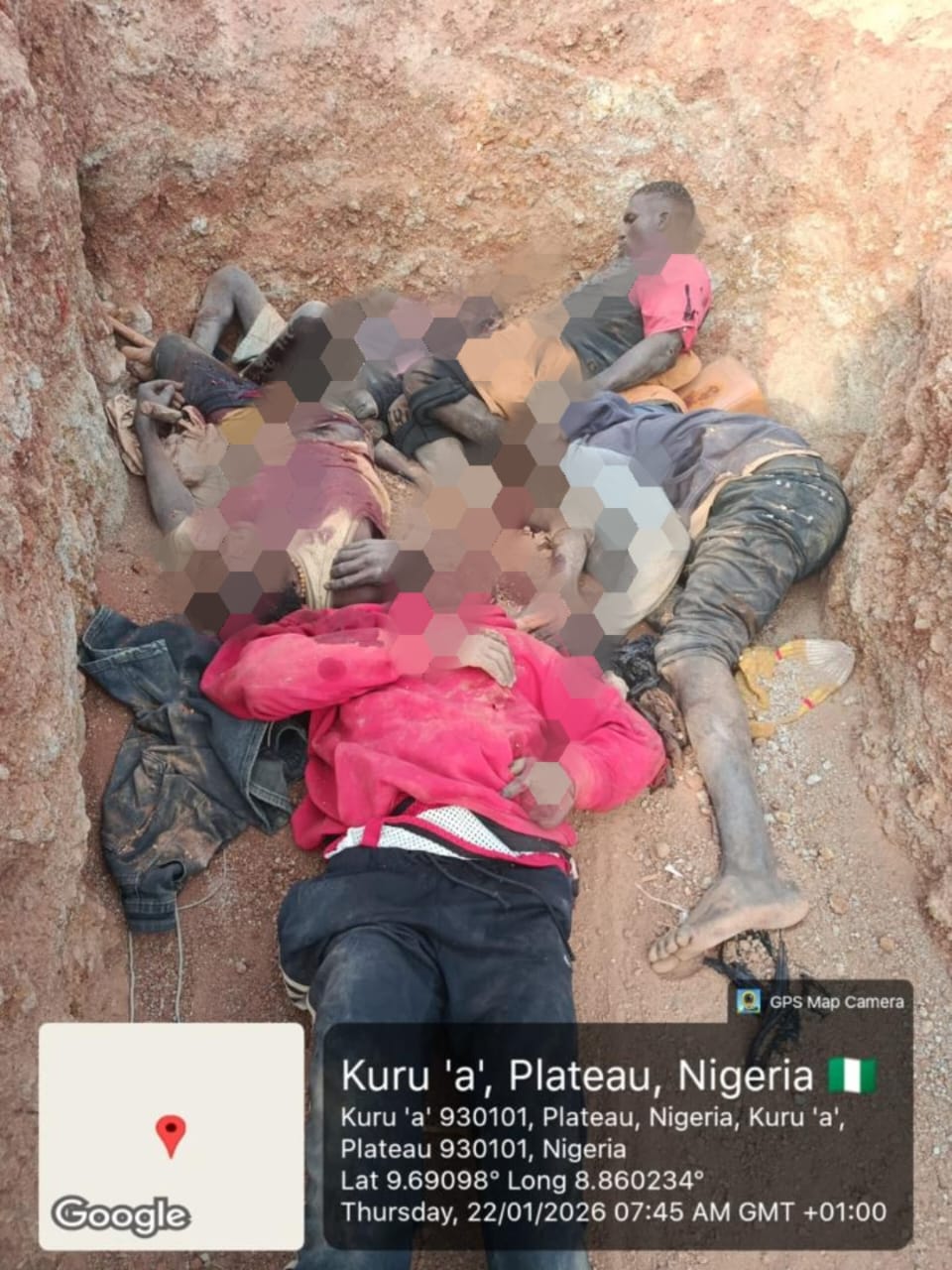
[1/23, 11:31 AM] Hamza Suleiman NAN: Plateau authorities confirm killing of seven youths at illegal mining site in Jos South, blame night operations
By: Zagazola Makama
Plateau State Security authorities have confirmed the killing of seven youths at an illegal mining site near Kavitex, Kuru in Jos South Local Government Area (LGA), describing the incident as a tragic outcome of violations of state mining laws and unsafe practices.
A Police sources told Zagazola Makama that the victims, Dung Gyang, 19; Weng Dung, 26; Francis Paul, 25; Samuel Peter, 22; Dung Simon, 28; Pam Dung, 23; and Francis Markus, 15 were shot dead by yet-to-be-identified armed men at about 2:00 a.m. on Thursday while engaging in illegal mining activities.
The sources said that the troops of Sector 6, Operation Safe Haven (OPEP), and the police
immediately mobilized to the site and conducted a thorough sweep of the area.
At the scene, they discovered ten spent cases of 7.62mm ammunition, indicating that the attackers were heavily armed. The corpses were subsequently moved to the Primary Health Care Centre, Dabwak, Kuru, to allow the families to make burial arrangements.
Preliminary investigations by security forces indicate that the attackers may have targeted the site to seize illegally mined minerals from the closed mining location at Capitex Kuru.
Security sources said the victims’ decision to remain at the mining site late into the night in violation of Plateau State’s ban on night and illegal mining made them particularly vulnerable.
“The miners’ continued operations in contravention of the extant laws, combined with the clandestine nature of illegal mining, significantly increased their exposure and contributed to this tragic outcome,” the security sources said.
Authorities further observed that an estimated eight-hour delay in reporting the incident to the security authorities likely stemmed from fear of sanctions associated with the prohibition of night mining.
Officials warned that delayed reporting often reduces the ability of security personnel to respond quickly, giving perpetrators a tactical advantage.
In response to the attack, troops of Sector 6 OPEP have intensified both kinetic and non-kinetic operations in the area. Sustained patrols, intelligence-driven offensive measures, and community engagement efforts are being conducted to identify, track, and apprehend the perpetrators, as well as to address underlying conflict triggers in the community and forestall further attacks.
The police on the other hand reiterated its commitment to restoring law and order, stating that security would maintain a strong presence in Kuru and other mining communities to prevent breakdowns of security.
Authorities also urged residents to cooperate with security agencies by providing timely information on suspicious movements or criminal activities, warning that fear of sanctions should not prevent reporting.
On the other hand sources from the Plateau State Government reiterated that enforcement of mining laws is essential to protect both miners and the general public. Officials appealed to youths to comply with existing regulations, including the prohibition on night mining, and to operate only at officially sanctioned sites under regulated conditions.
The Kuru killings are the latest in a series of attacks across Jos South, Barkin Ladi, and Riyom LGAs, where illegal mining sites have repeatedly become targets for armed groups seeking to exploit soft target in an intensified circle of violence in Plateau state.
Meanwhile, Zagazola Makama linked the attack to the latest in a spiral of violence in plateau in what began as disputes over land and livelihoods has metastasized into a tit-for-tat pattern where cattle rustling, livestock poisoning and armed raids trigger swift reprisals, dragging entire communities into a vortex of fear. Gakok attack did not erupt in isolation. It is the tragic crest of a wave that has been rising across the Barkin Ladi–Riyom–Jos South axis for weeks.
The current escalation tracks back to Wednesday, Jan. 14, when no fewer than 102 cows were rustled at Dan Sokoto in Ganawuri District, Riyom LGA. Witnesses said armed men suspected to be Berom Militia stormed the area in broad daylight, forcing herders to flee and driving the cattle away at gunpoint. The animals reportedly belonged to two pastoral families from Jos East, but were seized in Ganawuri, an inter-LGA fault line that complicated response and recovery.
Local accounts allege the attackers came from Vom District in Jos South. The Dan Sokoto raid was not an aberration. In the same month, at least seven cows were poisoned in Kwi village (Riyom LGA), while three others were shot dead near Kuru Gadabiyu in Barkin Ladi. Each incident deepened attacks and retaliation.
Days after the Dan Sokoto rustling, violence crossed from fields to homes. In the early hours of Saturday, at about 2:30 a.m., gunmen attacked Kasuwa Denkeli village in Barkin Ladi LGA. One person was killed on the spot; two others sustained gunshot wounds and were rushed to the Jos University Teaching Hospital. Police confirmed the incident, said a team led by the DPO moved to the scene, and announced an investigation to track the perpetrators.Residents linked the assault to retaliation over the stolen cattle in neighbouring Riyom.
This pattern attack on herds, reprisal on villages has repeated with grim regularity. On Jan. 6, coordinated attacks on Jol community in Riyom and Gero in Gyel District of Jos South left three people dead. The violence followed the shooting of two Fulani youths earlier that day in Jos South, one of whom later died. Witnesses described the ambush as unprovoked. What followed was swift retaliation and counter-retaliation, with communities caught in the crossfire.
The warning signs were already flashing in December. On Dec. 12, more than 130 cattle were reportedly rustled in Nding community. Around the same period, livestock poisoning was recorded in parts of Jos East and Riyom LGAs. Those incidents were followed by deadly clashes, including the killing of four children in Dorong village, Barkin Ladi LGA, and attacks on Gero that left deaths, injuries and the loss of more livestock.
On Dec. 16, an attack on an illegal mining site in Tosho, Barkin Ladi LGA, left 12 miners dead and others abducted. Security sources linked the violence to earlier rustling of 171 cattle belonging to Fulani. Again, a familiar sequence: cattle taken, emotions inflamed, guns answer.
Across Barkin Ladi, Riyom and Jos South, residents now speak of “no-go” zones. Areas like Vwang in Jos South and parts of Fan District in Barkin Ladi are whispered about as holding grounds for rustled cattle belonging to the Fulani.The claims, wether true or not, reinforce suspicion and hinder cooperation. Recovery becomes harder; rumours spread faster than facts.
Security agencies respond to each incident, but the terrain is complex, in most cases lacked accessibility by roads. Attackers move across forested LGA lines; victims come from multiple communities; reprisals target the nearest symbol of “the other.” Investigations start, but arrests lag. In the absence of swift, impartial justice, communities seek their own.
End



Troops arrest three Fulani men in Plateau after farmer’s killing
By: Zagazola Makama
Troops of Sector 6, Operation ENDURING PEACE (OPEP), have arrested three persons during a raid on two Fulani settlements in Bachi community, Riyom Local Government Area of Plateau State.
The operation, conducted on Sept. 13, 2026, followed a manhunt for criminal elements responsible for the killing of a farmer at Fang community in Riyom LGA on Sept. 12.
During the raid at Baggat and Shong 2 Fulani hamlets, troops arrested three residents identified as Anas Usman, Nuhu Mohammad and Haruna Ahmed.
Security sources said the three suspects are not necessarily the perpetrators of the killing, but their arrest is part of efforts to mount pressure on local Fulani leaders to assist security agencies in identifying and producing those responsible for the crime.
The suspects are currently in custody for further investigation and intelligence exploitation.
Troops arrest three Fulani men in Plateau after farmer’s killing
Uncategorized
Talata Mafara Attack: ISN Demands Intelligence Overhaul, Special Courts to Crush Banditry

Talata Mafara Attack: ISN Demands Intelligence Overhaul, Special Courts to Crush Banditry
The Institute of Security, Nigeria (ISN) has called for a fundamental overhaul of Nigeria’s approach to terrorism, banditry and kidnapping, warning that criminal groups are becoming increasingly organised and capable of challenging the authority of the state.
The institute made the call while reacting to the reported invasion of Talata Mafara market in Zamfara State, where non-state actors allegedly imposed a ₦50 million levy and demanded 100 livestock, giving residents a seven-day ultimatum.
The ISN said the development exposed the need for security agencies to move beyond reactive operations and adopt stronger intelligence-led strategies capable of identifying and dismantling criminal networks before they launch attacks.
In a statement signed by its Deputy President and Chief Executive Officer, Barr. Adebayo Akinade, the institute said the activities of terrorists and bandits were no longer limited to isolated attacks but increasingly involved the control of economic activities, collection of illegal levies and disruption of legitimate livelihoods.
It warned that such activities could gradually establish a parallel system of criminal authority in affected communities if left unchecked.
The institute consequently urged the Federal and state governments to establish a coordinated security framework bringing together federal security agencies, state security outfits and vetted community guards.
It also called for the creation of a National Security Fusion Centre, supported by state-level fusion desks, to facilitate real-time intelligence sharing and faster responses to emerging threats.
According to the ISN, security agencies should penetrate criminal networks operating around markets, cattle-rustling routes and illicit livestock value chains while targeting the logistics and financial structures sustaining banditry.
It recommended regulated livestock markets and improved tracking systems to prevent stolen cattle from being absorbed into legitimate commercial channels.
The institute further proposed special courts for terrorism, kidnapping and banditry cases, arguing that a faster judicial process would strengthen the fight against organised criminal groups.
It urged the government to deploy modern technologies, including forest geo-fencing, livestock tracking, drones and citizen-reporting platforms, alongside improved tactical mobility and air surveillance.
The ISN also called for a two-hour rapid-response mechanism in vulnerable areas and increased investment in night-vision equipment and other specialised capabilities.
Beyond security operations, the institute advocated stronger community-based early-warning systems and local peace and security forums involving traditional rulers, farmers, market unions, faith organisations and civil society groups.
It urged citizens to report threats rather than surrendering to ransom and illegal levy demands, while encouraging communities to document attacks and preserve evidence for investigations and prosecution.
The institute said professional training in terrorism studies, intelligence management and counter-banditry operations should be strengthened as part of efforts to build a more effective national security architecture.
The ISN reaffirmed its readiness to support government and security agencies through research, training, policy advisory services and professional certification, saying a coordinated response was essential to restoring public confidence and protecting national development.
Talata Mafara Attack: ISN Demands Intelligence Overhaul, Special Courts to Crush Banditry
Uncategorized
2026 Peace and Dialogue Awards: IPCR, Ufuk Foundation Call for Collective Investment in Peace

2026 Peace and Dialogue Awards: IPCR, Ufuk Foundation Call for Collective Investment in Peace
By: Michael Mike

The Director-General of the Institute for Peace and Conflict Resolution (IPCR), Dr. Joseph Ochogwu, has called on governments, businesses, civil society organisations, religious and traditional institutions, communities and individuals to invest deliberately in peacebuilding, warning that the cost of conflict far exceeds the resources required to prevent it.
Ochogwu made the call on Thursday, September 10, 2026, while delivering a lecture titled “Investing in Peace: A Collective Responsibility for Everyone” at the 2026 Peace and Dialogue Awards organised by the Ufuk Dialogue Foundation Nigeria in collaboration with the IPCR in Abuja.

He said the awards should go beyond recognising individuals and organisations contributing to peacebuilding, stressing that Nigeria must begin to treat peace as an investment requiring consistent resources, planning and accountability.
According to Ochogwu, global military expenditure exceeded $2.4 trillion in 2024, while peacebuilding expenditure remained below $60 billion, representing about 2.5 per cent of military spending.

He questioned why trillions of dollars could be mobilised for conflict and military expenditure while significantly smaller amounts remained difficult to commit to conflict prevention and peaceful societies.
Ochogwu said the message was consistent with the 2026 International Day of Peace and International Day of UN Peacekeepers, but noted that the IPCR had further domesticated it as “Invest in Peace for Everyone, Everywhere, Everyday.”
“Peace cannot be a seasonal product for September 21st; it must be deliberate, daily, and for all,” he said.

He identified early-warning systems, peace education, youth employment, interfaith literacy, justice reform, community mediation, psychosocial healing, and greater participation of women and young people as key areas requiring investment.
The IPCR Director-General noted that the benefits of peacebuilding were often measured by conflicts that never occurred, making its returns less visible than conventional security spending.
He stressed that peacebuilding interventions must reflect the specific causes of conflicts in different parts of Nigeria. He identified extremism in the North-East, banditry in the North-West and North-Central, resource-related conflicts across the Middle Belt, separatist agitation in the South-East and urban fragility as major security and conflict challenges.
He also said West Africa and the Sahel were facing a convergence of violent extremism, unconstitutional political transitions, farmer-herder tensions and climate-induced displacement.
“A blanket approach will fail,” he warned, urging policymakers to develop interventions based on the specific drivers of conflict in each community and region.

Ochogwu also linked economic development to sustainable peace, saying the Federal Government’s economic reforms under the Renewed Hope Agenda could contribute directly and indirectly to peacebuilding.
He said job creation, poverty reduction and addressing economic vulnerabilities could help prevent communities and young people from becoming susceptible to conflict and violent mobilisation.
“Economic renewal is not a separate track; it is the bedrock on which peace is sustained,” he said.
He identified a perception gap, fragmentation of interventions, funding misalignment and the absence of effective mechanisms for tracking peace expenditure and its impact as major obstacles to peace investment.
According to him, less than 0.5 per cent of the budgets of Ministries, Departments and Agencies (MDAs) were coded for peacebuilding, while corporate social responsibility (CSR) spending rarely reached peacebuilding initiatives.
He therefore called for a system to track who invests in peace, how much is invested, where resources are deployed and the results achieved.
Ochogwu warned that failure to invest in peace carries significant economic and humanitarian consequences. He cited an estimated $19.1 trillion global economic cost of violence in 2024, equivalent to about 13.5 per cent of global GDP.
He added that every dollar not invested in conflict prevention could ultimately cost significantly more in humanitarian response and reconstruction.
According to him, farmer-herder conflicts had resulted in losses estimated at more than $14 billion over five years, while infrastructure damage in the North-East had exceeded $9 billion, with about 2.2 million people displaced.
“The cost of not investing in peace far exceeds the cost of investing in it,” he said.
To address the challenges, Ochogwu proposed a five-point compact aimed at making peacebuilding a shared responsibility across Nigerian society.
He called for the speedy implementation of the National Peace Policy, the establishment of a National Peace Investment Fund, legislation for a minimum three per cent peacebuilding allocation across relevant MDAs, and stronger coordination and early-warning responsibilities for the IPCR.
He also proposed committing at least one per cent of CSR expenditure to peacebuilding initiatives, including mediation centres, school peace clubs, early-warning technology and youth employment programmes in vulnerable communities.
The IPCR boss urged faith, traditional and community leaders to institutionalise interfaith dialogue and community-level dispute-resolution mechanisms in every ward, saying vulnerable communities often need trusted local mediators more than externally organised workshops.
He further called for stronger action against hate speech and disinformation, the generation of locally relevant evidence and the development of a Peace Investment Tracker Dashboard at the IPCR.
Ochogwu urged individuals and communities to make peace part of their daily conduct by avoiding escalation, accommodating neighbours, reporting early-warning signs and mentoring vulnerable young people.
“Peace must become everyone’s business,” he said.
The Chairperson of the 2026 Peace and Dialogue Awards, Inspector-General of Police Olatunji Rilwan Disu, NPM, also said peace and democracy were mutually reinforcing, stressing the importance of peaceful engagement in strengthening Nigeria’s democratic development.
2026 Peace and Dialogue Awards: IPCR, Ufuk Foundation Call for Collective Investment in Peace

COAS charges Plateau troops to sustain security gains, strengthen peace efforts

NiDCOM Boss Honours Nigerians Killed in 9/11 Attacks

NHRC Raises Alarm Over Insecurity, Hate Speech Ahead of 2027 Polls

Roger Federer’s Shock as DNA Results Reveal Myla and Charlene Are Not His Biological Children

THE PLIGHT OF FARIDA

FAILED COUP IN BURKINA FASO: HOW TRAORÉ NARROWLY ESCAPED ASSASSINATION PLOT AMID FOREIGN INTERFERENCE CLAIMS
-
 News3 years ago
Roger Federer’s Shock as DNA Results Reveal Myla and Charlene Are Not His Biological Children
-
Opinions5 years ago
THE PLIGHT OF FARIDA
-
 News1 year ago
FAILED COUP IN BURKINA FASO: HOW TRAORÉ NARROWLY ESCAPED ASSASSINATION PLOT AMID FOREIGN INTERFERENCE CLAIMS
-

 News2 years ago
EYN: Rev. Billi, Distortion of History, and The Living Tamarind Tree
-
 Opinions5 years ago
POLICE CHARGE ROOMS, A MINTING PRESS
-

 ACADEMICS3 years ago
A History of Biu” (2015) and The Lingering Bura-Pabir Question (1)
-

 Columns3 years ago
Army University Biu: There is certain interest, but certainly not from Borno.
-

 Politics1 year ago
2027: Why Hon. Midala Balami Must Go, as Youths in Hawul and Asikira/Uba Federal Constituency Reject ₦500,000 as Sallah Gift
