
Politics
Nigeria’s VP: Kashim Shettima in 100 Days

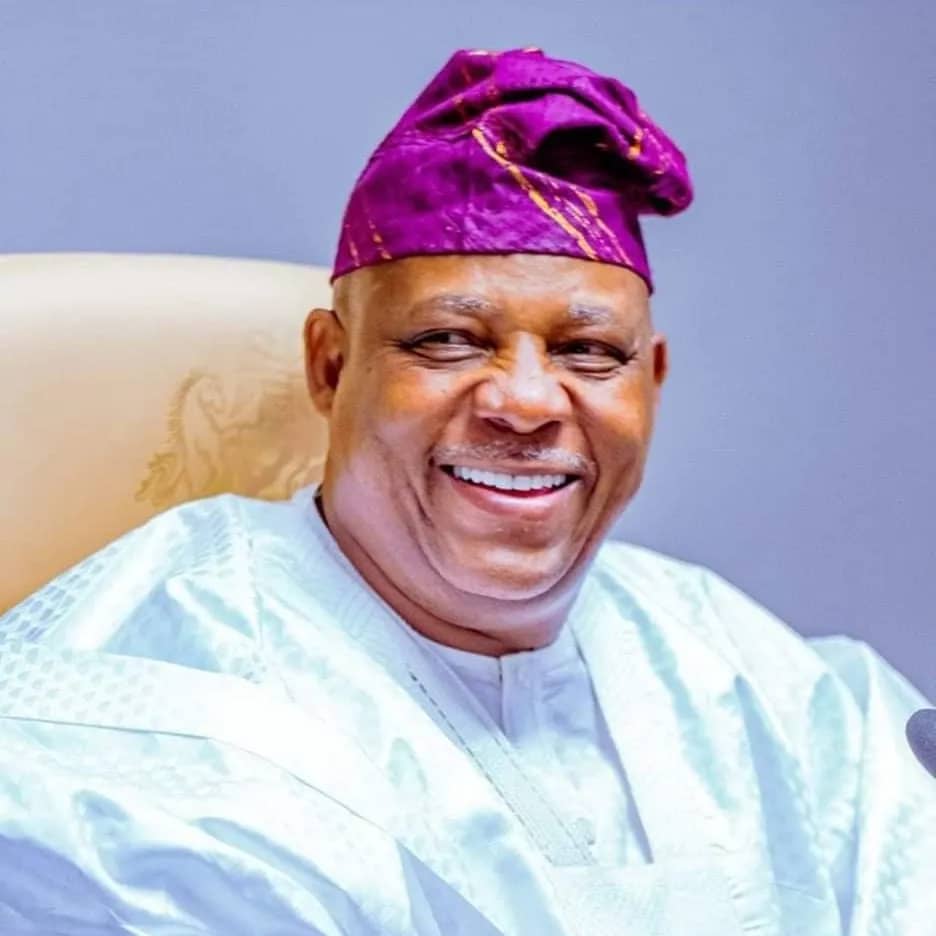
Nigeria’s VP: Kashim Shettima in 100 Days
By: James Bwala
The renewed hope agreements, according to President Bola Ahmed Tinubu, are a partnership for a better future for Nigeria and Nigerians. Nigerian citizens have been kept informed of the strategy and plan this administration is implementing to fulfill the Tinubu administration’s goal of providing Nigerians with the country of their dreams both at home and abroad.
The First Lady of Nigeria, Senator Oluremi Tinubu, recently advised Nigerians to have patience with the administration and to maintain faith that things are progressing for the greater good. She refrained from filling her mouth with justifications or placing blame on specific individuals or cabals. Senator Remi was unwavering in her stance since she had faith in the current situation and thought everything would work out.
The actions being taken by this administration show how a government that is responsible for more than 200 million Nigerians functions. In addition to the positive appointments that have already been made, I am concentrating on the new administration’s torchbearer, who will travel the breadth and length of land and sea to forge stronger diplomatic ties and sell the onions that will mend the wounds caused by the previous administration in order to create a Nigeria of hope.
I have been closely observing Kashim Shettima’s activities as the vice president of Nigeria for the past 100 days. Kashim Shettima has shown a special calling with such ambition to shape the nation in line with the dream of renewed hope that patches the long night with horrible dreams of deaths and corruptions as witnessed in the historical books of governance in Nigeria. In the last 100 days, he has redirected dreams from thinking climate change to the 15th BRICS SUMMIT.
READ ALSO:https://newsng.ng/the-plight-of-farida/
The theme of “renewed hope,” which the new administration is promoting to Nigerians starting on May 29, 2023, never stops reminding our citizens of the responsibility we share as citizens to develop Nigeria for our children and our children’s children. I’ve observed a spike in speakers over the past 100 days who have appeared on TV and in print media to criticize the administration from the perspective of their own opposition mindset, which directs their thought.
But I’d like to paraphrase a comment from an anonymous source who stated, for those criticizing the leaders: “This is how we are in our various corners. Our society has produced political leaders. We could perhaps fix the country if you fixed your corner. Hopeful Nigerians, who shared the same dream of renewed hope, are standing in prayer with the administration as the Tinubu and Shettima administrations get off to a fast start on the first day of their inauguration.
The Tinubu administration is taking steps to give Nigerians at home and abroad the promise of hope, not as defined in the words of the opposition but in the real sense of it for all Nigerians, even those who are already criticizing the administration in the name of selfish and evil desires. Vice President Kashim Shettima has been everywhere his duties have required him to be, and his words have been very piercing.
On the topic of “BRICS and Africa: Partnership for Mutually Accelerated Growth, Sustainable Development, and Inclusive Multilateralism,” Vice President Shettima addressed a sizable crowd that included the Presidents of China, India, Brazil, South Africa, and Russia’s Foreign Minister. He said the theme “underscores the profound realization that the cornerstone of stability within our intricate multipolar landscape lies in fostering developmental partnerships.”
Shettima claims that “the new government, which began in the last 100 days, is examining the variables and evaluating the scope and level of regional and global cooperation to pursue in order to establish Nigeria as the desired friend and partner. He declared, “We seek partnership that offers opportunities for trade, prosperity, and shared progress for all without marginalization based on geography, race, or legitimate sovereign affiliations.
The Vice President expressed gratitude on behalf of Nigeria to the government and people of the Republic of South Africa for hosting the 15th BRICS Summit, noting that “the BRICS-Plus Dialogue and the BRICS-Africa Outreach provide a unique platform for discussion, note comparison, and exploration of a mutually beneficial partnership that could evolve into a novel driving force for development.”
He said, “The international global governance structure to which we currently adhere was established prior to the independence of the African continent and many countries in the global south. So, it’s indeed imperative to reform global governance to align with the realities of today’s world and to acknowledge the necessity for partnerships that ensure shared prosperity, inclusivity, and sustainable development.”
According to the Vice President, Nigeria, under President Bola Tinubu, “is committed to shaping and fortifying the global framework and governance concerning all major international issues, particularly in the fields of finance, climate change, bridging the digital divide, adopting a comprehensive strategy towards debt alleviation, addressing food and energy insecurities, instituting post-pandemic recovery measures, and fostering financial inclusion within developing countries.”
Vice President Shettima spoke to his audience about Nigeria’s relationships with the global south and emphasized how important all facets of south-south cooperation are to Nigeria. He also said that the global south is currently facing unmatched challenges.
“We must develop climate change solutions and put in place security measures to stop and deter international crime, terrorism, and cyberattacks. Young people are unemployed at a high rate, and disruptive natural disasters are a constant threat. We now have the opportunity to reevaluate the difficulties we face jointly as well as those that our partners are dealing with,” he said.
I could go on and on about all the different subjects the vice president touched on. I applaud Kashim Shettima and Tinubu for their positive vision that aligns with the United Nations Sustainable Development Goals 2030 and the African Union’s Agenda 2063. I believe that certain challenges are imminent in developing solutions for nation-building and that they are relevant to our continental and national development aspirations.
Nigeria’s VP: Kashim Shettima in 100 Days



Fubara: My Projects Will Give APC Edge in Rivers 2027
By: Michael Mike
Rivers State Governor, Siminalayi Fubara, has said his administration’s infrastructure projects across the state could give the All Progressives Congress (APC) a significant advantage in the 2027 general elections.
Fubara said the visible impact of his administration’s projects would provide APC candidates with concrete achievements to campaign with when they approach voters at the grassroots.
The governor spoke on Wednesday while commissioning the 14.5-kilometre Agba-Ndele Road and a major bridge linking communities in Emohua and Abua/Odual Local Government Areas of the state.

According to him, the projects would make it easier for APC candidates to convince voters of the party’s performance during the electioneering campaign.
“When he comes here to campaign, more especially in Emohua, he will tell them: my party did this and my party did that. So it will be easy for us to win election here,” Fubara said.
The governor’s remarks effectively placed his administration’s infrastructure drive at the centre of the APC’s 2027 electoral strategy in Rivers, with the projects expected to serve as tangible evidence of government performance during campaigns.
Fubara said his administration was not interested in projects merely for political visibility but in interventions capable of changing the lives of residents.
He described the Agba-Ndele road and bridge as a critical intervention for communities that had suffered difficulties using the old Abua Road, saying the new infrastructure would reduce travel challenges and improve connectivity between communities.
“I’m not interested in just doing anything; I’m interested in doing something that can add value and change the life of our people,” he said.
The governor also used the occasion to make a case for continuity in governance, noting that the bridge was initiated by an earlier administration and not by either his government or that of his immediate predecessor.
He said completing projects started by previous governments should not be viewed through the prism of political ownership when such projects would benefit the people.
“When you see something that will benefit the people, it doesn’t matter who started it. What is important is you complete it and put it to use,” he said.
The 14.5-kilometre road has a 10.3-metre binder-course width, a 7.3-metre wearing-course width and three-metre shoulders, while its drainage section measures 0.6 metres by 0.6 metres.
The Commissioner for Works, Prof. Temple Nwofor, said the bridge is a 239.4-metre structure with a 10.3-metre width, including 1.5-metre walkways on both sides, and is complemented by a 1.2-kilometre access road.
Fubara charged the chairmen of Emohua and Abua/Odual councils, Chidi Lloyd and Owolobi Michael Ofori, respectively, to take responsibility for protecting government infrastructure in their areas.
He similarly urged traditional rulers, youth groups and residents of Agba-Ndele and neighbouring communities to regard the road and bridge as their collective assets.
The governor warned against vandalism, saying destruction of public infrastructure would amount to a waste of government resources and ultimately deprive communities of the benefits of development.
Fubara: My Projects Will Give APC Edge in Rivers 2027
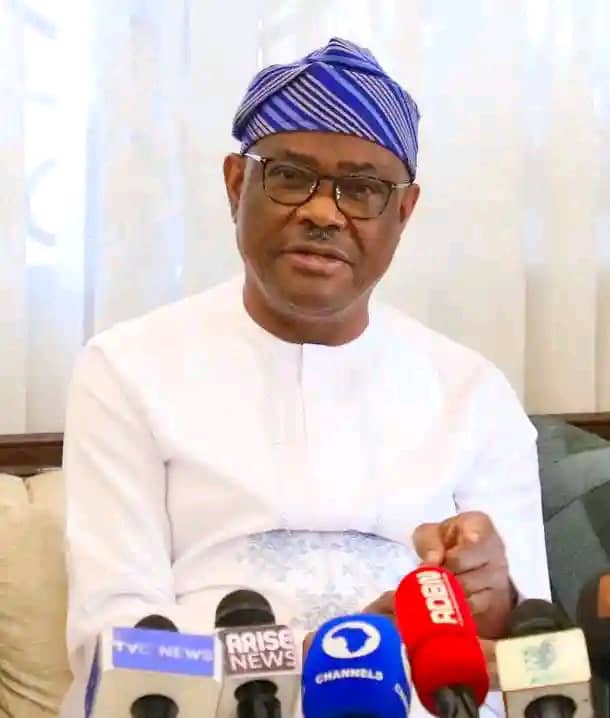
2027: WIKE PDP faction receives large number of defections in Yobe
By: Yahaya Wakili
The Yobe state faction of the Peoples Democratic Party (PDP) aligned with the minister of the Federal Capital Territory, Nyeson Wike, has received a large number of defectors from various political parties in Nangere and Fune local government areas ahead of the 2027 general election.
The Peoples Democratic Party receives defectors from the APC, ADC, and NDC, as well as large numbers of PDP supporters of the former national chairman of the PDP, Ambassador Umaru Illiya Damagum, in the Nangere and Fune local government areas of Yobe State.
Former APC and PDP members and supporters of Ambassador Umaru Damagum, pioneers in Damagum B and Tikau wards, Alhaji Muhammadu Abubakar and Malam Abdu Umar, respectively, cite hardship, unemployment, and bad leadership as reasons for defecting.
The Peoples Democratic Party (PDP) leaders in areas promise equal opportunities for new members.

Governorship candidate in Yobe State, Alhaji Abdullahi Usman Maigida, pledges jobs, infrastructure, and inclusive governance.
Alhaji Maigida says the PDP influx strengthens its grassroots structure ahead of the 2027 elections.
The event witnessed the defections of several prominent political figures, including Dr. Ibrahim Aliyu, widely recognized as the first person to introduce the All Progressives Congress (APC) in Tikau Ward in the Nangere local government area.
2027: WIKE PDP faction receives large number of defections in Yobe
Politics
The Psychology of Nigerian Politicians and Voters Power, Survival, Emotion, and the Nigerian Democratic Mind


The Psychology of Nigerian Politicians and Voters Power, Survival, Emotion, and the Nigerian Democratic Mind
By Ameen Amshi PhD
Politics in Nigeria is often discussed through the lenses of corruption, elections, ethnicity, governance, and insecurity. Yet beneath all these issues lies something deeper and less examined: psychology.
Nigerian politics is not only a struggle for power; it is a struggle for survival, relevance, identity, emotional influence, and public validation. To truly understand the Nigerian political system, one must understand both the psychology of Nigerian politicians and the psychology of Nigerian voters, because both continuously shape each other.
The Nigerian politician does not operate in isolation. Neither does the Nigerian voter. They exist in a complicated relationship built on fear, hope, poverty, loyalty, identity, emotion, and expectation.
For many Nigerian politicians, political office is far more than public service. It represents security, influence, social status, economic access, and protection. In a society where institutions are still evolving and political relevance often determines personal influence, power becomes psychologically addictive.
This explains why many politicians struggle to leave the political space even after decades in office. Losing power in Nigeria can mean losing visibility, weakening alliances, reduced access, and fading public relevance. To many political actors, staying connected to power becomes a form of survival.
This survival mentality shapes political behavior:
- constant alliance building,
- aggressive control of party structures,
- loyalty calculations,
- and the endless pursuit of appointments and influence.
At the same time, Nigerian voters also operate from a survival mindset.
Many citizens do not vote based purely on ideology or policy sophistication. Instead, they often vote based on emotional connection, identity, accessibility, and immediate need. In communities where poverty, unemployment, insecurity, and weak public institutions exist, politics becomes personal.
The average voter frequently asks: - Who can help us?
- Who remembers our community?
- Who can provide opportunities?
- Who can we call in times of hardship?
This creates a system where politicians are expected not just to govern, but to function as providers, sponsors, protectors, and emergency responders.
As a result, patronage becomes psychologically normalized.
A politician who pays hospital bills, sponsors school fees, supports funerals, distributes food, or empowers youth groups is often perceived as compassionate and trustworthy, even when governance performance remains poor. The emotional visibility of generosity tends to outweigh the invisible value of long-term policy reforms.
This is one of the reasons Nigerian politics remains heavily personality driven rather than institution driven.
Another unique feature of politics in Nigeria is the near absence of rigid ideological divisions that traditionally define politics in many parts of the world.
In many democracies, political parties are clearly identified as: - leftwing,
- rightwing,
- conservative,
- liberal,
- progressive,
- labor oriented,
- socialist,
- nationalist,
- or populist.
In Nigeria, however, these ideological boundaries are largely blurred.
Most Nigerian political parties operate within similar political and economic frameworks, and politicians frequently move from one party to another without major ideological conflict. A politician may criticize a party today and join the same party tomorrow without fundamentally changing political beliefs or policy direction.
This is because Nigerian politics is driven less by ideology and more by: - access to power,
- coalition building,
- regional balancing,
- elite negotiations,
- influence,
- and political survival.
In reality, many Nigerian politicians regardless of party affiliation align around one central concept: the acquisition, retention, and management of power.
Perhaps the most important psychological reality in Nigerian politics is this:
“Every Nigerian politician was once a Nigerian voter.”
Most politicians did not begin as part of the elite political establishment. At some point, they were ordinary citizens criticizing government, complaining about corruption, questioning leadership failures, and believing they could do better if given the opportunity.
However, the Nigerian political system often transforms individuals faster than individuals transform the system.
The same person who once condemned government inefficiency from outside power may eventually find himself struggling with the same institutional pressures, political compromises, bureaucratic limitations, elite negotiations, and survival calculations once criticized.
That is what makes Nigerian politics psychologically complex:
the voter eventually becomes the politician,
and the politician eventually becomes part of the system the voter complains about.
Another reality many Nigerians rarely consider is that Nigerian politics is entirely different from what it appears to be from the outside.
Before elections, politicians often criticize everything: - government policies,
- insecurity,
- economic hardship,
- corruption,
- infrastructure failures,
- and administrative inefficiency.
From the outside, many genuinely believe:
“If I get there, I will do things differently.”
“I will solve these problems quickly.”
“I will fulfill all these promises.”
However, governance in Nigeria is far more complicated internally than it appears externally.
The moment many politicians enter office, they discover: - institutional limitations,
- bureaucratic bottlenecks,
- entrenched interests,
- political compromises,
- financial constraints,
- security complexities,
- legal restrictions,
- and layers of power negotiations that were previously invisible to them.
They suddenly realize that governance is not as simple as opposition rhetoric or campaign promises made during rallies.
What seemed easy from outside government becomes far more difficult within the system itself.
Timelines change.
Expectations change.
Outcomes change.
Political realities change.
Social media has also transformed Nigerian political psychology, especially among younger citizens. A new generation of voters increasingly demands accountability, competence, transparency, and issue based governance.
Recent years have shown signs of political awakening and generational shifts, particularly among younger Nigerians. Movements such as the #EndSARS protests and the momentum surrounding the 2023 Obi/Datti movement demonstrated growing dissatisfaction with traditional political structures and an increasing demand for accountability, transparency, and issue based governance.
Still, one major challenge remains: in many cases, Nigerian elites rotate access to power rather than fundamentally transform the system itself.
Political transitions often change personalities more than structures. As a result, the deeper psychological contract between politicians and voters remains largely intact.
Importantly, these political dynamics are not uniquely Nigerian. Similar patterns exist across much of Africa and many developing democracies: - patronage politics,
- ethnic voting,
- personality driven leadership,
- weak ideological structures,
- and elite centered political systems.
Yet, despite decades of instability, economic pressure, insecurity, and political tension, Nigeria has continued to endure.
Nigerian society remains: - adaptive under pressure,
- highly relational,
- emotionally resilient,
- resourceful,
- and socially interconnected.
Ultimately, Nigerian politics reflects Nigerian society: - resilient yet emotional,
- complex yet adaptive,
- divided yet interconnected,
- survival driven yet deeply hopeful.
And perhaps that enduring hope, more than anything else, remains the strongest psychological force sustaining Nigerian democracy today.
The Psychology of Nigerian Politicians and Voters Power, Survival, Emotion, and the Nigerian Democratic Mind

Troops foil kidnapping attempt, rescue two victims in Plateau

Troops recover five cattle rustle by Berom Militia in Plateau

Troops investigate suspected Malicious poisoning of cattle in Plateau

Roger Federer’s Shock as DNA Results Reveal Myla and Charlene Are Not His Biological Children

THE PLIGHT OF FARIDA

FAILED COUP IN BURKINA FASO: HOW TRAORÉ NARROWLY ESCAPED ASSASSINATION PLOT AMID FOREIGN INTERFERENCE CLAIMS
-
 News2 years ago
Roger Federer’s Shock as DNA Results Reveal Myla and Charlene Are Not His Biological Children
-
Opinions5 years ago
THE PLIGHT OF FARIDA
-
 News1 year ago
FAILED COUP IN BURKINA FASO: HOW TRAORÉ NARROWLY ESCAPED ASSASSINATION PLOT AMID FOREIGN INTERFERENCE CLAIMS
-

 News2 years ago
EYN: Rev. Billi, Distortion of History, and The Living Tamarind Tree
-
 Opinions5 years ago
POLICE CHARGE ROOMS, A MINTING PRESS
-

 ACADEMICS3 years ago
A History of Biu” (2015) and The Lingering Bura-Pabir Question (1)
-

 Columns2 years ago
Army University Biu: There is certain interest, but certainly not from Borno.
-

 Politics1 year ago
2027: Why Hon. Midala Balami Must Go, as Youths in Hawul and Asikira/Uba Federal Constituency Reject ₦500,000 as Sallah Gift
