
News
Oluremi Tinubu, Governors Wives Sign Agreement to Stop Harmful Practices Against Women

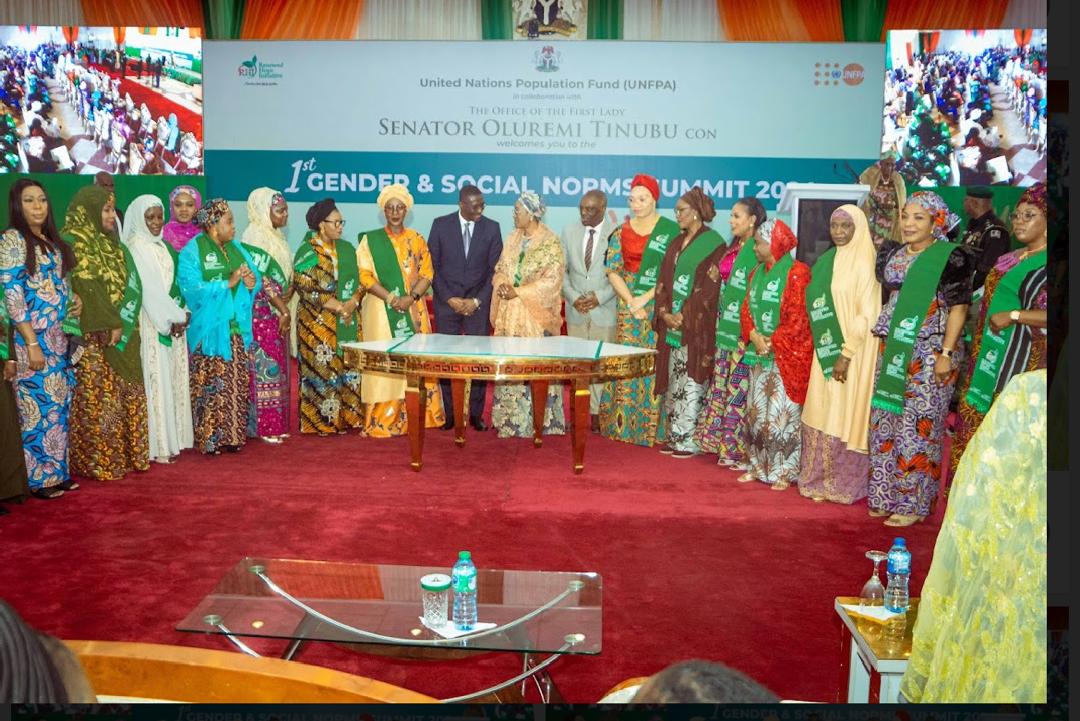
Oluremi Tinubu, Governors Wives Sign Agreement to Stop Harmful Practices Against Women
The First Lady, Sen. Oluremi Tinubu and the wives of state governors on Tuesday signed an agreement to tackle Gender-Based Violence (GBV) and harmful social practices against women in Nigeria.
The agreement was signed in Abuja at the maiden edition of Gender and Social Norms Summit 2024 organised by the United Nations Population Fund (UNFPA) and Renewed Hope initiative in collaboration with the Office of the First Lady.

In her keynote address, the First Lady said that the prevalence of harmful practices such as Female Genital Mutilation (FGM), child marriage, which in some cases leads to Vesicovaginal Fistula (VVF), and other forms of violence against girls and women remain unacceptably high.
She said, in spite of various efforts, the incidence of these practices continues to grow, decrying that the spate of rape cases and GBV had reached an alarming rate, not sparing babies too.
She said: “Do we allow this trend to continue, or do we look the other way? That is why I am calling on the law enforcement agencies, the Inspector General of Police, the Attorney General of the Federation and the National Assembly.
“To appropriate and enforce stiffer laws and punishments for perpetrators of rape, sexual violence, and other forms of GBV.
No guilty party should be allowed to go free and start running the streets looking for the next victim.”

Tinubu admitted that collective action was needed to put an end to the practices, while advocating for the development of state-specific action plans to promote the allocation of adequate resources in government budgets to support gender equality initiatives and GBV prevention programmes.
She noted that: “This summit provides us with a common platform to create awareness, exchange lessons learned, and promote effective strategies for preventing and responding to GBV and harmful practices.”
The UNFPA Officer-In-Charge of the Nigerian office, Mr Koessan Kuawu, on his part, said that family planning was not only a crucial health intervention but a cornerstone of gender equality and women’s empowerment.
He however lamented that in many communities across Nigeria, social norms drive misconceptions and cultural barriers, hindering the uptake of family planning.
He noted that Nigeria occupies a unique position globally in the pursuit of the Social Development Goals (SDGs) for 2030 due to its vast population.
He, however, commended the government for its steadfast dedication to creating an enabling environment, through the passage and enforcement of critical legislation, such as the Violence Against Persons Prohibition (VAPP) Act 2015, and also the implementation of the National FGM Policy, National Child Marriage Policy, and state-specific action plans to eliminate FGM and child marriage.
He said: “These milestones have been achieved through persistent advocacy efforts aimed at strengthening the adoption and implementation of these laws.”
Kuawu noted that though eliminating GBV and harmful social practices was an immense task, it was not insurmountable, insisting that: “With the right resources, political will, and community support across the states, we can change the narrative for women and girls in Nigeria.”
On her part, the Minister of Women Affairs and Social Development, Mrs Uju Ohanneye, advocated for stricter penalties for perpetrators of violence against women.
She noted that: “Overseas, where they are afraid to commit crimes or social norms or things that can harm another, it’s because when you do it, you face the consequences, legally and otherwise.
“However, here in Nigeria, when you have connection, before you know it, it dies a natural death and we forget so easily.
“So on this note, to support this program, we in the Ministry of Women Affairs will move forward to make sure there will be consequences if you commit a crime.”
The Attorney-General of the Federation, Lateef Fagbemi (SAN), defined social norms are the unspoken rules or expected behaviour that set social standards of appropriate and inappropriate behaviour in a specific culture or social group.
Fagbemi, who was represented by the Solicitor-General of the Federation, Mrs Beatrice Agba, said GBV encompasses various forms of violence directed at individuals based on their gender, often rooted in unequal power dynamics and societal norms.
Fagbemi noted that the practices “may unfortunately be attributed to the patriarchal and male dominance theoretical framework in place in our society.”
He said that the Federal Ministry of Justice was fully aware of the crucial role that the justice system plays in addressing gender and social norms issues through the provision of a framework for accountability, protection, and empowerment.
The Attorney General added that by upholding the rule of law, promoting gender equality, and advancing justice for all, the justice system could contribute significantly to creating a more inclusive, equitable, and just society for the present and future generations.
He said in addition to ongoing legislative reforms, the ministry was working with critical stakeholders to engage community actors such as traditional rulers, faith-based organisations, and informal community justice systems to address the notions and institutions that perpetrate violence against women and girls within the criminal justice system.
“We are initiating a pilot phase with the Area Councils in collaboration with area council chairmen in order to support ongoing dialogue and initiatives on this subject.”
Oluremi Tinubu, Governors Wives Sign Agreement to Stop Harmful Practices Against Women


Military
Mutiny: Presidential Guard Tightens Security Around Niger Presidency Amid Reports of Military Protest

Mutiny: Presidential Guard Tightens Security Around Niger Presidency Amid Reports of Military Protest
By Zagazola Makama
Security was significantly reinforced around Niger’s Presidential Palace in Niamey following reports of unrest involving elements of the country’s armed forces, security sources told Zagazola Makama.
According to multiple security sources, the heightened deployment of the Presidential Guard, supported by armoured vehicles around the Presidential Palace on the night of July 3 and into July 4, followed what was described as a limited protest by personnel of an armoured unit within the Niger Armed Forces (FAN).
The sources said some soldiers reportedly declined deployment to frontline positions in northern Tillabéri Region, particularly around Inatès and Chinagodrar, citing inadequate heavy equipment and insufficient operational resources to confront the growing security threats in the area.
The protest was described by one source as a “small mutiny,” although there has been no official confirmation from the Nigerien authorities.
Security sources said the development triggered concern within the country’s leadership, prompting the reinforcement of security around the Presidential Palace and temporary restrictions on movement in the surrounding area as a precautionary measure.
The Tillabéri Region remains one of Niger’s most volatile security zones, with recurrent attacks by armed extremist groups, including factions linked to the so-called Islamic State in the Greater Sahara (ISGS).
As of the time of filing this report, the Nigerien government and military authorities had not issued any official statement regarding the reported protest or the increased security presence around the Presidency.
The situation remains under close observation.
Mutiny: Presidential Guard Tightens Security Around Niger Presidency Amid Reports of Military Protest

Two suspected criminals arrested during patrol in Plateau
By: Zagazola Makama
Troops of Sector 1 under Operation Enduring Peace have arrested two suspected criminals during a routine patrol in Jos East Local Government Area of Plateau.
Security sources disclosed that the suspects, identified as Azi Ezekiel, 21, and Ajiji Emmanuel, 19, were apprehended at about 10:30 a.m. on Saturday along the road leading to Forbur Village.
The sources said the suspects were intercepted by troops of Sector 1, Sub-Sector 12, while conducting a routine patrol in the area.
According to the sources, the two suspects have been handed over to the Keystone Police Station in Forbur for further investigation and possible prosecution.
The arrest forms part of ongoing security operations aimed at combating criminal activities and enhancing safety across Plateau State.
Two suspected criminals arrested during patrol in Plateau

Troops arrest suspected kidnapper in Plateau community
By: Zagazola Makama
Troops of Sector 4 of Operation Enduring Peace have arrested a suspected kidnapper during a security operation in Barkin Ladi Local Government Area of Plateau.
Security sources said the suspect, identified as Mohamdu Surajo, 29, was arrested at about 6:45 p.m. on Friday at Sabon Layi Village following sustained security operations in the area.
The sources disclosed that the suspect is currently in military custody and is undergoing preliminary interrogation to aid ongoing investigations.
They added that the arrest is part of continued efforts by security forces to dismantle criminal networks and enhance security across Plateau State.
Troops arrest suspected kidnapper in Plateau community

President Tinubu Flags Off the Construction of Dikwa–Gamboru Ngala, Bama–Banki International Road Projects

Mutiny: Presidential Guard Tightens Security Around Niger Presidency Amid Reports of Military Protest

Troops Arrest Two Suspected Berom Militia Linked to NIPSS Attack as Security Sources Say Investigation Supports Earlier Leads

Roger Federer’s Shock as DNA Results Reveal Myla and Charlene Are Not His Biological Children

THE PLIGHT OF FARIDA

FAILED COUP IN BURKINA FASO: HOW TRAORÉ NARROWLY ESCAPED ASSASSINATION PLOT AMID FOREIGN INTERFERENCE CLAIMS
-
 News2 years ago
Roger Federer’s Shock as DNA Results Reveal Myla and Charlene Are Not His Biological Children
-
Opinions4 years ago
THE PLIGHT OF FARIDA
-
 News1 year ago
FAILED COUP IN BURKINA FASO: HOW TRAORÉ NARROWLY ESCAPED ASSASSINATION PLOT AMID FOREIGN INTERFERENCE CLAIMS
-

 News2 years ago
EYN: Rev. Billi, Distortion of History, and The Living Tamarind Tree
-
 Opinions5 years ago
POLICE CHARGE ROOMS, A MINTING PRESS
-

 ACADEMICS2 years ago
A History of Biu” (2015) and The Lingering Bura-Pabir Question (1)
-

 Columns2 years ago
Army University Biu: There is certain interest, but certainly not from Borno.
-

 Politics1 year ago
2027: Why Hon. Midala Balami Must Go, as Youths in Hawul and Asikira/Uba Federal Constituency Reject ₦500,000 as Sallah Gift
