
News
Panel Absolves Military of Reuters’ Allegation of 10,000 Forced Abortion, Children Massacre

Panel Absolves Military of Reuters’ Allegation of 10,000 Forced Abortion, Children Massacre
By: Michael Mike
The Special Independent Investigative Panel on Human Rights Violation in Counter-Insurgency Operations in North-East Nigeria (SIIP-North East) on Friday submitted its report to the National Human Rights Commission (NHRC).
The panel was set up by NHRC to investigate Reuters’ allegations of human rights violation in the North Eastern region of the country by the Nigerian Army in its ongoing operations against insurgency in the area.
In the report of the seven-member panel chaired by a retired Justice of the Supreme Court, Justice Abdu Aboki, received by the Executive Secretary of the NHRC, Dr. Tony Ojukwu, the Nigerian military was absolved of the allegation of forced illegal abortions and massacre of children as alleged by Reuters, a foreign media agency.
According to the report presented by the General Counsel to the Panel, Mr. Hillary Ogbona, who is also the Senior Human Right Adviser to the NHRC boss: “The panel did not find evidence that the Nigerian Armed Forces committed a systematic, secret, or policy-driven abortion in the North-East to the tune of 10,000 abortions”.
The report said, the Panel found that, the Nigerian military had no agreement with any civilian healthcare institution to forcibly and illegally terminate pregnancies in the North-East.
Part of the report stated that: “There was no evidence before the panel to prove that. The panel found probability, based on witness testimony, that the NGO, Medecins San Frontieres (MSF) was engaged in abortion procedures for some years in the North East through its medical facilities that it operated”.
For smuggled, poisoned, and shot, which was also alleged by Reuters, Ogbona said, the panel did not find the Military culpable for the massacre of children in Kukawa, in Dasarua, in Abagano, and in many parts of Marte.
The report said, the panel found the military culpable of infanticide and the killing of community members in a village of Adisawe, in Marte local government area of Borno State, on the 16th of June, 2016, and that, the panel received witness testimonies, including those of survivors and relations of the deceased.
In terms of war on women, the SIIP-North-East also absolved the military, stating that the panel did not find that the Nigeria Armed Forces specifically targeted women in military camps or in IDP camps, adding that it did not find evidence to that effect.
“Rather, the panel found evidence from military sources and civilian sources, especially women and girls who are still in military custody and who have left internal displaced camps, that the military took care of them while they were in camps. A lot of them gave birth to children while they were in camps as well, and we saw evidence of all of those”, the report added.
The panel, in its recommendations contained in the report urged the Federal Government to compensate the victims of the killings in Abisare in Marte Local Government within 90 days of the receipt of the report.
It also recommended that the NHRC should work out a compensation regime and recommend same to the Federal Government within a period of 30 days from the receipt of the report and that, Nigerian Armed Forces and other appropriate authorities to constitute a Court Martial to prosecute suspected officers and men of the Defunct 8 Task Force Division, Monguno who were operational in Abisare, Marte Local Government of Borno State in June 2016 or other units of the Nigerian Armed Forces who were operational at the location within the same period.
The Panel also recommended the retirement of suspected officers and men of the Defunct 8 Task Force Division, Monguno who were operational in Abisare, Marte in June 2016 or other units of the Nigerian Armed Forces who were operational at the location within the same period.
It advised the Borno state Government to provide basic social facilities such as schools, hospitals and recreational centres in the recovered communities, especially in Kukawa and environs, ensuring
that children in the communities have access to basic education and adequate social development.
It also advised that the Borno state government develop and execute within six months of the submission of the report, in collaboration with the Nigerian Armed Forces and the UN System, a contextual standard of assessment of security situations in post-conflict communities prior to initiating the return of communities as well as a comprehensive economic and social empowerment programme for women recovering from conflict in the state.
The panel also recommended the strengthening of the mandate of the NHRC to play an oversight, monitoring and reporting roles in integrating human rights principles in the counter-insurgency operations and the rehabilitation, detention and prosecution of terrorist suspects, among others.
The Government and Military leadership, the report said, should implement robust protections for whistle-blowers who report human rights abuses within the military, ensuring they are safeguarded from retaliation and that, the Nigerian Military should ensure that all military operations are conducted without discrimination based on race, ethnicity, religion, or other statuses, respecting the human rights of all individuals involved.
Ogbona said, the panel’s report which took 18 months of thorough investigations, testimonies of 199 witnesses and visit to 20 field locations to produce would not only stand the test of time in terms of its thoroughness, but also in terms of the fact that the panel made almost good of a hopeless situation.
Speaking earlier, the chairman of the panel, Justice Abdu Aboki, said the challenges of conducting an investigation in a volatile environment as well as the non-appearance of Reuters and a few other key institutions made the Panel worked longer and more extensively, broadening its investigations and reach.
He revealed that the reporr include analyses of documentations and records received from state hospitals and the Nigerian military and several aspects of the investigative processes that would be instrumental in framing human rights accountability mechanism as well as the criminal justice system in Nigeria.
Aboki, who said the report is informative and would serve as a guide or future reference material for future Panels, highlighted the non-appearance of Reuters and the lack of cooperation from the International Committee of the Red Cross (ICRC) and Medecins Sans Frontieres (MSF) as major challenges faced by the panel in the course of its investigation.
He called for the implementation of the recommendations contained in the report by the NHRC, the Federal and State governments, the Nigerian military, UN Agencies and NGOs working in the region.
Receiving the report, the NHRC boss said, the report embodies months of dedicated work in response to allegations of gross violations of human rights against the Nigerian Armed Forces reported in December 2022 by Reuters.
In the three-part report, he said, Reuters alleged that the Nigerian Military conducted illegal and forced termination of 10,000 pregnancies, extrajudicial killing of children, and the violation of the rights of women through targeted attacks during counter-insurgency operations in the North-East.
In response to the grave concerns, the NHRC, empowered by Sections 5 and 6 of the NHRC Act which gives it the mandate to receive complaints, investigate human rights violations in Nigeria and make appropriate determination and compensation to victims of human rights violations, established the independent panel to conduct a thorough and unbiased investigation.
The work of the panel, he said reflects a major contribution by the NHRC in ongoing efforts to ensure accountability and uphold human rights standards in Nigeria and assured of the commitment of the Commission to justice, transparency, and accountability to any form of human rights violation associated with conflict and insurgency.
He said, the findings and recommendations of the Panel, which offer both clarity and a call for action will instigate and inspire multi-stakeholder partnerships in humanitarian response in the North-East.
“They underscore the complexities and human costs of counter-insurgency operations in Nigeria’s North-East and provide a blueprint for meaningful reform. They highlight the urgent need for transparency within our security forces and the establishment of mechanisms to protect civilians.
“As part of our commitment to ensuring the panel’s recommendations are fully realized, the NHRC will be embarking upon series of public consultations and conversations on the report.
“The first of this series will be taking place in Maiduguri next week. We plan to host similar forums in Damaturu and Yola. In December, NHRC plans to host a Civil-Military Forum where the report and its implementation strategies will be discussed with all stakeholders.
“Additionally, the NHRC will work closely with military and medical institutions to foster respect for human rights in humanitarian situations. The NHRC is committed to ensuring that citizens of Abisari community identified in the report receive compensation and will continue to work with the military and the Office of the Attorney General to ensure that justice is served.
“The NHRC will liaise with our UN partners to propose human rights-based programs focused on the resettlement and reintegration of returnees and vulnerable populations, including children affected by conflict”, he added.
Ojukwu also said, the Commission is dedicated to actively monitoring progress and ensuring that every recommendation of the panel is pursued to the fullest.
It would be recalled that, in December 2022, Reuters published “Nightmare in Nigeria,” a three-part investigative report alleging series of systematic gross human rights violations by the Nigerian military during counter-insurgency operations in the North-East region.
These violations, the Reuters said, are targeted women and children, involving mass abortions and systematic killings of women and children.
Panel Absolves Military of Reuters’ Allegation of 10,000 Forced Abortion, Children Massacre


Zulum Appoints Engr Peter Samuel as General Manager BOSAMA
By: Our Reporter
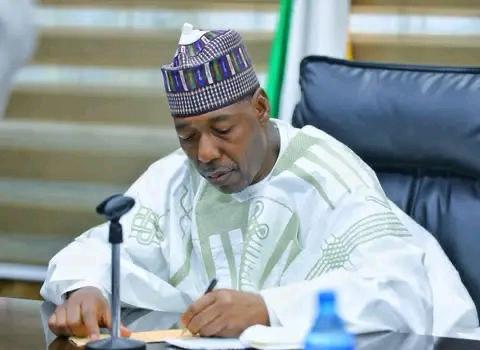
Borno State Governor, Professor Babagana Umara Zulum, has approved the appointment of Engr Peter Samuel, MNSE, MNIAE, as the General Manager of Borno State Agricultural Mechanization Authority (BOSAMA).
In a statement by the Special Adviser to the Governor on Media, Dauda Iliya, the appointment was based on Engr Samuel’s outstanding professional competence, proven track record, and experience in agricultural engineering and mechanization.
The statement noted that Engr Samuel possesses the requisite qualifications, technical expertise and leadership capacity required to reposition BOSAMA in line with Governor Zulum’s agricultural transformation agenda.
The newly appointed General Manager is an Agricultural Engineer with academic, professional, administrative, and practical experience in agricultural mechanization, farm power and machinery, irrigation engineering, and agricultural infrastructure development.
He holds a Master of Engineering (M.Eng.) in Farm Power and Machinery from Joseph Sarwuan Tarka University, Makurdi (formerly the Federal University of Agriculture, Makurdi), a Postgraduate Diploma in Farm Management and Production Economics from Nasarawa State University, and a Bachelor of Engineering (B.Eng.) in Agricultural and Environmental Resources Engineering from the University of Maiduguri.
Engr Samuel has distinguished himself through years of meritorious service in teaching, research, agricultural engineering practice, and project implementation. He currently serves as a Lecturer in Farm Power and Machinery at Ramat Polytechnic, Maiduguri.
Over the years, he has held several strategic leadership positions, including General Manager of a commercial agricultural enterprise, Project Coordinator, Programme Coordinator, and Consultant on numerous agricultural development interventions implemented by reputable national and international organisations.
He is a member of the Nigerian Society of Engineers (NSE) and the Nigerian Institution of Agricultural Engineers (NIAE).
Governor Babagana Zulum congratulated the new General Manager on his appointment and urged him to deploy his wealth of knowledge, technical expertise, and experience in agricultural mechanization to strengthen the operations of BOSAMA
Zulum Appoints Engr Peter Samuel as General Manager BOSAMA
Troops Arrest Suspected Military Impostor in Katsina
By Zagazola Makama
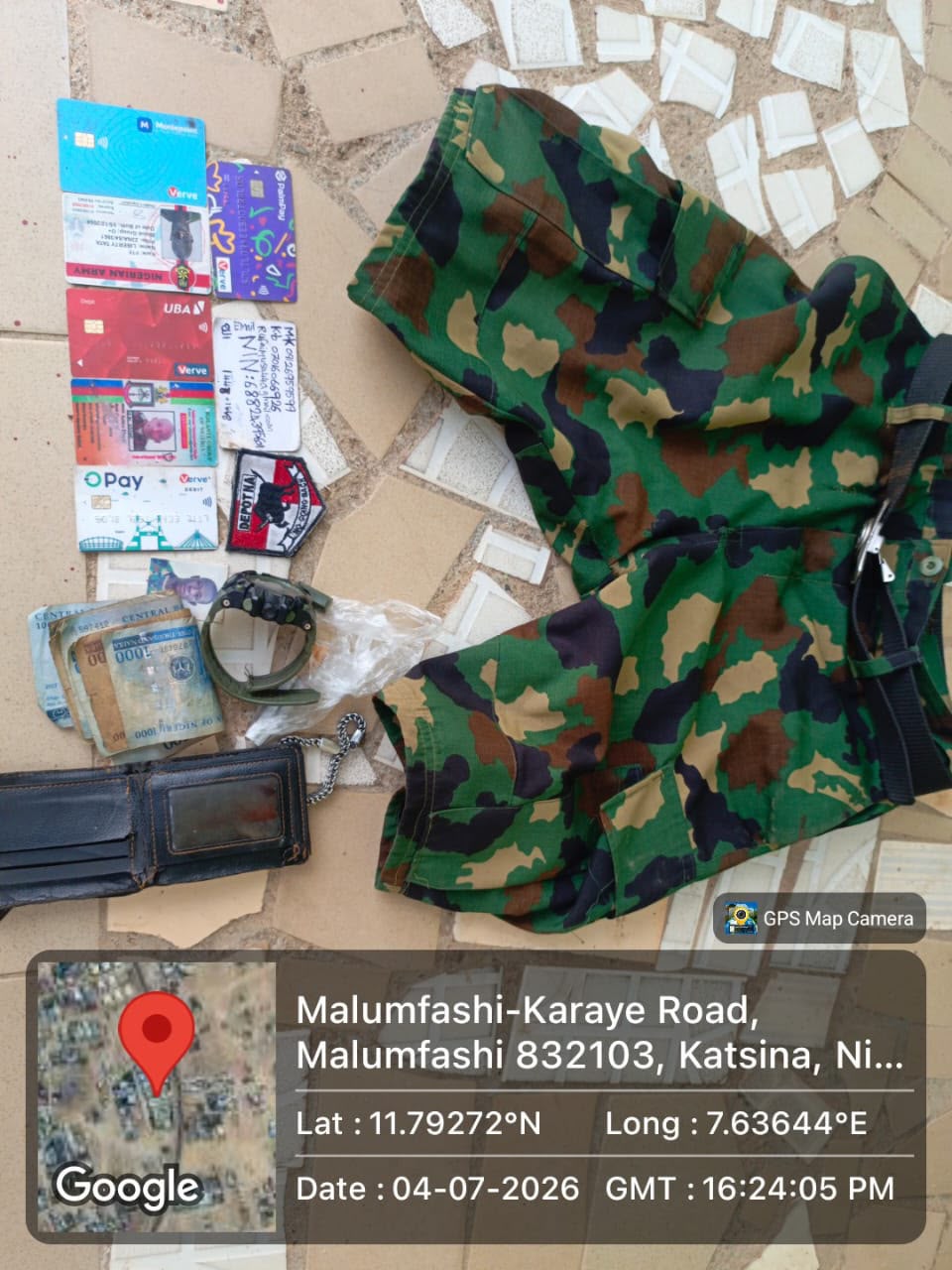
Troops of 17 Brigade have arrested a suspected military impostor during a fighting patrol in Malumfashi Local Government Area.
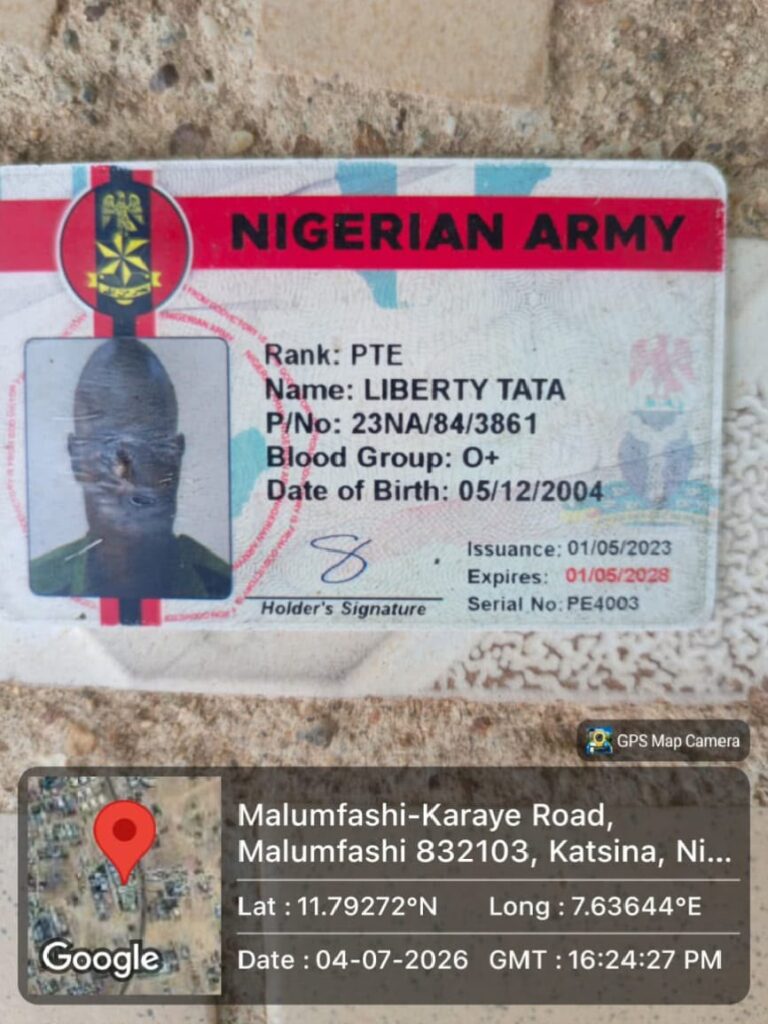
Security sources told Zagazola Makama that the suspect was apprehended at about 1:30 p.m. on July 4 by troops deployed at the Forward Operating Base (FOB) Malumfashi while conducting routine patrols within Malumfashi town.
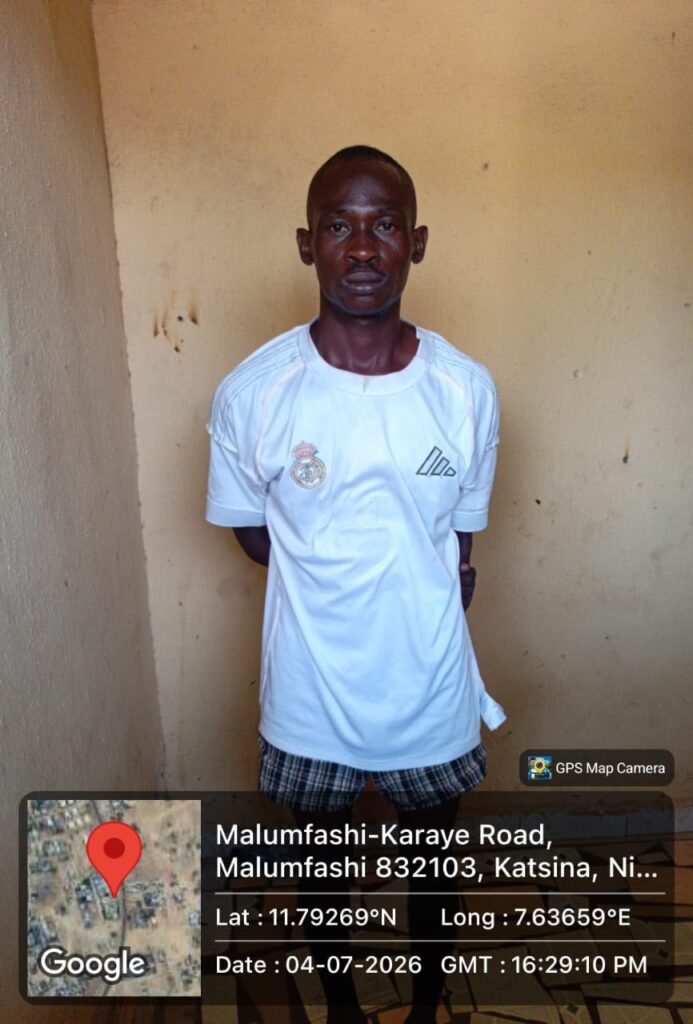
According to the sources, the suspect was intercepted while wearing a woodland camouflage three-quarter short, raising suspicion among the troops.
A search conducted on the suspect led to the recovery of a fake Nigerian Army identity card, four Automated Teller Machine (ATM) cards, one woodland camouflage three-quarter short, a wristwatch and the sum of ₦17,000.
The suspect and the recovered exhibits are currently in military custody pending further investigation.
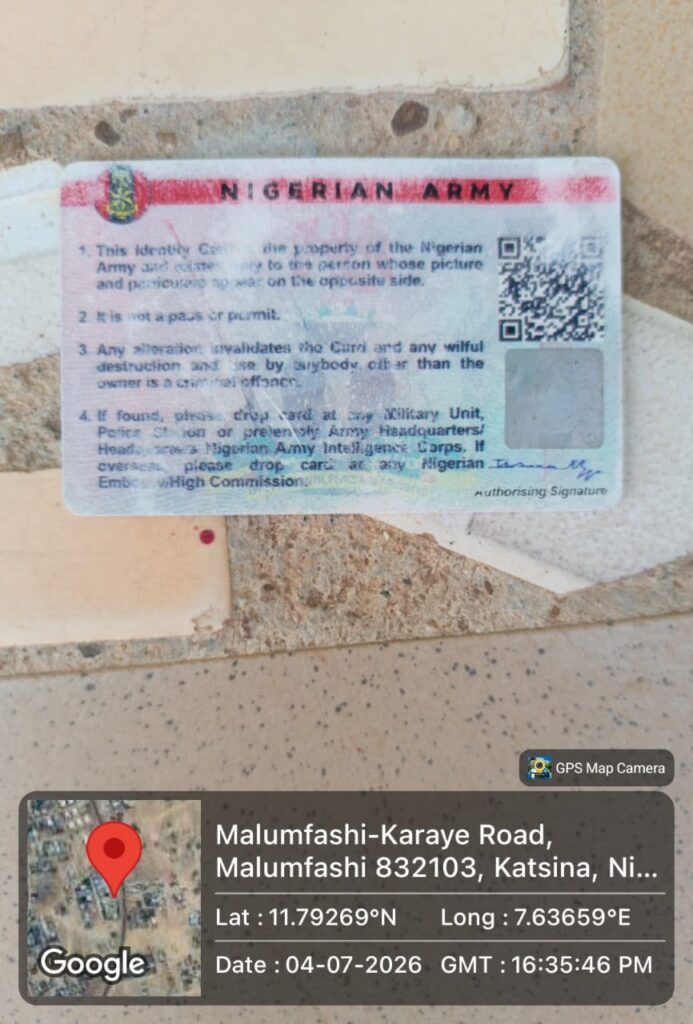
Military sources said the arrest forms part of ongoing efforts to curb impersonation of security personnel and other criminal activities within the area.
Troops Arrest Suspected Military Impostor in Katsina
Troops Recover 50 Rustled Cattle, Repel Suspected Rustlers in Kaduna
By Zagazola Makama
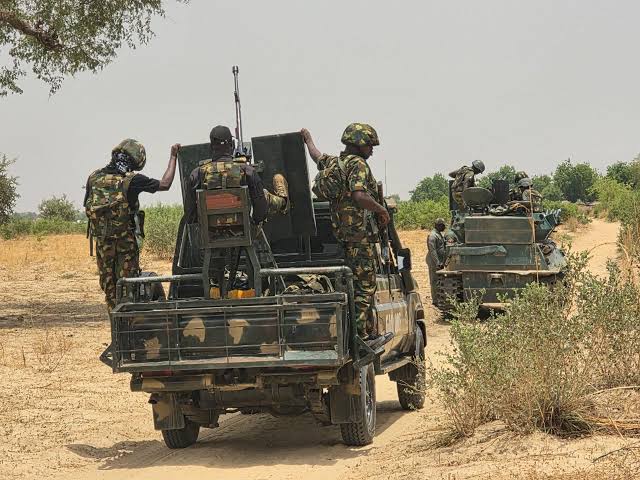
Troops deployed at the Forward Operating Base (FOB) Kankomi have recovered 50 rustled cattle after repelling suspected cattle rustlers during an ambush operation in Chikun Local Government Area.
Security sources told Zagazola Makama that the troops responded to a distress call at about 9:55 a.m. on July 4 over the activities of suspected rustlers at Ungwan Gontu community.
According to the sources, the troops swiftly laid an ambush and made contact with the fleeing suspects, forcing them to abandon the stolen livestock and escape into the surrounding area.
During the operation, the troops recovered 50 rustled cattle, which were subsequently identified and handed over to their rightful owner.
Military sources said efforts are ongoing to track down the fleeing suspects as security operations continue to combat cattle rustling and other criminal activities across Kaduna State.
Troops Recover 50 Rustled Cattle, Repel Suspected Rustlers in Kaduna

Zulum Appoints Engr Peter Samuel as General Manager BOSAMA

DSS Frees Cardiac Surgeon Martin Aghaji on Bail Over Alleged Economic Crime

Troops Arrest Suspected Military Impostor in Katsina

Roger Federer’s Shock as DNA Results Reveal Myla and Charlene Are Not His Biological Children

THE PLIGHT OF FARIDA

FAILED COUP IN BURKINA FASO: HOW TRAORÉ NARROWLY ESCAPED ASSASSINATION PLOT AMID FOREIGN INTERFERENCE CLAIMS
-
 News2 years ago
Roger Federer’s Shock as DNA Results Reveal Myla and Charlene Are Not His Biological Children
-
Opinions4 years ago
THE PLIGHT OF FARIDA
-
 News1 year ago
FAILED COUP IN BURKINA FASO: HOW TRAORÉ NARROWLY ESCAPED ASSASSINATION PLOT AMID FOREIGN INTERFERENCE CLAIMS
-

 News2 years ago
EYN: Rev. Billi, Distortion of History, and The Living Tamarind Tree
-
 Opinions5 years ago
POLICE CHARGE ROOMS, A MINTING PRESS
-

 ACADEMICS2 years ago
A History of Biu” (2015) and The Lingering Bura-Pabir Question (1)
-

 Columns2 years ago
Army University Biu: There is certain interest, but certainly not from Borno.
-

 Politics1 year ago
2027: Why Hon. Midala Balami Must Go, as Youths in Hawul and Asikira/Uba Federal Constituency Reject ₦500,000 as Sallah Gift
