
News
Pockets of attacks on our communities will never deter us from keeping the peace….Kadafur

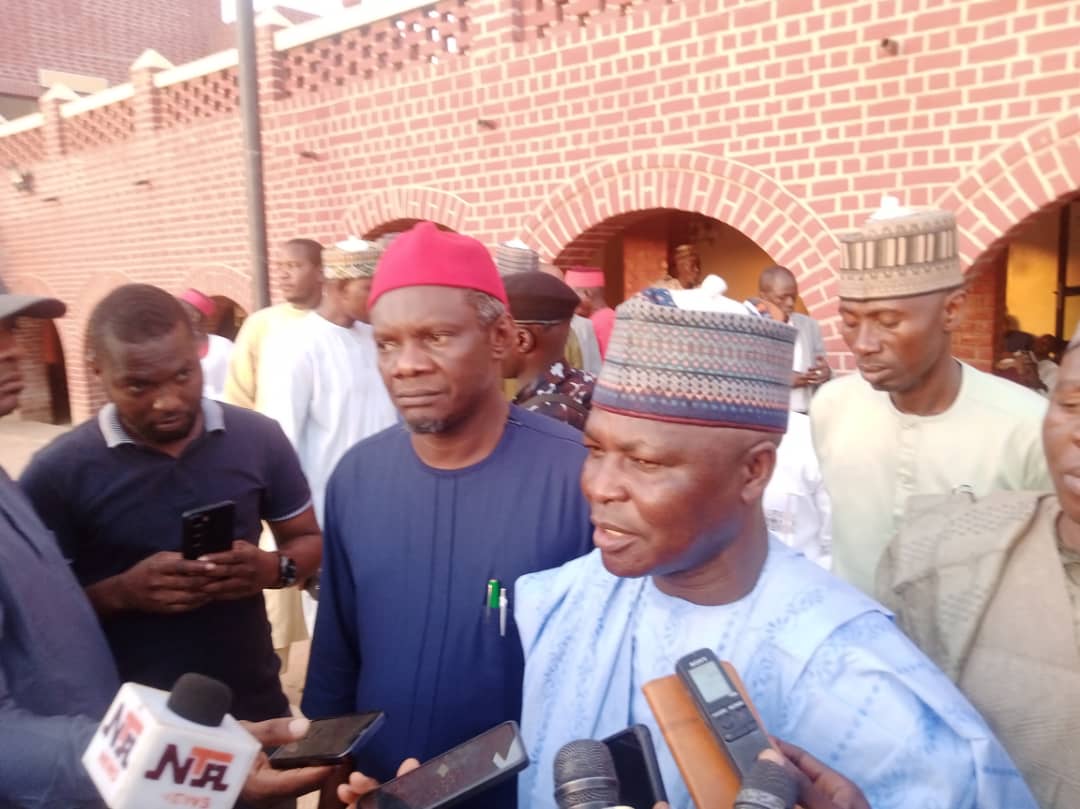
Pockets of attacks on our communities will never deter us from keeping the peace….Kadafur
By: Bodunrin Kayode
The Deputy Governor of Borno state Usman Kadafur has said the recent attacks on certain communities in the state will not deter the efforts of the government in restoring the peace for residents.
He stated this during a visit by the House of Reps. Committee on Insurance and Actuarial led by it’s chair Usman Jaha
who also represents Gwoza/Chibok/Damboa federal constituency in Borno State.
The committee members had met in the the office of the Deputy governor in the Borno state government house in Maiduguri during the week where they intimated him about their retreat.p
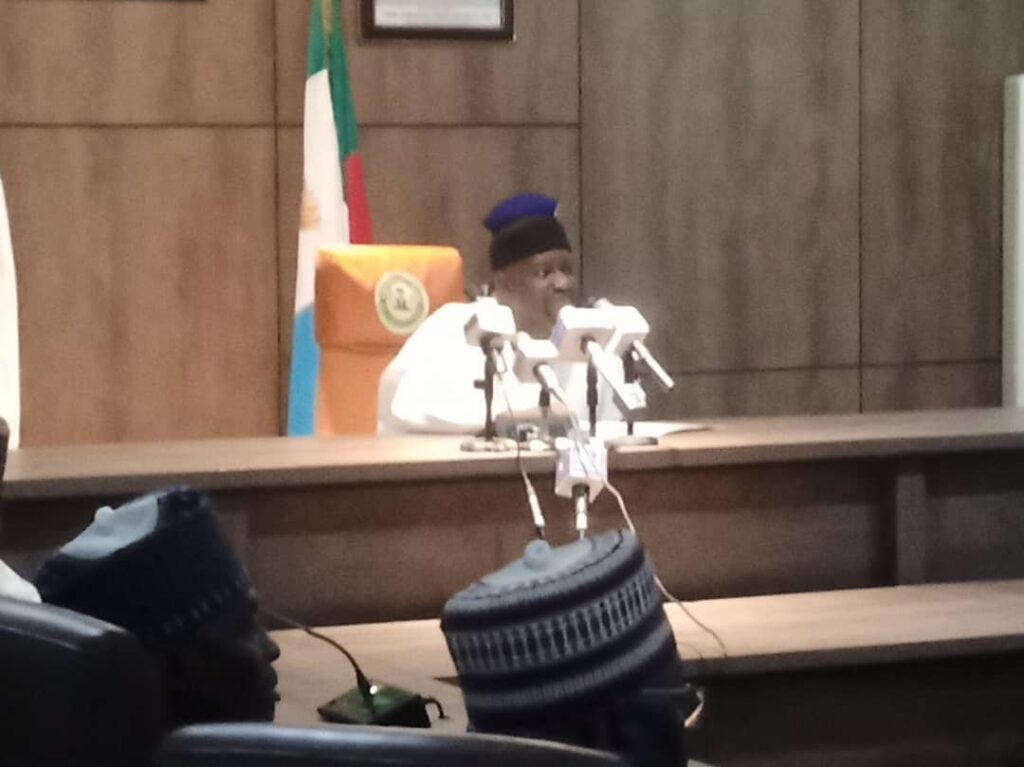
Responding to their visit, the Deputy Governor had said that despite the challenges and destruction caused by insurgency the state government has rebuilt affected communities through its resettlement initiative and rekindled the resilience of the people.
He noted that the state government’s collective achievements against terrorism will not be deterred because peace restoration in the the state is paramount adding that the Zulum government is consolidating at the present post insurgency era.
The Chairman, Reps. Committee on Insurance and Actuarial Usman Jaha also visited the Shehu of Borno Dr Abubakar Garbai Elkanemi where his members had a session with the monarch going down memory lane on how the lingering insurgency war.
Speaking on behalf of the Committee and members of his delegation, reps member Jaha lauded the Shehu of Borno for their exemplary leadership at the traditional level which has brought about relative peace and development in the state.
He said, Maiduguri was chosen as venue to carry out their retreat, because, they believed that the whole World would know that peace has actually returned after a decade of atrocities posed by insurgents.
The Lawmaker added that, their engagement “will focus on the Renewed Hope Agenda of President Bola Ahmed Tinubu’s vision to reposition the economy for better service delivery and development, considering the Federal Government’s determination towards achieving sustainable growth by strengthening Legislation, Insurance Regulation, Protection, Financial System (LIRPFS), and ensuring its stability to the public”.
He observed that, the retreat will also focus on how to tackle financial disruptions, which are events or situations that have the capacity to change the way things are done and are always associated with opportunities and challenges in the country.
The Lawmaker also appreciated the sacrifices of the Military and other security agencies in the fight against Boko Haram terrorists, which he noted has paved the way for the peace and development in the state and the North East sub-region.
Responding, the Shehu of Borno, Dr. Abubakar Garbai had praised Usman Jaha and his team, made up of over 70 members for choosing Maiduguri, the state capital as venue to conduct their 2- Day 3rd Quarter 2025 Retreat.
The Monarch posited that, Borno which had witnessed series of deadly Boko Haram attacks is now getting out of its wounds as peace has relatively returned within a large portion of the state.
Dr. Abubakar Garbai lauded Jaha Babawo and other members of the delegation for not only choosing Maiduguri as a safe place to conduct the exercise, but for finding time to visit him.
He went down memory lane on the historical challenges that were staged against the people of Borno State, such as the Rabi, Maitatsine among others, adding that they were all conquered by the resilient people in the state, even as he expressed optimism that the Boko Haram conflict would soon be defeated for total peace and development of the state.
“Your coming here into my palace is a clear testimony of your respect for the traditional institution. Let me commend you all choosing Maiduguri as a place to conduct your retreat.
“We call on many Committees of the House and other institutions or organizations to emulate you by visiting Borno, the Home of Peace for their retreats and other engagements”. stated the Monarch.
Pockets of attacks on our communities will never deter us from keeping the peace….Kadafur



Benjamins-Laniyi Tasks Media on Gender-Sensitive Reporting, Women’s Leadership
By: Michael Mike
The Director-General of the Maryam Babangida National Centre for Women Development (MBNCWD), Dr Adedayo Benjamins-Laniyi, has called for a structured partnership with the media to promote women’s leadership, strengthen gender-sensitive reporting and hold governments and institutions accountable for policies aimed at improving the lives of women and girls.
She said the media must move beyond reporting activities marking International Women’s Day to consistently highlighting women’s contributions, exposing barriers to their advancement and tracking the implementation of policies designed to address their challenges.
Benjamins-Laniyi made the call at the weekend in Abuja when the Nigeria Union of Journalists (NUJ), Federal Capital Territory (FCT) Council, led by its Chairman, Comrade Grace Ike, visited the Centre to explore areas of collaboration.
She proposed a formal media-partnership framework involving joint advocacy, public enlightenment, capacity building and regular engagements to improve the quality, depth and visibility of reporting on women’s development.
The director-general said journalists remained critical to shaping public understanding of gender issues, influencing policy conversations and ensuring that the experiences of women and girls received adequate attention in national discourse.
She proposed periodic training sessions, media roundtables and knowledge-sharing engagements to equip journalists with the skills and information required to report issues such as women’s economic empowerment, leadership, gender-based violence, education and social inclusion accurately and sensitively.
“Let us invest in the capacity of journalists to report gender issues responsibly and effectively,” she said.
Benjamins-Laniyi, the Centre’s 16th director-general, congratulated Ike on becoming the first female chairman of the NUJ FCT Council in 41 years, describing the development as an opportunity to strengthen collaboration around women’s representation and leadership.
She stressed that the proposed partnership must translate into measurable results rather than remain at the level of goodwill and declarations.
“As the 16th Director-General of the Maryam Babangida National Centre for Women Development, I extend a formal invitation to the NUJ FCT Council to become a strategic media partner in advancing the Centre’s mandate and strengthening the national movement for women’s empowerment,” she said.
To ensure accountability, she proposed that both organisations designate focal persons to coordinate activities, identify priorities and periodically assess progress through measurable indicators, including programmes implemented, women reached, stories published, public awareness raised and opportunities created.
She also urged the media to give greater visibility to women entrepreneurs, rural women, young innovators, women with disabilities and community leaders whose contributions often receive limited public attention.
According to her, journalists should be involved in shaping conversations on women’s development rather than being restricted to covering the Centre’s official activities.
“The Centre has a mandate to empower women. The media has the power to amplify that mandate. Together, we can turn that power into progress,” she said.
Earlier, Ike said the NUJ FCT Council visited the Centre to establish what she described as a “partnership of purpose”, aimed at placing women’s stories, voices and contributions at the heart of national development.
She said Nigerian women had made significant contributions to families, the economy, culture and democracy, but many of their achievements remained undocumented or inadequately represented in the national narrative.
“Our theme is: Women in Journalism: Centring Women’s Stories, Voices and Contributions for National Development,” she said.
Ike urged journalists to highlight women’s achievements and challenges while promoting public conversations that advance equal opportunities and participation in national development.
She identified the Nigerian Women Hall of Fame, located within the Centre, as an important platform for preserving the contributions of Nigerian women and said the union was willing to collaborate with the institution to document their stories for future generations.
She said such efforts should particularly inspire girls and young women by showcasing the experiences and achievements of women who had broken barriers in different fields.
The NUJ FCT chairman called for sustained media attention to grassroots and rural women, women in informal employment, women with disabilities and young women whose work often goes unrecognised.
She proposed regular features, interviews and programmes focusing on women’s leadership, enterprise, innovation and community impact, alongside intergenerational dialogues involving veteran women leaders, emerging professionals and young girls.
Other areas identified for collaboration included public discussions on women’s economic empowerment, digital inclusion, leadership, health, safety and rights, as well as joint capacity-building programmes to strengthen ethical and gender-sensitive reporting.
Ike also called for greater professional development opportunities for female journalists and increased representation of women in leadership positions within the media industry.
She urged journalists to ensure that women were adequately represented in coverage of governance, the economy, technology, security, education, health, climate change and other issues shaping the country.
“Women are not merely beneficiaries of policy. They are experts, employers, innovators, caregivers, peacebuilders, taxpayers, voters, traders, farmers, researchers and leaders,” she said.
She added that media reports should connect women to information, opportunities, essential services and decision-making spaces, while explaining policies in accessible language, exposing barriers and examining whether government commitments translated into tangible improvements in their lives.
The proposed partnership, both sides indicated, would seek to strengthen the relationship between the media and the Centre while making women’s development a sustained national priority rather than an occasional subject of public attention.
Benjamins-Laniyi Tasks Media on Gender-Sensitive Reporting, Women’s Leadership
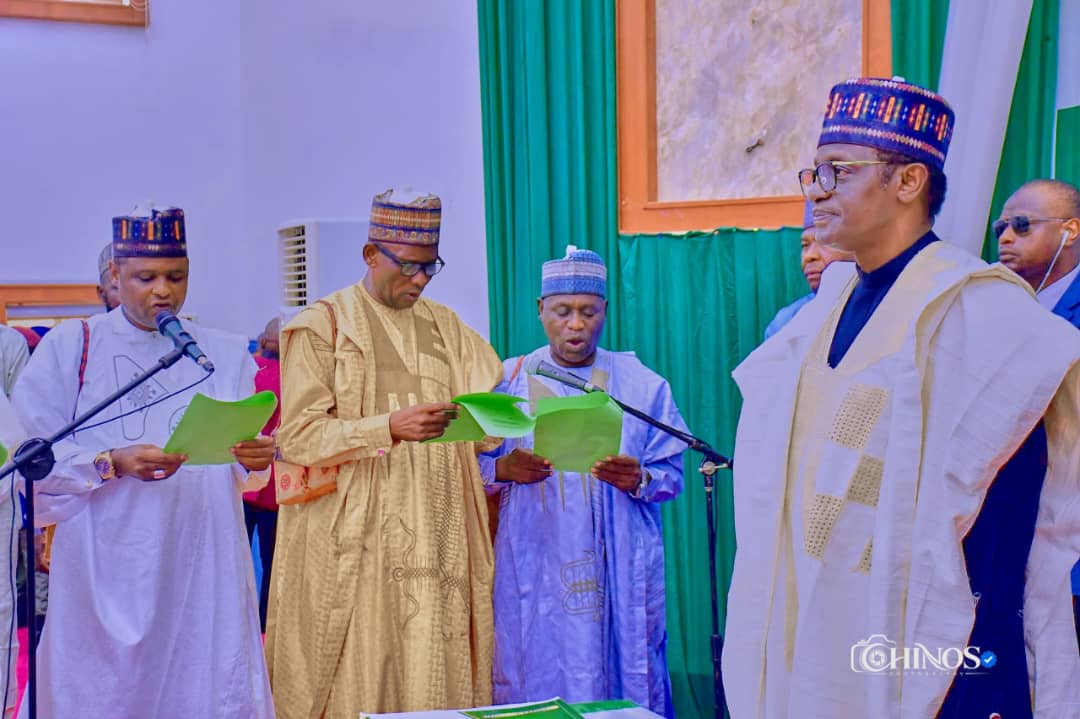
Gov. Buni swore in 2 commissioners and 7 local government chairmen in Yobe
By: Yahaya Wakili
Yobe state governor, Hon. Mai Mala Buni CON, COMN, has today sworn in two commissioners, the permanent secretary, and the 17 newly elected local government chairmen at the Banquet Hall, Government House, Damaturu.
Governor Buni said their appointment was based on merit, expertise, and individual commitment to serve and noted that, as the administration approaches its ends, there was still an opportunity for the new appointees to make a difference in their offices, assuring them of government support to discharge their duties efficiently and effectively.
According to Buni, the oath of office had provided the appointees with the legal framework to execute their duties fully, honestly, and diligently and filled the vacuum in the state executive council just as the election of council chairmen and councillors had delivered democracy to the grassroots.
He further said his administration had remained consistent in conducting local government elections to give grassroots people a sense of belonging and participation in governance through duly elected representatives.
“Yobe State was ranked second best performance” with a score of 64.3 percent, behind Oyo State’s 70 percent, in the latest assessment of the 36 states by the Kimpact Development Initiative.
Governor Mai Mala Buni tasked the chairmen of the local government to deliver their local government areas to the party in the forthcoming general elections.
“Those whose victory must be ensured to include President Bola Ahmed Tinubu GCFR for a second term in office, the state governorship candidate, Alhaji Baba Malam Wali mni, the three senatorial candidates, including Mai Mala Buni CON, six House of Representatives candidates, and the 24 state House of Assembly,” Buni listed.
Buni appealed to all political stakeholders and their supporters across all political parties to conduct their political activities peacefully and according to the rules of the game during and after the electioneering period.
“We remain a family, and Yobe State is a politically peaceful state; therefore, we must avoid and resist all activities capable of breaching peace in the state,” Governor Buni added.
Gov. Buni swore in 2 commissioners and 7 local government chairmen in Yobe

Kuje Prison Inmates Debate Education, Vocational Skills as Command Promises Jobs After Release
By: Michael Mike
The Nigerian Correctional Service (NCoS), Federal Capital Territory Command, has pledged to facilitate employment opportunities for inmates upon their release, as the Medium Security Custodial Centre, Kuje, held its maiden debate competition to promote rehabilitation and prepare inmates for reintegration into society.
The Controller of Corrections, FCT Command, Christopher Peter Jen, disclosed this on Thursday during the competition, which saw two teams of inmates argue the merits of formal education and vocational skills acquisition, with the vocational skills team emerging victorious.

Jen said the command was partnering with relevant stakeholders and support organisations to secure employment opportunities for discharged inmates, in a move aimed at improving their prospects of rebuilding their lives outside the custodial facility.
He expressed optimism that inmates could rise to positions of leadership and responsibility if given the necessary support, education and opportunities to reform.
“An inmate today can be a governor or any high-ranking individual in society tomorrow, if properly reformed,” he said.
The Controller also commended the Controller-General of Corrections, Sylvester Ndidi Nwakuche, for the opportunity to serve, saying it had strengthened his commitment to improving inmate rehabilitation and reformation across the FCT Command.
The Officer-in-Charge of the Kuje custodial centre, Assistant Controller of Corrections Adekunmi Sunday, said the debate was part of efforts to transform the facility into a centre for learning and reformation rather than one focused solely on confinement.
“Custody without training is punishment; custody with training is correction,” Sunday said.

He stressed that education and vocational training were critical to preparing inmates for life after incarceration, adding that he expected every inmate under his supervision to acquire at least one of the two.
The maiden competition featured two teams of five speakers each. Team A argued in favour of education, while Team B defended vocational skills acquisition. Following the contest, the panel of judges declared Team B the winner.
The debate was organised to develop inmates’ intellectual abilities, improve their confidence and encourage constructive interaction, while providing a platform for them to express and defend their ideas.
Representatives of partner organisations and support groups also delivered goodwill messages, commending the service for its commitment to inmate education and rehabilitation.
In a vote of thanks delivered on behalf of the officer-in-charge by Superintendent of Corrections Yusuf Muye, the centre appreciated the FCT Controller, partners, staff and inmates for their contributions to the event’s success.
The centre said the debate would become a regular feature of its reformation calendar.
The employment pledge comes amid broader efforts by correctional institutions to equip inmates with practical skills and improve their chances of reintegration after serving their sentences. However, the command did not disclose the number of inmates expected to benefit from the proposed employment initiative or identify the organisations involved in the partnership.
Kuje Prison Inmates Debate Education, Vocational Skills as Command Promises Jobs After Release

2027: No Sacred Cows—Atiku’s Record Must Face Scrutiny

Benjamins-Laniyi Tasks Media on Gender-Sensitive Reporting, Women’s Leadership

Gov. Buni swore in 2 commissioners and 7 local government chairmen in Yobe

Roger Federer’s Shock as DNA Results Reveal Myla and Charlene Are Not His Biological Children

THE PLIGHT OF FARIDA

FAILED COUP IN BURKINA FASO: HOW TRAORÉ NARROWLY ESCAPED ASSASSINATION PLOT AMID FOREIGN INTERFERENCE CLAIMS
-
 News3 years ago
Roger Federer’s Shock as DNA Results Reveal Myla and Charlene Are Not His Biological Children
-
Opinions5 years ago
THE PLIGHT OF FARIDA
-
 News1 year ago
FAILED COUP IN BURKINA FASO: HOW TRAORÉ NARROWLY ESCAPED ASSASSINATION PLOT AMID FOREIGN INTERFERENCE CLAIMS
-
 Opinions5 years ago
POLICE CHARGE ROOMS, A MINTING PRESS
-

 News3 years ago
EYN: Rev. Billi, Distortion of History, and The Living Tamarind Tree
-

 ACADEMICS3 years ago
A History of Biu” (2015) and The Lingering Bura-Pabir Question (1)
-

 Columns3 years ago
Army University Biu: There is certain interest, but certainly not from Borno.
-

 Politics1 year ago
2027: Why Hon. Midala Balami Must Go, as Youths in Hawul and Asikira/Uba Federal Constituency Reject ₦500,000 as Sallah Gift
