
National News
WFP To Ration Food to 500,000 persons in Northeast Over Dearth of Fund

WFP To Ration Food to 500,000 persons in Northeast Over Dearth of Fund
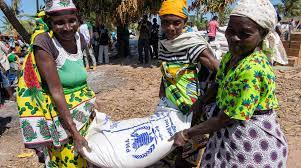
The United Nations World Food Programme (WFP) may soon cut off food rations to half a million women, men and children in troubled north-eastern Nigeria as a result of the dearth of funds.
A statement on Friday by WFP said the UN agency may soon be forced to cut food rations to more than half a million women, men and children in north-eastern Nigeria unless urgent funding is secured to continue life-saving operations in crisis-ridden Borno, Yobe and Adamawa states.
The statement read that: “The cuts would come just as severe hunger reaches a five-year high in the country in the wake of years of conflict and insecurity – a situation that has been worsened by the socio-economic fallout from COVID-19, high food prices and limited food supply. Moreover, the number of internally-displaced surpassed two million in September 2021 – reaching another grim milestone.”
The statement quoted WFP’s Regional Director for West Africa, Chris Nikoi, to have said following a recent visit to Nigeria, that: “Cutting rations means choosing who gets to eat and who goes to bed hungry. We are seeing funding for our life-saving humanitarian work dry up just at the time when hunger is at its most severe.”
The statement said if at least US$ 55 million is not received in a matter of weeks, WFP will have no choice but to cut food rations and reduce the number of people it serves – where assistance is already prioritized for the most vulnerable – as early as November.
Nikoi said: “Our food assistance is a lifeline for millions whose lives have been upended by conflict and have almost nothing to survive on. We must act now to save lives and avoid disruptions to this lifeline.”
The statement added that the number of internally displaced people – people forced to flee their homes in search for safety – in northeast Nigeria has been rising steadily and reached a new all-time high of over 2 million in September 2021, while current food security analyses show that 4.4 million people in northeast Nigeria do not know where their next meal is coming from. Additionally, over 1 million children are malnourished.
Continued attacks on communities by non-state armed groups, harsh lean season conditions amid an economy dealing with the fallout from the COVID-19, high food prices and a severe reduction in household purchasing power – all contribute to a bleak outlook for the most vulnerable people in northeast Nigeria.
Also Read: Political Instability: ECOWAS MPs task Community’s…
Despite increasing needs, WFP may soon be unable to sustain life-saving operations in conflict-riddled north-eastern Nigeria. Without additional resources, the food assistance agency will run out of funds for emergency food distribution and nutrition support by the end of October 2021.
United Nations Humanitarian Coordinator in Nigeria, Edward Kallon had earlier said: “Cutting food assistance will be a painful decision for humanitarians as it will negatively affect children, women and men uprooted from their homes due to continued violence,” adding that: “As we call upon our partners to step up their support in response to the growing needs, I would like to say thank you to those who have stood with us over the years in providing the much-needed humanitarian assistance in the country.”
It could be recalled that for five years, WFP has provided life-saving food and nutrition assistance to severely food insecure people, displaced families in camps, and to vulnerable people living in host communities thanks to generous contributions from Canada, the European Union, France, Germany, Italy, Japan, Nigeria, Republic of Korea, Sweden, Switzerland, United Kingdom, the United States of America, and private donors.
This year, relying on the continued generosity of donor partners, WFP ramped up its response to address rising food insecurity and the impact of COVID-19, targeting 1.9 million displaced people in Nigeria with life-saving food assistance. To sustain humanitarian operations in northeast Nigeria until March 2022, WFP urgently requires USD 197 million.
WFP To Ration Food to 500,000 persons in Northeast Over Dearth of Fund



NHRC Boss Honoured for Victim-Centred Human Rights Push
…UTA rewards Ojukwu for compensation, restorative justice, empowerment of rights-abuse victims
By: Michael Mike
The Executive Secretary of the National Human Rights Commission (NHRC), Chief Tony Ojukwu, has been honoured with the 2026 UTA International Humanitarian Award for championing a victim-centred approach to human rights protection, including compensation, economic empowerment and restorative justice for victims of violations.
The United Towns Agency for North-South Cooperation (UTA), Nigeria Chapter, presented the award to Ojukwu in Abuja on Thursday as part of activities marking World Humanitarian Day 2026.
The recognition, according to UTA, was in acknowledgement of Ojukwu’s sustained efforts to promote human dignity, expand access to justice and protect vulnerable and marginalised Nigerians.
Rather than limiting the response to documenting violations, the interventions highlighted by UTA focused on helping victims recover and rebuild their lives through economic empowerment, compensation and restorative support.
The initiatives also include transitional and restorative justice programmes in the North-East and efforts to improve access to justice for poor and marginalised persons.
The recognition comes against the backdrop of Nigeria’s continuing humanitarian and human rights challenges arising from conflict, displacement, poverty and other forms of vulnerability.
Under Ojukwu’s leadership, the NHRC has increasingly positioned victims at the centre of its interventions, pursuing not only accountability for violations but also remedies, restoration and practical support for affected persons.
Receiving the award, Ojukwu described it as both an honour and a fresh call to humanitarian service.
“As a humanitarian myself, this award has stimulated me to do more,” he said.
He stressed the importance of placing victims, dignity and justice at the heart of human rights protection, particularly in a country facing complex humanitarian challenges.
UTA described the NHRC chief’s interventions as contributing to the advancement of human dignity and the protection of vulnerable populations.
The organisation is a United Nations-affiliated non-governmental organisation with consultative status with the United Nations Economic and Social Council (ECOSOC).
The award ceremony attracted government officials, diplomats, humanitarian actors and other stakeholders.
The Vice President, Senator Kashim Shettima, was represented by the Director-General of the National Emergency Management Agency (NEMA), Hajiya Zubaida Abubakar Umar.
Also present were representatives of the Zamfara State Governor; the Comptroller-General of the Nigeria Customs Service, Adewale Adeniyi; the Minister of Humanitarian Affairs and Poverty Alleviation, Bernard Doro; members of the diplomatic corps; UTA International Global Secretary-General, Dr. (Amb.) Eya Essif; and UTA-Nigeria Country President, Amb. Princess Abigail Amalaha.
The honour effectively places renewed attention on the humanitarian dimension of human rights protection in Nigeria, particularly the need to move from responding to violations to ensuring that victims receive justice, restitution and the means to regain sustainable livelihoods.
NHRC Boss Honoured for Victim-Centred Human Rights Push
FG Declares Tuesday Holiday for Eid-ul-Mawlid, Charges Nigerians on Peace, Unity
By: Michael Mike
The Federal Government has declared Tuesday, August 25, 2026, a public holiday to mark the 2026 Eid-ul-Mawlid, the anniversary of the birth of Prophet Muhammad, with the government urging Nigerians to turn the religious celebration into a renewed commitment to peace, unity and national cohesion.
The Minister of Interior, Olubunmi Tunji-Ojo, announced the declaration on behalf of the Federal Government in a statement issued on Friday by the ministry’s Permanent Secretary, Dr Magdalene Ajani.
The declaration gives Muslim faithful across the country a day to commemorate the occasion, while the minister urged Nigerians to look beyond the festivities and draw practical lessons from the life and teachings of Prophet Muhammad.
Tunji-Ojo identified compassion, humility and service to humanity as some of the values associated with the Prophet’s life, saying they were particularly relevant to Nigeria’s current quest for peace and national development.
“Every Eid ul Mawlid gives us reason to pause and draw lessons from a life defined by compassion, humility and service to others.
“These are qualities our nation needs now more than ever, and I encourage every Nigerian, not just our Muslim brothers and sisters, to reflect on them,” he said.
The minister called on Nigerians to use the occasion to pray for peace, unity and national cohesion, stressing that the responsibility for building and sustaining a peaceful nation rested on all citizens.
He also urged Muslim faithful and other Nigerians to celebrate responsibly, with restraint, mutual respect and consideration for people of different faiths and backgrounds.
According to him, the values of peaceful coexistence and respect for one another remained essential to strengthening the bonds that hold the country together.
Tunji-Ojo congratulated Muslims in Nigeria and across the diaspora on the celebration and wished them a peaceful and joyous Eid-ul-Mawlid.
He further reaffirmed the commitment of the President Bola Tinubu administration to protecting lives and property and promoting peace and stability across the country.
The minister urged citizens to support government and community efforts aimed at strengthening national unity, fostering peaceful coexistence and building a more stable and prosperous Nigeria.
The public holiday will therefore provide Muslim faithful with an opportunity to mark the religious occasion while joining other Nigerians in reflecting on the values of tolerance, compassion, service and peaceful coexistence highlighted by the Federal Government.
FG Declares Tuesday Holiday for Eid-ul-Mawlid, Charges Nigerians on Peace, Unity
National News
President Tinubu, Spreading Opportunities Across Overburdened Communities, Says VP Shettima

President Tinubu, Spreading Opportunities Across Overburdened Communities, Says VP Shettima
**Inaugurates 33.5km dual carriageway in Rivers, says it’s consistent with president’s Renewed Hope Agenda
By: Our Reporter
The Vice President, Senator Kashim Shettima, has said the administration of President Bola Ahmed Tinubu is deliberately spreading infrastructure and economic opportunities beyond major cities to reduce congestion, expand jobs and promote balanced national development across Nigeria.
This, he noted, is driven by the administration’s conviction that such state-driven projects are consistent with the Renewed Hope Agenda’s push to expand security, welfare and economic opportunity beyond the centre.
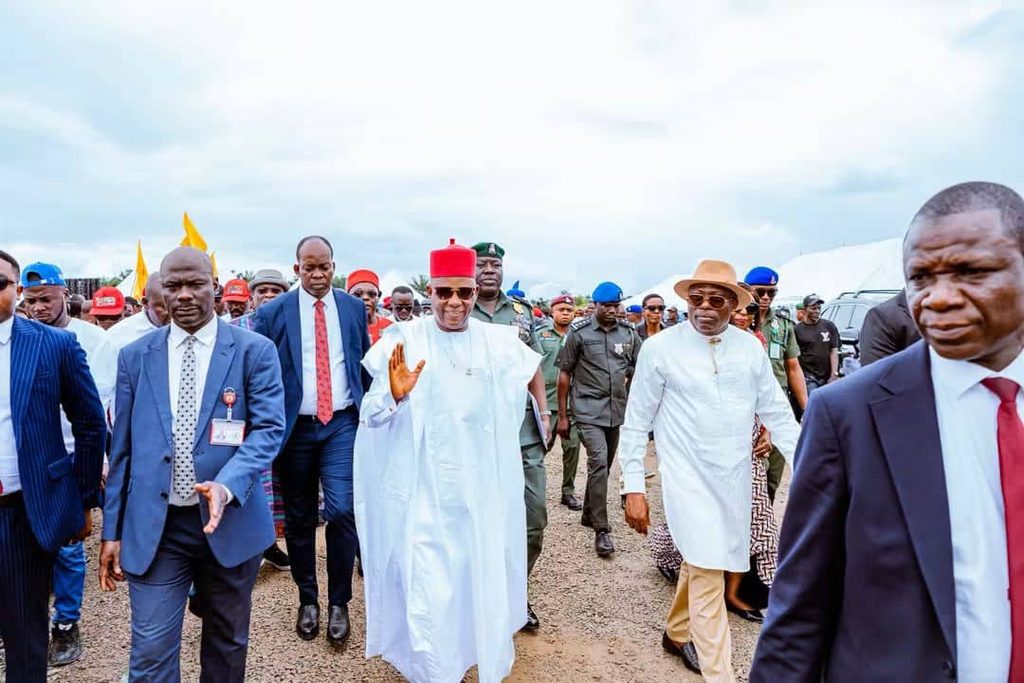
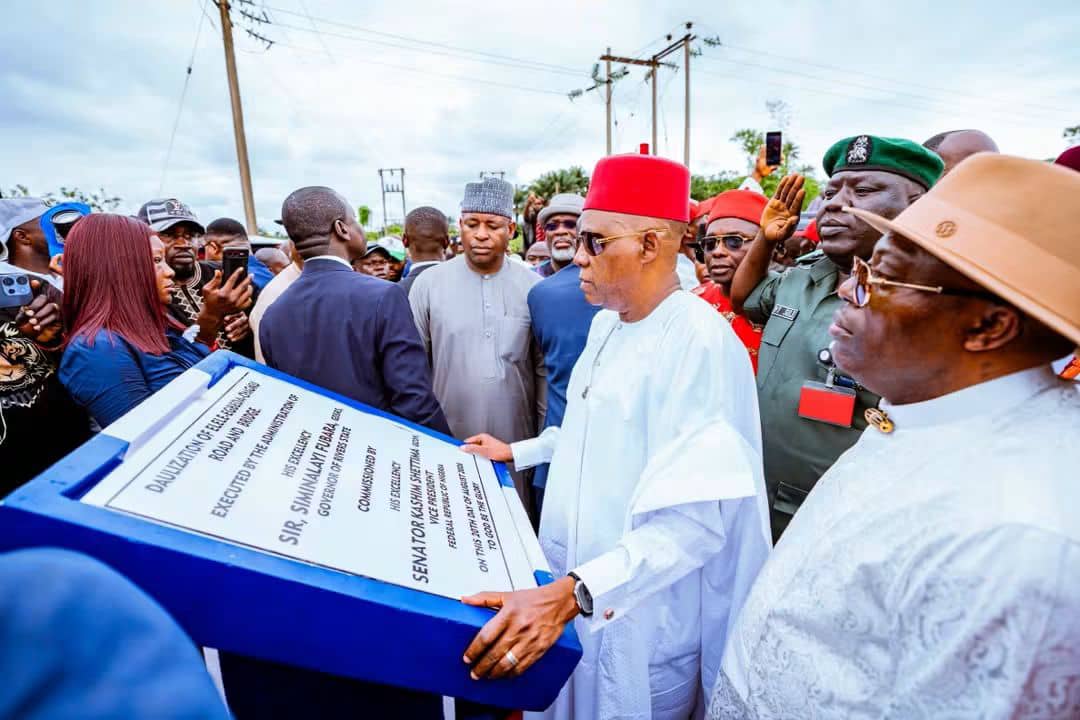
Senator Shettima stated this on Thursday while inaugurating the Elele-Umudioga-Egbeda-Ubimini-Akpabu-Ikiri-Omoku Dual Carriageway in Rivers State on behalf of President Tinubu.
The 33.5-kilometre road runs through Ikwerre, Emohua and Ogba/Egbema/Ndoni local government areas of the state, connects communities along an important agricultural, commercial and oil and gas corridor leading towards Omoku, widely regarded as the state’s “Gas City.”
“A nation becomes congested when opportunity is congested. People move because roads, markets, jobs and services have not moved far enough towards them,” the Vice President stated.
He said roads are among the most democratic instruments of development, noting that they connect farmers to markets, workers to jobs, students to schools and patients to healthcare.
“Roads are among the most democratic instruments of development. They serve the farmer carrying produce to market, the trader seeking customers, the worker travelling to employment, the student going to school and the patient seeking care. When a road works, society moves,” VP Shettima maintained.
According to him, the completed road will help farmers move produce faster, reduce losses, lower logistics costs for businesses and open communities along the corridor to greater economic activity.
“Public infrastructure must be judged by the lives it improves. A road earns its value when a farmer earns more, a child reaches school earlier, and isolation no longer punishes enterprise,” he said.

Senator Shettima commended Rivers State Governor Siminalayi Fubara for completing the project, describing it as consistent with President Tinubu’s Renewed Hope Agenda and the Federal Government’s support for state-led investments that improve security, welfare and economic opportunities.
He also stressed the importance of continuity in governance, saying, “One administration lays a foundation, another strengthens it, and the people remain the final beneficiaries.”
The Vice President urged communities along the corridor to protect the infrastructure against vandalism and other activities capable of shortening its lifespan.
“Our next responsibility is to protect this asset from vandalism, reckless use and every practice that shortens the life of public infrastructure,” he said.
Earlier, Governor Siminalayi Fubara of Rivers State said the 33.5-kilometre road, with a river crossing bridge, will improve security and ease the age-long suffering of the people of the three local government areas of Ikwere, Emohua and Ogba/Egbema /Ndoni.
The governor explained that in the past, the road was a corridor for kidnapping, oil bunkering, and other forms of criminality, assuring that with the commissioning of the road, insecurity will be a thing of the past along the road corridor, and that security agencies would increase surveillance in the area.

“In this project, we have lights from the beginning to the end. So, even in the night, insecurity is totally eliminated. This won’t have been possible without the support of the Federal Government and the good people of Rivers State.
“I want to thank you for this special support that you have been giving to us for us to come here to say, to the glory of God, that promise made is a promise kept,” the governor said.
He thanked President Tinubu and the Vice President for their unwavering support to the government and people of Rivers State.
“I am a bit emotional today because for a very long time, I felt maybe we were not part of this country, but today I feel very happy that our country is also standing by us, ably represented here by no other person but distinguished Senator Kashim Shettima, Vice President of the Federal Republic of Nigeria. You can see why I feel emotion,” Fubara added..
On his part, the Commissioner for Works, Rivers State, Prof. Temple Nwofor, said the commissioning of the road represents another significant step in the determination of the Rivers State government to provide durable infrastructure that would improve connectivity, enhance mobility and promote economic activities within the benefiting communities.
He noted that the 33.5-kilometre road linking three local government areas in Rivers State will enhance development and open up opportunities that would address societal challenges.
Also, the Chairman of Emohua Local Government Area of the state, Dr Chidi Lloyd, said the project will open communities, ease transportation and boost economic activities in the affected local governments areas.
Lloyd said the project was more than asphalt, adding that it was a road to reconciliation and prosperity that connects people’s hearts.
“This day is significant not because we are commissioning the Elele-Omoku road but because of what it represents. We sincerely appreciate the President of the Federal Republic of Nigeria. We also thank the Minister of the Federal Capital Territory for his fatherly intervention and for standing with Rivers people on this journey.”
President Tinubu, Spreading Opportunities Across Overburdened Communities, Says VP Shettima

Farmer Injured in Machete Attack by Herder in Plateau

Unidentified Corpse with Gunshot Wound Found Along Road in Plateau

Troops Rescue Kidnap Victim, Recover AK-47 Rifle After Gun Battle in Kogi

Roger Federer’s Shock as DNA Results Reveal Myla and Charlene Are Not His Biological Children

THE PLIGHT OF FARIDA

FAILED COUP IN BURKINA FASO: HOW TRAORÉ NARROWLY ESCAPED ASSASSINATION PLOT AMID FOREIGN INTERFERENCE CLAIMS
-
 News2 years ago
Roger Federer’s Shock as DNA Results Reveal Myla and Charlene Are Not His Biological Children
-
Opinions5 years ago
THE PLIGHT OF FARIDA
-
 News1 year ago
FAILED COUP IN BURKINA FASO: HOW TRAORÉ NARROWLY ESCAPED ASSASSINATION PLOT AMID FOREIGN INTERFERENCE CLAIMS
-

 News2 years ago
EYN: Rev. Billi, Distortion of History, and The Living Tamarind Tree
-
 Opinions5 years ago
POLICE CHARGE ROOMS, A MINTING PRESS
-

 ACADEMICS2 years ago
A History of Biu” (2015) and The Lingering Bura-Pabir Question (1)
-

 Columns2 years ago
Army University Biu: There is certain interest, but certainly not from Borno.
-

 Politics1 year ago
2027: Why Hon. Midala Balami Must Go, as Youths in Hawul and Asikira/Uba Federal Constituency Reject ₦500,000 as Sallah Gift
