
News
Zulum to Resettle 5,000 Displaced Persons in Bama

Zulum to Resettle 5,000 Displaced Persons in Bama
… Borno State Governor Announces Resettlement of 5,000 Displaced Persons Ahead of Farming Season
By: Our Reporter
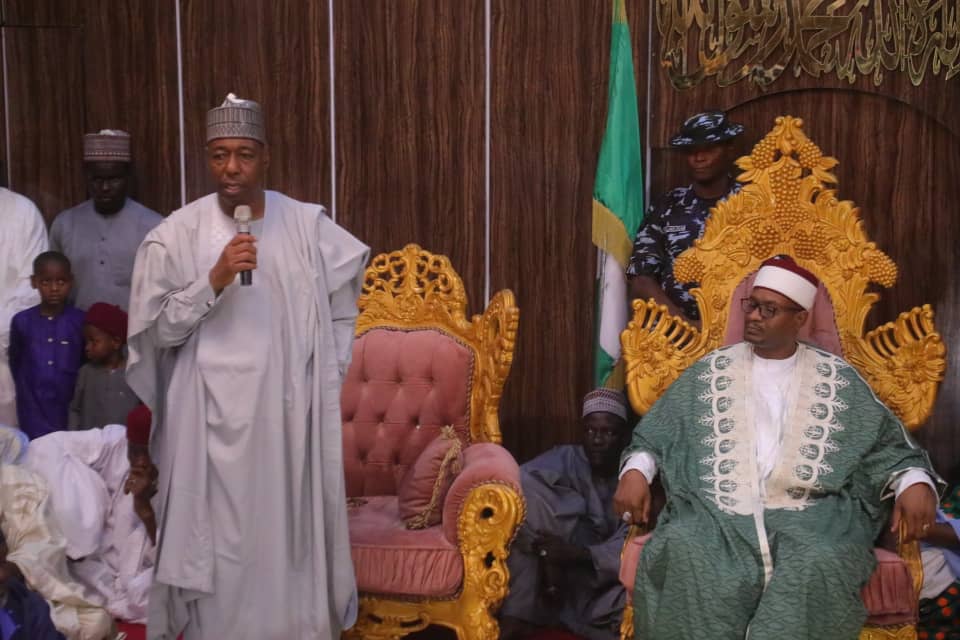
Borno State Governor, Professor Babagana Umara Zulum, has revealed plans to resettle 5,000 displaced persons from five communities before the end of the rainy season to enable them to engage in farming activities.
The communities include Goniri, Bula Kuriye, Mayanti, Abbaram, and Darajamal.

Governor Zulum disclosed this during a courtesy visit to the Shehu of Bama, Dr. Umar ibn Kyari Umar ElKanemi, at his palace in Bama on Friday.
The governor stated that the construction of 1,000 transitional shelters has commenced in each of the communities, with Darajamal’s already completed.
“We are committed to resettling all displaced persons living in IDP camps back to their communities. Construction of transitional shelters has started in Mayanti, Goniri, Bula Kuriye, and Abbaram, while that of Darajamal has been completed. I have also directed the digging of trenches to fortify the communities,” Governor Zulum said.
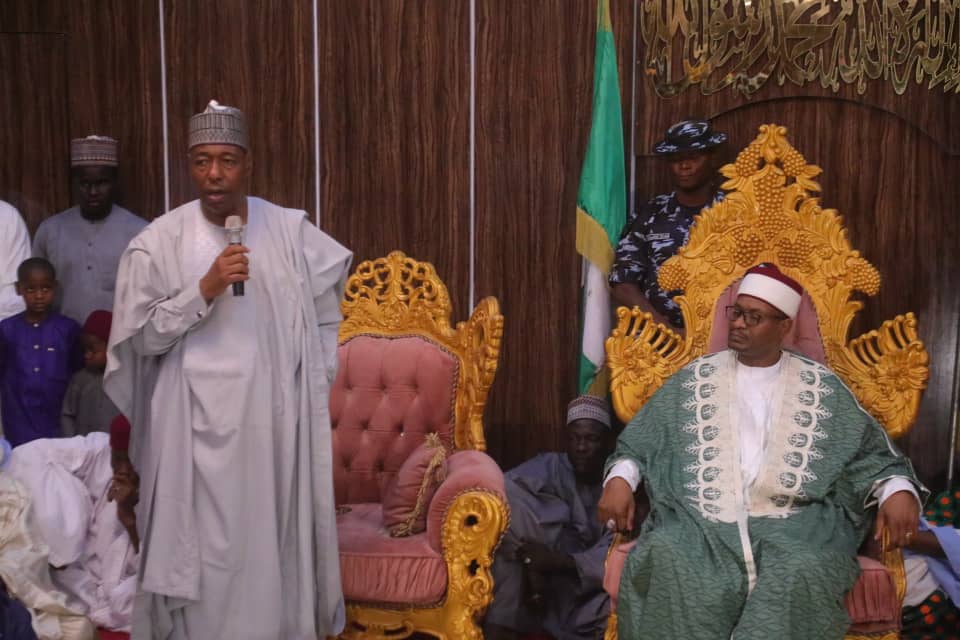
He emphasised the importance of farming, stating, “Our target is to ensure that they participate in this cropping season. Farming is our greatest treasure. I will interface with the Commanding Officer and leaders of Civilian JTF to strategise on how best to further protect these areas.”
Additionally, Governor Zulum informed the Shehu of Bama that security measures have been strengthened in Nguro Soye, a community on the outskirts of Bama town, to ensure safe farming activities.
“While returning from Gwoza, I stopped at the military formation in Banki Junction, where we discussed intensifying security in Nguro Soye and surrounding areas. I have provided the necessary logistics to the military and Civilian JTF and pledged six months’ allowances for volunteers patrolling the area,” he announced.
In response, the Shehu of Bama commended Governor Zulum for his purposeful leadership and commitment to the security and welfare of the people.
“I will like to appreciate the governor for resettling the people of Darajamal and for ongoing efforts to return more displaced persons to their homes. We are grateful, Your Excellency,” the Shehu said.
He also appealed for additional support to members of the Civilian JTF to safeguard farmers and farmlands during the rainy season.
Zulum to Resettle 5,000 Displaced Persons in Bama



Seven ISWAP Fighters’ Family Members, 12 Children Flee Yaganari Enclave, Surrender to Troops
By Zagazola Makama
Seven family members of suspected terrorists, accompanied by 12 children, have surrendered to troops of Operation HADIN KAI at Mafa in Borno State, following reported hunger and violent clashes among rival terrorist factions.
According to sources, the seven women surrendered at about 5 p.m. on Aug. 17 to troops of 112 Task Force Battalion deployed in Mafa.
The women were identified as Falamatai Modu, 30; Kelu Yaga, 25; Fada Yaga, 30; Gwaya Kadi, 25; Hauwa Mallam, 25; Maryam Yusuf, 25; and Fanna Kadi, 40.
They were accompanied by 12 children, aged between three months and 10 years.
Preliminary interrogation revealed that the women escaped from the Yaganari terrorist enclave due to hunger and concerns over their safety following violent clashes between rival terrorist factions.
The report said the escapees were profiled and documented by the troops and would be handed over to the 24 Task Force Brigade Military Intelligence Regiment for further action.
The development highlights the increasing pressure on terrorist enclaves in the North-East, where sustained military operations and internal factional clashes continue to disrupt the groups’ activities and survival networks.
The military authorities said the general security situation across the theatre remained calm but unpredictable, while troops’ morale and fighting efficiency remained satisfactory.
Seven ISWAP Fighters’ Family Members, 12 Children Flee Yaganari Enclave, Surrender to Troops
Again, Military Neutralise 8 ISWAP Fighters in Precision Airstrike in Timbuktu Triangle
By Zagazola Makama
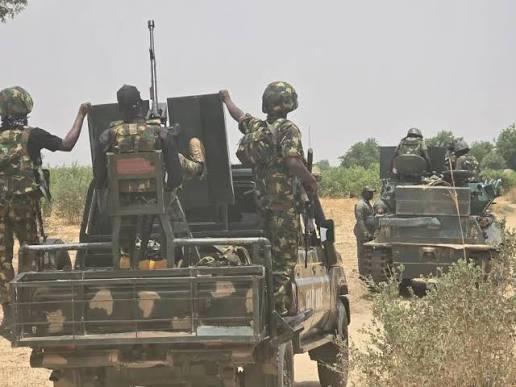
Troops of Operation HADIN KAI have neutralised eight suspected Islamic State West Africa Province (ISWAP) terrorists in a precision airstrike at Thethangala, within the Timbuktu Triangle of Borno State.
According to a Special Situation Report obtained by Zagazola Makama, the operation followed intelligence on terrorist activities in the area.
The report said a Guardian aircraft established overhead at Thethangala at about 9:56 p.m. on Aug. 18 and subsequently sighted eight terrorists who had converged and were lying in wait, apparently preparing to attack troops at their location.
Following the sighting, the aircraft conducted a precision strike on the identified terrorists.
“Battle Damage Assessment shows all the terrorists neutralised with no further movement observed after the strike,” the report stated.
The military said the general security situation remained calm but unpredictable, while the morale and fighting efficiency of troops remained satisfactory.
The latest air operation is part of sustained intelligence-led efforts by the Air Component of Operation HADIN KAI to disrupt terrorist concentrations and prevent planned attacks against troops operating in the North-East.
The Timbuktu Triangle remains one of the areas where terrorist groups have continued to seek opportunities to regroup and launch attacks against military positions.
Again, Military Neutralise 8 ISWAP Fighters in Precision Airstrike in Timbuktu Triangle
NTTF VP Mailantarki tasks stakeholders on grassroots development
The Vice President of the Nigeria Table Tennis Federation (NTTF), Honourable Khamisu Ahmed Mailantarki, has commended the sponsor of the Senior Advocate Cup, Muhammed Sani Ndanusa (SAN), urging more stakeholders to emulate his profound passion for grassroots talent development across Northern Nigeria and the nation at large.
Hon. Mailantarki gave the commendation in a press statement issued on Tuesday by his media aide, Mr Adamu Usman Ahmed.
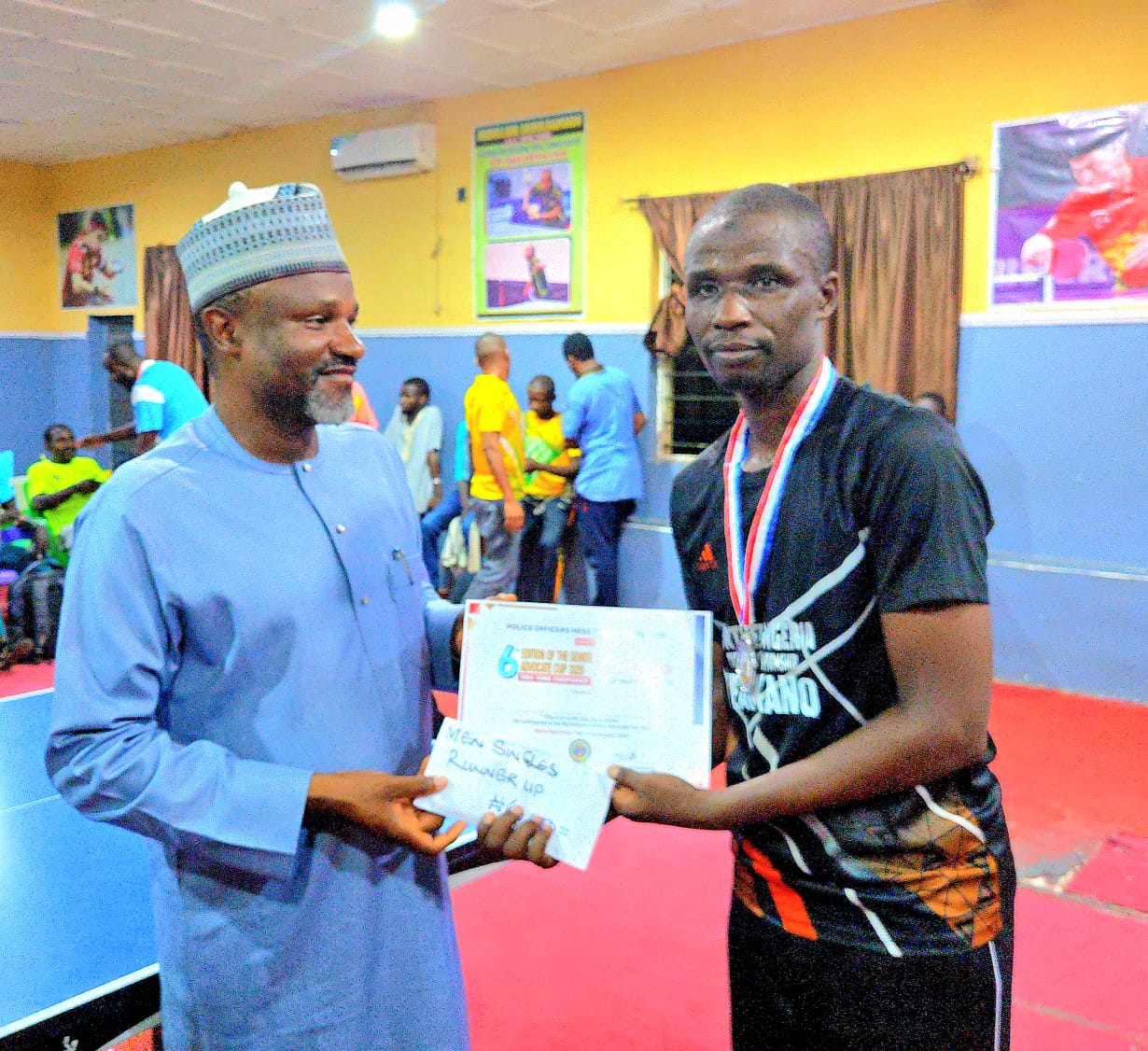
Mailantarki while speaking during the closing ceremony of the highly anticipated tournament congratulated the various winners across the different categories of Men Singles, Junior Single and the veterans.
The NTTF VP thrilled the audience at the Kaduna Police Officers’ Mess Indoor Sport hall with an exciting developmental announcement.
He revealed that the two finalists of the Junior Singles category have been selected for a special performance camping program at his prestigious Table Tennis Academy in Abuja. Based on their performance at the camp, they stand the chance of securing full sponsorship to an upcoming international youth championship.
The 6th edition of the championship witnessed spectacular displays of talents. In the elite category, Abayomi Martins from Borno State delivered a stellar performance to take home the overall winner’s prize, leaving Kamal Muktar of Kano State to settle for the runner-up medal.
In the fiercely contested Junior category, the host state’s Mustapha Muktar (Kaduna) triumphed over Taraba State’s Harrison Jacob to clinch the ultimate prize.
Looking to the future, Hon. Mailantarki assured fans and players that similar grassroots and elite developmental championships would be organized in other states to ensure the continuous discovery and nurturing of table tennis talents in the country.
NTTF VP Mailantarki tasks stakeholders on grassroots development

Seven ISWAP Fighters’ Family Members, 12 Children Flee Yaganari Enclave, Surrender to Troops

Again, Military Neutralise 8 ISWAP Fighters in Precision Airstrike in Timbuktu Triangle

Troops Foil Kidnap Attempt, Rescue Four Minors in Plateau

Roger Federer’s Shock as DNA Results Reveal Myla and Charlene Are Not His Biological Children

THE PLIGHT OF FARIDA

FAILED COUP IN BURKINA FASO: HOW TRAORÉ NARROWLY ESCAPED ASSASSINATION PLOT AMID FOREIGN INTERFERENCE CLAIMS
-
 News2 years ago
Roger Federer’s Shock as DNA Results Reveal Myla and Charlene Are Not His Biological Children
-
Opinions5 years ago
THE PLIGHT OF FARIDA
-
 News1 year ago
FAILED COUP IN BURKINA FASO: HOW TRAORÉ NARROWLY ESCAPED ASSASSINATION PLOT AMID FOREIGN INTERFERENCE CLAIMS
-

 News2 years ago
EYN: Rev. Billi, Distortion of History, and The Living Tamarind Tree
-
 Opinions5 years ago
POLICE CHARGE ROOMS, A MINTING PRESS
-

 ACADEMICS2 years ago
A History of Biu” (2015) and The Lingering Bura-Pabir Question (1)
-

 Columns2 years ago
Army University Biu: There is certain interest, but certainly not from Borno.
-

 Politics1 year ago
2027: Why Hon. Midala Balami Must Go, as Youths in Hawul and Asikira/Uba Federal Constituency Reject ₦500,000 as Sallah Gift
