
News
DG Harps on Discipline, Patriotism as TAC Deploys Volunteers to S’Leone

DG Harps on Discipline, Patriotism as TAC Deploys Volunteers to S’Leone
By: Michael Mike
Director General of the Nigerian Technical Aid Corps, Rt.Hon. Yusuf Buba Yakub has called on the Corps’ Volunteers to always abide by the laws of the country where they have been deployed to serve.
He said it is by so doing that Nigeria as a big-brother country will continue to retain the respect and admiration of their host countries wherever the Volunteers have been deployed.
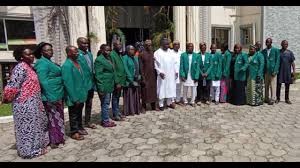
The TAC DG, who made the call on Saturday in Abuja during the ceremony for the deployment of 18 Volunteers to Sierra Leone, thanked President Tinubu for his continuous support for the 37-year-old programme since assuming office in 2023.
Buba added that the Volunteers were Ambassadors of the Nigerian nation and were, therefore, expected to exhibit the highest form of discipline, decorum and obedience to constituted authorities.
He said: “Just as you have been informed, the Technical Aid Corps was established 37 years ago as a flagship programme for the advancement of our nation’s Foreign Policy goals through the deployment of technical support to our brothers and sisters in African, Caribbean and Pacific countries. The Nigerian Technical Aid Corps has deployed over 35,000 professionals and experts in various fields of learning to these countries over the past 37 years.
“The Government of Nigeria places great interest and value on this foreign policy tool. This is why you go out there with our official passports. And just as our Ambassadors, you are expected never to do the don’ts of the country in which you are going to serve. You must keep in mind that what you are involved in is volunteer service. So, no matter the opulence of your home, if you are quartered in a 1-room apartment, do not forget what took you there.
“Over the last 37 years, all those who have served everywhere in this Scheme, have done so with dignity and honour, and nothing less is expected of you. I congratulate you on being successful among the thousands of those who applied for this opportunity and wish you well in the journey ahead of you all.
“I also like to add that, while in Sierra Leone, the High Commission of Nigeria there remains your guardian, while we here are your parents. Whatever you want to do, please, remember to follow the rules in the Country Agreement and the tripartite agreement the Federal Government through TAC has signed with you and the Government of Sierra Leone. Endeavour to study these rules and regulations in order not to fall foul of any of the provisions. For us, as an Agency, we will ensure that all responsibilities towards you are followed to the letter”
Earlier speaking while presenting the Volunteers to the DG, Director of Programmes in the Agency, Amb.Zakari Usman, explained that the new Volunteers had arrived from across the country and had since undertaken various processes in the bid to prepare for deployment. He thanked the DG for his support at ensuring that the processes were easy and seamless.
Among the 18 health professionals, who belong to the first batch of the Volunteers scheduled for Sierra Leone, are very experienced nurses and Medical Doctors that have served Nigeria in various communities and public institutions.
The Volunteers who also spoke to journalists during the exercise also expressed readiness to commit to the ideals of the TAC mandate and make Nigeria proud through hard work and obedience to the authorities of the host country.
It will be recalled that the Agency has since last month commenced the deployment of Volunteers to The Gambia, Uganda and now Sierra Leone. It is expected to carry out more deployments in the weeks ahead to different ACP countries.
DG Harps on Discipline, Patriotism as TAC Deploys Volunteers to S’Leone



Two Worlds, Two Leaders, One Lesson
By Abiodun Adigun
In London, the Mayor Sadiq Khan just announced: “Due to high cost of living, Londoners will receive £15.45 per hour to reflect the current economic realities.”
15 pounds 45 pence per hour. That is the new London Living Wage.
Not because election is coming. Not because people protested. But because the price of fuel went up, rent went up, food went up, and government said, we must adjust wages to reflect reality. That is what responsible countries do when fuel becomes expensive, they increase what workers earn so workers can survive.
In other countries, when fuel price shocks hit, they give energy support, they cap electricity bills, they give transport palliatives, they reduce taxes for the poor. They understand that high fuel cost without higher income is equal to death for the masses.
Now come to Nigeria.
In Nigeria, the President Bola Tinubu says: “I understand the pains Nigerians are going through, but there is no other way out of the sufferings.”
No other way? There is always another way.
London found another way. America found another way. Even Ghana found another way.
But in Nigeria, there is no other way except for the people to suffer.
How can you say there is no other way when you and other politicians are spending billions every day to campaign for re-election in 2027?
Billboards everywhere, jingles everywhere, defection ceremonies everywhere, billions that could have been used to pay workers or subsidise food.
How can you say there is no other way when you travel abroad for holidays with a large entourage, when you buy a new presidential jet worth over N150 billion, when National Assembly members buy N160 million SUVs each?
You understand the pains, but you don’t feel the pains.
If you felt the pains, you would not increase your own comfort while telling people to be patient in suffering.
In London, when cost of living goes up, wages go up.
In Nigeria, when cost of living goes up, taxes go up. Fuel up, electricity tariff up, VAT up, gas price up.
Everything up except salary and compassion.
London’s Mayor is not more intelligent than Nigerian leaders. He is just more humane.
He knows that leadership is not about telling people to endure hardship you created.
Leadership is about cushioning hardship.
The painful part is this: Nigerians are working harder than Londoners.
A Lagos bus driver wakes by 4am and closes by 11pm.
A market woman sits in sun from morning till night.
But their work can no longer feed them because government removed subsidy without any living wage adjustment.
Minimum wage is N70,000, that is less than 30 pounds a month. London’s hourly wage is almost half of Nigeria’s monthly minimum.
May Nigerians not remain foolish indeed.
Stupid to clap for politicians who tell us to be patient while they live in luxury.
Stupid to vote again for people who said “If we reduce the purchasing power of the people, we can further slow down the economy, let’s widen the tax net” and they actually did it.
Stupid to think there is no other way when other countries have shown us the other way.
There is always another way: cut cost of governance, stop profligacy, increase wages to reflect realities, and stop punishing the people for your reforms.
Two Worlds, Two Leaders, One Lesson
Gombe, UNICEF train 104 health workers to curb newborn deaths
By Elizabeth Ogunjobi
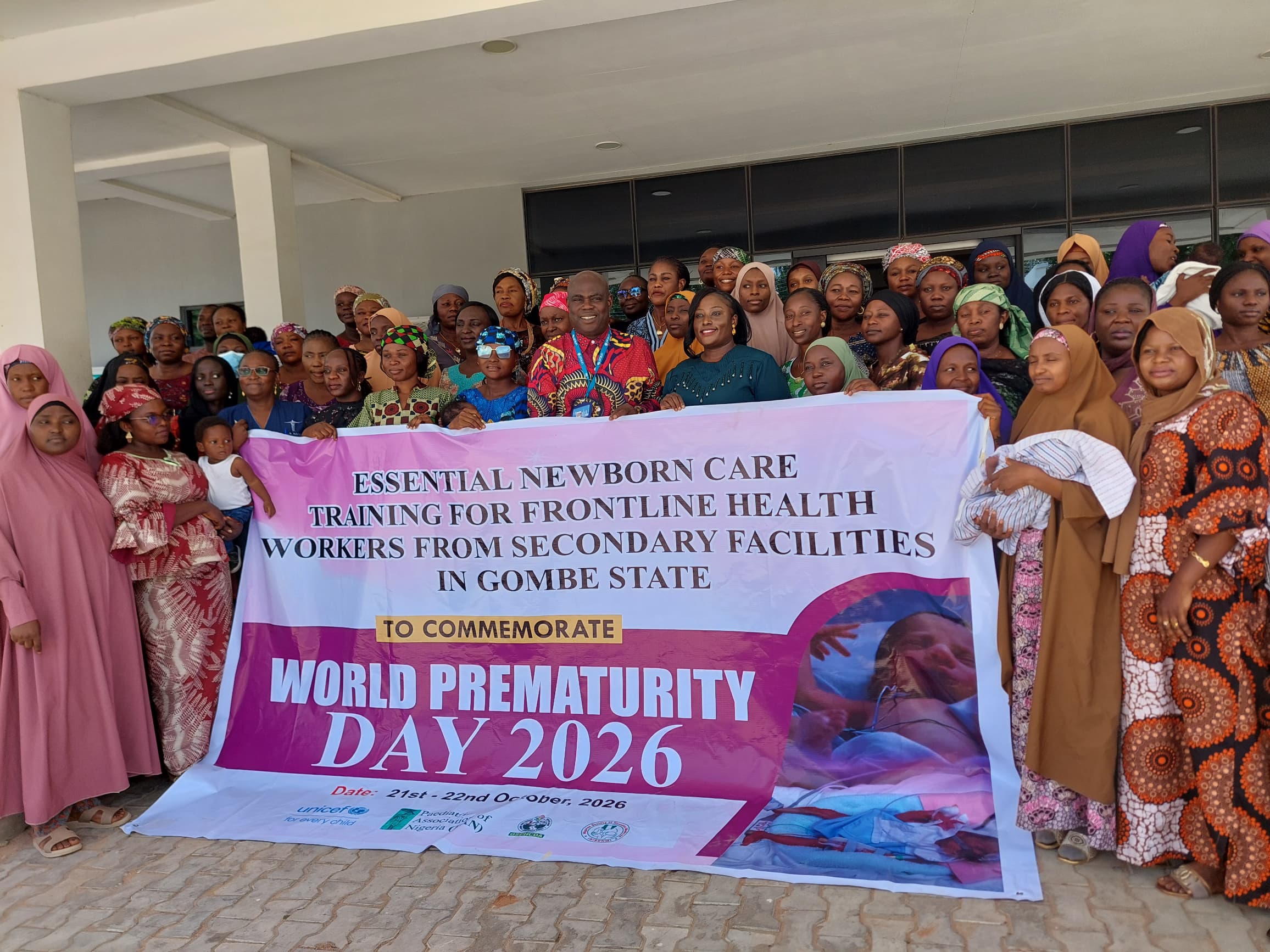
The Gombe government and UNICEF have trained 104 frontline health workers to improve newborn survival amid persistently high neonatal mortality across northern Nigeria.
The two-day training covered 48 workers from secondary healthcare facilities, following a separate programme for 56 primary healthcare workers.
Dr Abdulrahman Shuaibu, Executive Secretary of the Gombe State Primary Health Care Development Agency, said strengthening newborn care was critical to reducing preventable deaths.
Speaking in Gombe on Thursday, Shuaibu said many babies were born in communities before being referred to secondary facilities for specialised care.
“Therefore, it is important to strengthen the capacity of healthcare workers at these facilities to provide appropriate care for newborns,” he said.
He said neonatal and infant mortality remained high in the state, requiring coordinated efforts by government, healthcare providers and development partners.
“It is our hope and prayer that this training will contribute to a significant decline in neonatal mortality across our communities,” he said.
Shuaibu urged participants to share their knowledge with colleagues who did not attend, ensuring that more facilities could deliver effective newborn care.
He said the programme complemented government efforts to upgrade primary and secondary healthcare facilities, while commending UNICEF and other development partners for their support.
Mr Oluseyi Olosunde, a UNICEF health officer at its Bauchi Field Office, said the training was organised to commemorate the 2026 World Prematurity Day.
Olosunde said the initiative focused on improving the quality of care provided to newborns, particularly premature babies and those requiring specialised attention.
“Every child deserves to live, and to make every child enjoy this right to life, the quality of care is important,” he said.
He said the training targeted nurses, midwives and doctors involved in caring for women during pregnancy, childbirth and the postnatal period.
“We are training them to ensure that the mother survives, every woman survives, and every child survives,” he said.
Olosunde described newborn deaths as unacceptably high in many northern states, stressing the importance of strengthening healthcare workers’ skills.
He urged participants to apply their knowledge to improve services and protect the lives of mothers and babies under their care.
Dr Raymond Mercy, a consultant paediatrician at the Federal Teaching Hospital, Gombe, also urged healthcare workers to prioritise proper newborn care.
Mercy, a member of the Paediatric Association of Nigeria and the Nigerian Society of Neonatal Medicine, said Nigeria’s neonatal mortality rate stood between 34 and 41 deaths per 1,000 live births.
She said Nigeria had the world’s second-highest burden of neonatal mortality, underscoring the urgency of improving newborn healthcare nationwide.
Gombe, UNICEF train 104 health workers to curb newborn deaths

NHRC Orders Probe into Alleged Misconduct at Uyo Office
By: Michael Mike
The National Human Rights Commission (NHRC) has ordered an immediate investigation into allegations of unprofessional conduct by its personnel at the Akwa Ibom State office in Uyo following a video circulating on social media.
The Commission said the allegations were being treated with serious concern, stressing that its personnel were expected to uphold the highest standards of professionalism and respect for the rights and dignity of complainants, irrespective of provocation.
In a statement issued on Thursday by its Director of Corporate Affairs and External Linkages, Fatimah Agwai Mohammed, the NHRC said its Executive Secretary, Chief Tony Ojukwu, had directed an immediate investigation to establish the facts surrounding the incident.
It said appropriate administrative action would be taken in accordance with existing rules if any infraction was established.
The Commission emphasised that its responsibility to protect human rights must begin with the treatment of people who approach its offices for assistance, adding that every complainant deserved to be treated with dignity, respect and professionalism.
“Our professional training is that at no point in time should a complainant be charged against even if there is provocation,” the statement said.
The NHRC reiterated its commitment to ensuring accessible, free, timely and accountable service delivery, urging members of the public experiencing difficulties in accessing its offices to report such cases through its toll-free line, 6472.
The Commission’s response follows the circulation of the video alleging misconduct at its Uyo office, with the investigation expected to establish the circumstances surrounding the incident and determine whether any disciplinary action is warranted.
NHRC Orders Probe into Alleged Misconduct at Uyo Office

Two Worlds, Two Leaders, One Lesson

Gombe, UNICEF train 104 health workers to curb newborn deaths

Plateau Indigenous Youths Defend DSS, Demand Probe of Alleged Security Leaks

Roger Federer’s Shock as DNA Results Reveal Myla and Charlene Are Not His Biological Children

THE PLIGHT OF FARIDA

FAILED COUP IN BURKINA FASO: HOW TRAORÉ NARROWLY ESCAPED ASSASSINATION PLOT AMID FOREIGN INTERFERENCE CLAIMS
-
 News3 years ago
Roger Federer’s Shock as DNA Results Reveal Myla and Charlene Are Not His Biological Children
-
Opinions5 years ago
THE PLIGHT OF FARIDA
-
 News2 years ago
FAILED COUP IN BURKINA FASO: HOW TRAORÉ NARROWLY ESCAPED ASSASSINATION PLOT AMID FOREIGN INTERFERENCE CLAIMS
-
 Opinions5 years ago
POLICE CHARGE ROOMS, A MINTING PRESS
-

 News3 years ago
EYN: Rev. Billi, Distortion of History, and The Living Tamarind Tree
-

 ACADEMICS3 years ago
A History of Biu” (2015) and The Lingering Bura-Pabir Question (1)
-

 Columns3 years ago
Army University Biu: There is certain interest, but certainly not from Borno.
-

 Politics1 year ago
2027: Why Hon. Midala Balami Must Go, as Youths in Hawul and Asikira/Uba Federal Constituency Reject ₦500,000 as Sallah Gift
