
News
Sahel on edge as sabotage campaigns spread across Niger and Mali, threatening regional stability and economic survival

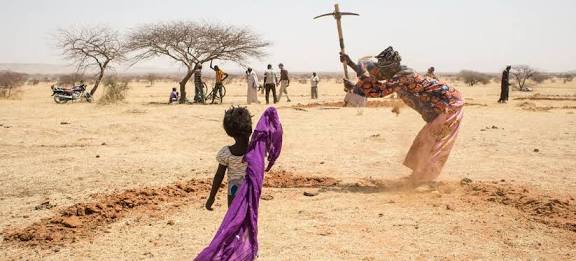
Sahel on edge as sabotage campaigns spread across Niger and Mali, threatening regional stability and economic survival
By: Zagazola Makama
A sharp escalation in economic sabotage by armed groups in Niger Republic and Mali is deepening instability across the Central Sahel, with fresh attacks on oil and fuel infrastructure pointing to an increasingly insecure landscape for governments, civilians and foreign partners in the region.
The latest incident occurred on Sunday night in Niger Republic’s eastern Diffa Region, where an oil pipeline explosion at Agadem was attributed to the Mouvement Patriotique pour la Libération du Jihad (MPLJ), a newly emergent armed faction led by Moussa Kounai. The group released a video claiming responsibility for damaging a section of the pipeline and vowed further attacks unless the ruling Conseil National pour la Sauvegarde de la Patrie (CNSP) steps down and reinstates constitutional governance.
The MPLJ also accused the junta of supporting foreign rebel groups, specifically naming the Chadian Front pour l’Alternance et la Concorde (FACT), which it alleges operates with the approval and logistical backing of Niger’s transitional military authorities.
Security sources say the attack marks a worrying expansion of anti-state sabotage in Niger, where armed groups such as the Lakurawa network have previously targeted oil infrastructure. These incidents now coincide with sustained assaults by jihadist formations like JNIM and Islamic State Sahel Province, creating an increasingly complex and volatile security environment.
Zagazola warn that the proliferation of armed groups following the 2023 coup has eroded state control, with economic assets such as pipelines, storage facilities and export routes becoming strategic targets for factions seeking bargaining power or political influence. The Agadem basin a cornerstone of Niger’s crude output and a critical link in its export chain to international markets is especially vulnerable.
Meanwhile in neighbouring Mali, the situation has taken on an even more disruptive dimension as the Al-Qaeda-affiliated JNIM intensifies a sweeping fuel blockade that has crippled the country’s economy and strained daily life for millions.
Since September, JNIM fighters have systematically attacked fuel tankers travelling from Senegal and Côte d’Ivoire, routes that account for the majority of Mali’s fuel imports. Tankers have been burned, drivers and security escorts killed, and entire convoys halted by improvised explosive devices and ambushes.
The insurgents are believed to be retaliating against a government directive restricting fuel sales in rural areas, a measure aimed at cutting off jihadist access to diesel and petrol used for mobility, logistics and explosives manufacturing.
The impact has been devastating. Fuel scarcity has worsened Mali’s longstanding electricity crisis, plunging Bamako and several regional capitals into long blackouts. With power plants relying heavily on diesel, factories have shut down, cold-chain food systems are collapsing, and telecommunications have become unreliable.
Government offices, banks and airports are also struggling to maintain normal operations. On Sunday, authorities suspended classes in all schools and universities for two weeks due to the acute shortage.
In rural communities, the blockade coincides with harvest season. Farmers say tractors and irrigation pumps have become idle, threatening crop yields and heightening food insecurity in a country already burdened by displacement and declining agricultural output.
Despite several rounds of negotiations involving community leaders and intermediaries, no agreement has been reached with JNIM. The group appears intent on leveraging the economic pressure to force political concessions from the military-led government.
Security experts say the rising wave of economic sabotage across Niger and Mali reflects a broader trend in the Sahel, where armed groups are increasingly shifting from territorial warfare to strategic economic disruption. By targeting energy supply lines pipelines in Niger and tanker routes in Mali these groups are undermining state capacity, weakening public confidence, and heightening the cost of governance for already fragile juntas.
The dual crises also signaled troubles for neighbouring countries, particularly Nigeria, which shares extensive energy, trade and security ties with Niger. These misattributed attacks or cross-border accusations could trigger diplomatic strains at a time when regional cooperation is crucial.
With militants in both countries signalling readiness for escalated operations, the Sahel is bracing for deeper instability unless coordinated regional and international responses are mobilised to protect critical infrastructure, restore supply chains and contain armed group expansion.
Zagazola Makama is a counter Insurgency Expert and Security Analyst in the Lake Chad region.
Sahel on edge as sabotage campaigns spread across Niger and Mali, threatening regional stability and economic survival


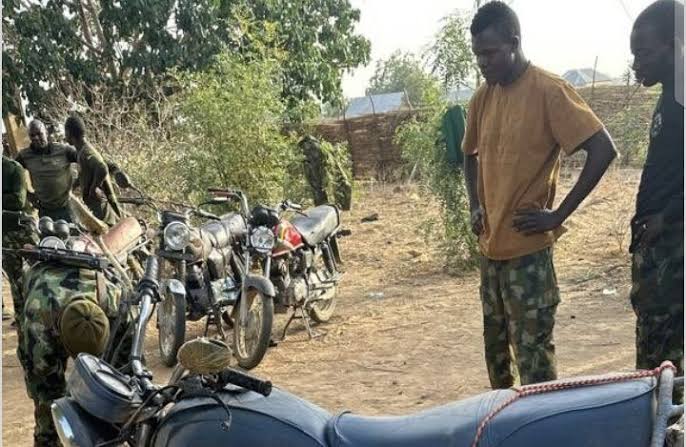
Farmer Injured in Machete Attack by Herder in Plateau
By Zagazola Makama
A farmer, Mr Charles Tuwan, has sustained machete injuries following an alleged attack by a herder during a dispute over grazing on farmland in Pankshin Local Government Area of Plateau State.
The incident occurred at about 6:53 p.m. on August 23, 2026, at Tekas Community, where troops of Sector 8, Operation ENDURING PEACE, operating under Operation HARD KNOCK, responded to a report of an assault.
Security sources said the dispute reportedly started after the farmer refused to allow the herder to graze cattle on his farmland.
On arrival at the scene, the troops found Tuwan with machete cuts sustained during the attack.
The alleged attacker, identified as Abdullahi Saleh, had reportedly fled the area with his cattle before the arrival of the troops.
The injured farmer was evacuated to Pankshin General Hospital for medical attention.
Troops are currently intensifying efforts to locate and arrest the suspect for investigation and possible prosecution.
The incident comes amid heightened tensions between farming and herding communities in parts of Plateau State, underscoring the need for early intervention in disputes over farmland and grazing to prevent isolated incidents from escalating into wider communal violence.
Farmer Injured in Machete Attack by Herder in Plateau
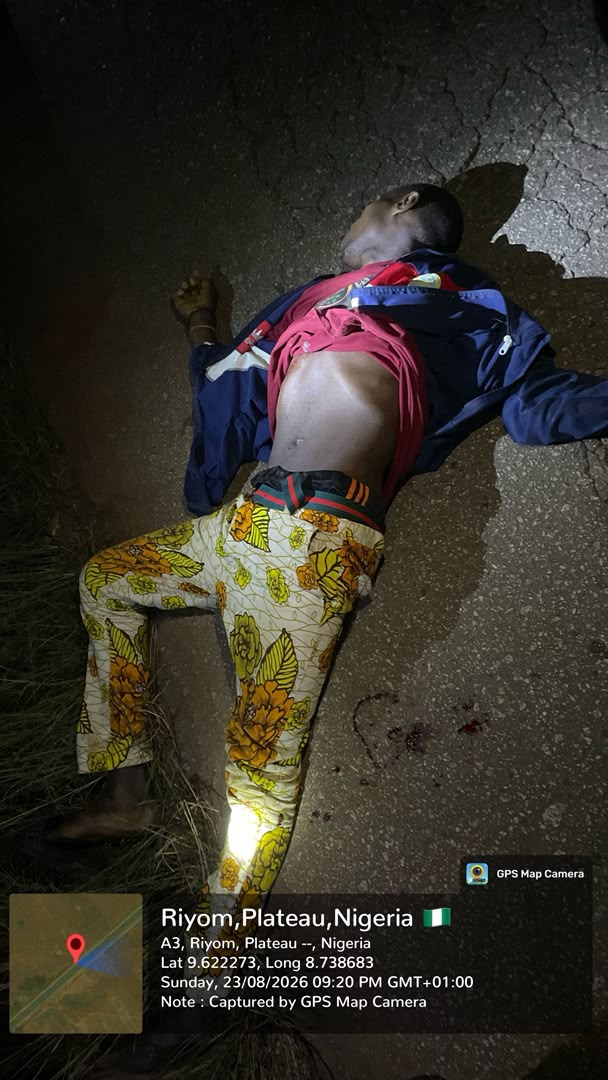
Unidentified Corpse with Gunshot Wound Found Along Road in Plateau
By Zagazola Makama
Troops of Operation ENDURING PEACE have recovered the corpse of an unidentified person bearing a gunshot wound along a roadside in Riyom Local Government Area of Plateau State.
The corpse was discovered at about 9:30 p.m. on August 23, 2026, along the Farin Lamba axis, close to the Primary Health Centre in Riyom.
Troops of Sector 6, Operation ENDURING PEACE, responded to the report and found the body with an apparent gunshot wound to the stomach.
However, security personnel observed that there were no visible traces of blood or spent ammunition casings around the scene.
The circumstances led investigators to suspect that the body may have been transported from another location and dumped at the scene.
The corpse was evacuated to the Primary Health Centre mortuary in Riyom, while the youth leader of Tahoss Community was contacted to assist in identifying the deceased.
Troops have continued to dominate the general area as investigation into the circumstances surrounding the death and possible identity of the victim continues.
Unidentified Corpse with Gunshot Wound Found Along Road in Plateau
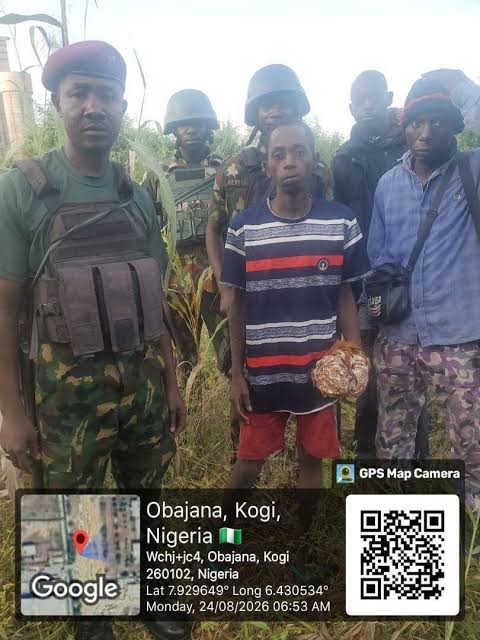
Troops Rescue Kidnap Victim, Recover AK-47 Rifle After Gun Battle in Kogi
By Zagazola Makama
Troops operating under the Joint Security operation in the 2 Division Area of Responsibility have rescued a 28-year-old kidnap victim and recovered an AK-47 rifle following a gun battle with suspected kidnappers in Kogi State.
The operation, according to security sources, took place at about 0300 hours on August 24, 2026, when troops from Patrol Base Obajana intercepted the victim, identified as Hussaini Shehu.
Preliminary questioning revealed that Shehu had allegedly been abducted from the Abaji general area of the Federal Capital Territory about five days earlier.
The rescued victim subsequently led the troops to the location where he had been held captive.
Security sources said the troops made contact with the suspected kidnappers and engaged them in a firefight, forcing the criminals to abandon an AK-47 rifle and flee into the surrounding area.
The weapon was recovered by the troops, while the victim was evacuated to the military medical centre for medical attention.
Security forces have continued operations in the area to track the fleeing kidnappers and prevent them from regrouping.
The latest operation underscores the importance of intelligence-led patrols and rapid exploitation of information obtained from rescued victims in disrupting kidnapping networks operating across the FCT-Kogi corridor.
Troops Rescue Kidnap Victim, Recover AK-47 Rifle After Gun Battle in Kogi

Farmer Injured in Machete Attack by Herder in Plateau

Unidentified Corpse with Gunshot Wound Found Along Road in Plateau

Troops Rescue Kidnap Victim, Recover AK-47 Rifle After Gun Battle in Kogi

Roger Federer’s Shock as DNA Results Reveal Myla and Charlene Are Not His Biological Children

THE PLIGHT OF FARIDA

FAILED COUP IN BURKINA FASO: HOW TRAORÉ NARROWLY ESCAPED ASSASSINATION PLOT AMID FOREIGN INTERFERENCE CLAIMS
-
 News2 years ago
Roger Federer’s Shock as DNA Results Reveal Myla and Charlene Are Not His Biological Children
-
Opinions5 years ago
THE PLIGHT OF FARIDA
-
 News1 year ago
FAILED COUP IN BURKINA FASO: HOW TRAORÉ NARROWLY ESCAPED ASSASSINATION PLOT AMID FOREIGN INTERFERENCE CLAIMS
-

 News2 years ago
EYN: Rev. Billi, Distortion of History, and The Living Tamarind Tree
-
 Opinions5 years ago
POLICE CHARGE ROOMS, A MINTING PRESS
-

 ACADEMICS2 years ago
A History of Biu” (2015) and The Lingering Bura-Pabir Question (1)
-

 Columns2 years ago
Army University Biu: There is certain interest, but certainly not from Borno.
-

 Politics1 year ago
2027: Why Hon. Midala Balami Must Go, as Youths in Hawul and Asikira/Uba Federal Constituency Reject ₦500,000 as Sallah Gift
